Over the past two weeks, Ukraine has launched a series of drone attacks on targets deep inside Russian territory—most consequentially in and near Moscow. Last night near the Russian capital, according to President Volodymyr Zelensky, Ukrainian weaponry attacked the Dubna Space Communications Center, which Russia uses to collect intelligence and coordinate operations by its army units in occupied Ukraine. This was Ukraine’s second strike on the Dubna facility in about a week.
Zelensky’s announcement of the latest attacks taunted Vladimir Putin, declaring matter-of-factly that “relevant actions are also being prepared against other similar enemy facilities.” The intended message to the Russian public is that the drone campaign, which Ukraine coyly describes as “long-range sanctions” against the country that invaded its territory, is nowhere near plateauing.
The recent focus on Moscow-area targets reveals how the Ukrainian government and military, in addition to trying to defend their territory from Russian aerial attack, are now taking the war to Vladimir Putin’s doorstep. They are trying to put political and economic pressure on Putin’s regime and disable his war machine by starving it of money, supplies, and soldiers. Recent attacks on the Dubna facility and on a major Moscow oil refinery typify distinct parts of the Ukrainian strategy to make the war unsustainable for the Russian dictator.
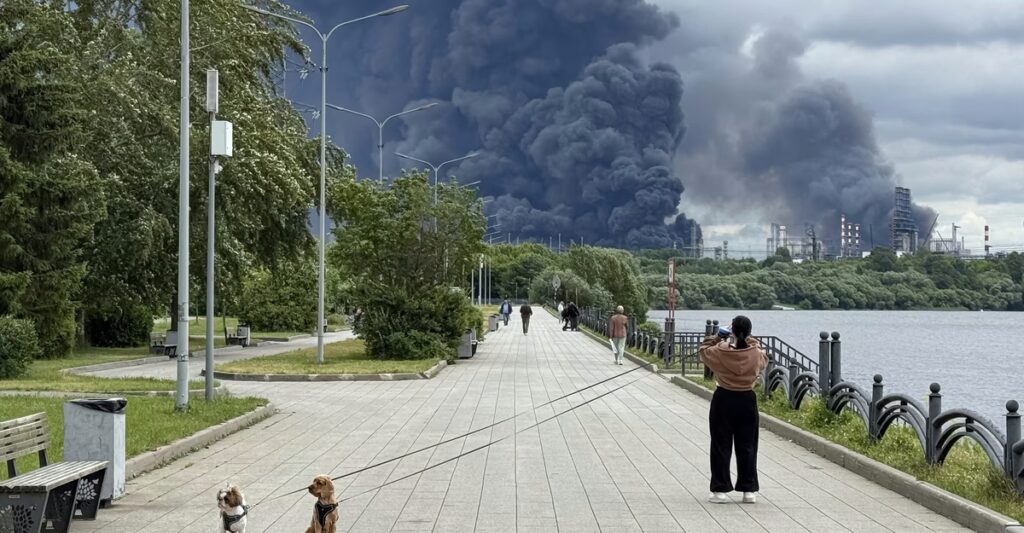
The refinery, which was targeted as part of a mass Ukrainian attack on the Russian capital on June 18, produces about 40 percent of the Moscow region’s fuel market and has reportedly been put out of action for the remainder of 2026. This attack worked on a number of levels to embarrass and undermine Putin.
[Read: The warrior-witches of Ukraine’s resistance]
First, the attack created, almost certainly intentionally, a massive fire that released a thick plume of black smoke that was visible across Moscow. The point was unmistakable: Ukraine is here and can hit even the most important economic targets. Muscovites, your days of pretending the war is far away from your own comfortable existence are over. Indeed, Ukrainian strikes on oil infrastructure have created major gas shortages that are bedeviling much of the Russian hinterland. Similar pain may soon be in store for the capital.
The Moscow refinery attacks also point to another Ukrainian goal: threatening Putin’s access to the money that he needs to keep on fighting. Putin’s war has already burned through much of Russia’s once-large sovereign wealth fund. A fascinating recent report from a German think tank concludes that the Russian economy is approaching its “endgame,” as “growth has come to a standstill and fiscal buffers are largely exhausted.” To fund the country’s armed forces, Russia is almost entirely dependent on selling oil and other petroleum products to the rest of the world.
For the past few months Donald Trump has been providing Putin with a reprieve—the Iran war drove up world oil prices and created many new consumers for Russian gas, thereby creating a massive surge in income. But as hostilities in the Persian Gulf have somewhat subsided, so has the global oil price—meaning that Russia is earning less per barrel of oil that it exports.
The Ukrainian strikes on oil facilities have presented Putin with a dilemma. The gasoline shortage is plainly creating public discontent. But if Russia limits exports to preserve domestic oil supply, it will also reduce the amount of money it can pour into the war. Less money coming into government coffers also means fewer goodies for the population of Moscow, whose acquiescence Putin desperately needs.
[Anne Applebaum: Ukraine is not losing. Russia is not winning.]
Just as the refinery attack sent a warning to Russia’s economic policy makers and the general population, the two strikes on the Dubna facility speak loudly to the Russian military. Since its full-scale invasion in 2022, Russia has already suffered more than 1.3 million casualties, and Ukrainian mid-range weaponry has badly disrupted Russian military logistics. The invaders’ command-and-control systems were lumbering even before Ukraine began attacking them in earnest. Now the Ukrainians are saying: Not even your most important facilities deep in Russia are safe. Your poor performance in the field is going to get worse.
Perhaps Russia will adapt to Ukraine’s nimble deployment of rapidly advancing drone technology. But its efforts to do so should not inspire much confidence among the Russian public. Putin’s regime has reportedly been shifting air-defense systems to Moscow from elsewhere in Russia. Ukraine has still managed to penetrate those defenses, and may now have an easier time hitting targets outside Moscow.
For the past few days, Ukraine has been insisting that the future will only get worse for Russians. On June 25, Zelensky announced “a 40-day influence operation” meant to compel the “aggressor state” to end the war.
The recent attacks probably won’t force Russia out of the war quickly, and Zelensky surely knows this. But even if Ukraine’s drone strikes do not immediately end Putin’s rule, they have dispelled the idea that Putin can defend Moscow, protect the Russian economy, and look after the Russian military. By revealing the limits of Putin’s power, Ukraine has to be making his allies and flatterers very nervous.
The post Ukraine Takes the War to Putin appeared first on The Atlantic.