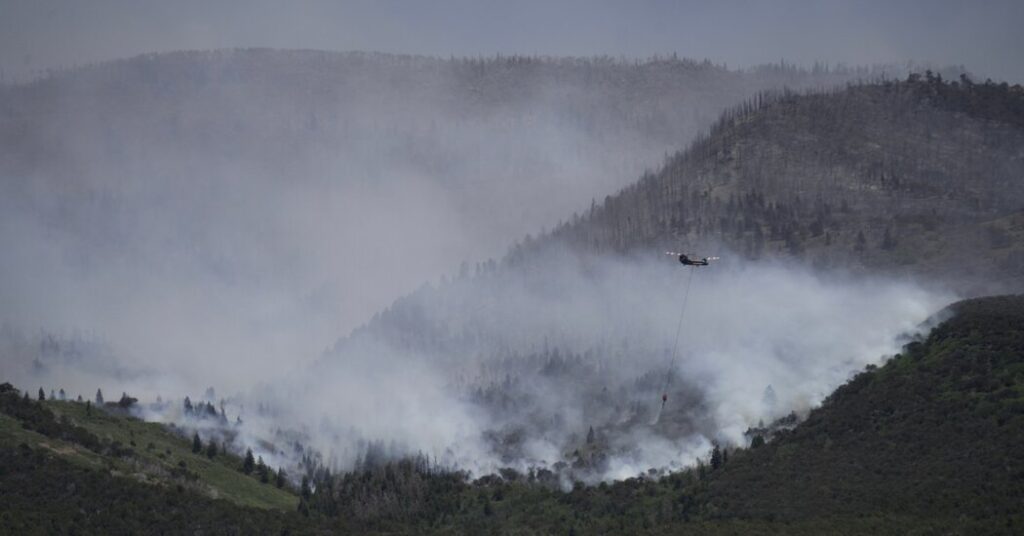
Three firefighters died on Sunday while battling an inferno along the Utah-Colorado border.
They were fighting a group of fires that merged as high winds, low humidity and dry fuels created ideal conditions for the blaze, which has burned some 30,000 acres as of Tuesday. Two of the victims were women, who make up only about 10 percent of wildland firefighters. Two other firefighters were injured as well.
A different fire in Utah encompassed more than 90,000 acres and destroyed more than 100 condos and cabins by last weekend, making it the most destructive fire in the state’s history in terms of property loss.
In total, there were at least 12 wildfires burning across Utah over the weekend, charring more than 214,000 acres. Smoke has drifted as far as Kansas.
“It’s end-of-days-type stuff,” Matt Robinson, the mayor of Beaver, Utah, told The Times.
Global warming, driven by the burning of fossil fuels, is making wildfires worse. Fire season is getting longer and fires are growing more intense, frequent and larger, according to NASA.
Right now, much of the Western United States is primed to burn.
An unusually dry winter led to record low snowpack across the region. That, combined with atypically warm temperatures, has left the landscape highly combustible.
Then in recent days, the heat spiked and the winds kicked up.
“The conditions we’re seeing right now, we usually don’t see until mid-July to August,” Karl Hunt, a spokesman for the Utah department that oversees forestry and wildfires, told The Times.
Fire watchers anticipated that the high temperatures in the West this week would lead to dangerous fires, upgrading the forecast to “extremely critical” — the highest risk level.
As my colleague Judson Jones explains, the designation, issued by a part of the National Weather Service called the Storm Prediction Center, means that fires are more likely to spark and are harder to contain if they do.
Already, firefighters are battling blazes in California, Arizona, New Mexico and Nevada as well as Utah and Colorado.
Ahead of the 4th of July holiday weekend, Governor Spencer Cox, Republican of Utah, issued a temporary restriction on fireworks.
And in the days ahead, the extreme heat is set to move east across much of the rest of the country, raising the specter of more fires.
A new study in Science Advances found that 42 percent of burned area in the Western United States from 2001 to 2024 occurred during and immediately following heat waves.
A dire forecast
Just days into summer, much of the country is bracing for a bout of extreme heat.
Temperatures from Minnesota to Florida will soar in the coming days, with many cities, including New York, Philadelphia and Washington, expected to exceed 100 degrees Fahrenheit.
The worst of it is expected to hit the East Coast on Thursday and persist through the weekend. On those days, some 250 million people will live in areas anticipating some level of dangerous heat, according to the Weather Service.
Cities are unlikely to cool significantly in the evening, with overnight lows stuck in the high 70s. That kind of persistent heat can be punishing, especially for older people, and does not “really allow for any cooling,” according to Casey Sullivan, a meteorologist with the Weather Service.
“The next day of the heat wave, it allows it just to be that much more oppressive,” Sullivan said. “So it’s a cumulative effect on people.”
It will also be humid.
As Nazaneen Ghaffar wrote, “the National Weather Service said that heat index values — a measure of what the temperature feels like to the human body, when humidity is considered with the air temperature — could reach as high as 110 degrees, and locally up to 115.”
Europe cooking
The United States is heating up just a week after Europe endured a deadly heat wave.
It was just days ago that London Climate Action Week was disrupted by heat dome.
In France, authorities said that soaring temperatures led to roughly 1,000 excess deaths. The vast majority of those who died were elderly.
And over the weekend, the heat shifted east and clamped down over Germany, Poland and other Central and Eastern European countries.
Human-caused climate change made the European heat wave more likely than it would have been even just two decades ago, Raymond Zhong reported.
“This event would not have been possible in June without climate change,” said Theodore Keeping, a climate scientist at Imperial College London and the lead author on a new report on the heat wave.
This was Europe’s second heat wave of the year, after much of the continent was gripped by a heat dome in May.
A celebration’s side effects
This Independence Day, America will celebrate 250 years and President Trump posted about launching the “largest fireworks show in history.”
The Philippines holds the current record, which was set during New Year celebrations in 2016 when more than 810,000 fireworks exploded for more than an hour, according to Guinness World Records. That blew past Norway, the previous record-holder, which had detonated more than 540,000 in 2014.
Now President Trump is saying, hold my beer. On Saturday night in Washington, D.C., organizers say they will set off more than 850,000 fireworks.
Pyrotechnics bring plenty of delight and bombs-bursting-in-air spectacle. They also come with something else, namely lots of smoke.
Experts say the weekend extravaganza is likely to degrade air quality in the city, particularly as temperatures are expected to sizzle around 100 degrees Fahrenheit. Heat waves can magnify air pollution.
Fireworks release tiny particles that can irritate lungs and trigger asthma attacks, along with gases like carbon monoxide and sulfur dioxide, and metals including aluminum, manganese and cadmium, according to the American Lung Association, which warns that inhaling firework smoke is “detrimental to health.”
“It’s probably going to be incredibly hot, and adding a firework show is just going to compound the air quality that’s already destined to be poor,” said Dr. Panagis Galiatsatos, a pulmonary physician and assistant professor at Johns Hopkins University School of Medicine. He advised people with respiratory conditions like asthma to stay indoors and watch the explosions on TV.
“Sometimes we need to just be mindful of safety versus grandiosity,” said Dr. Galiatsatos.
In a 2024 study, researchers at New York University found that particulate pollution in New York City spiked during the Macy’s Fourth of July fireworks show in 2023, which totaled some 60,000 fireworks, 7 percent the number planned in the nation’s capital this weekend. The researchers said that concentrations of hazardous metals and organic compounds near the show peaked at more than 6.5 times the levels recorded earlier that same year, when smoke from Canadian wildfires had blanketed New York.
Fireworks have enthralled people for millenniums, becoming a fixture at Lunar New Year celebrations in China, at Diwali festivals in India and for Bastille Day in France. For some, the deafening booms and sulfur aroma are irreplaceable. But a few places are experimenting.
This year, communities including Chapel Hill, N.C., and Salt Lake City will launch hundreds of light-up drones into the night sky for a towering display of digitally-coordinated shapes and colors — without the smoke. — Quinn Glabicki
Other climate news from around the web
-
Reuters reports on the World Bank’s decision to abandon its goal of devoting 45 percent of its lending resources to climate change projects.
-
One of the Supreme Court decisions announced Monday gives the Trump administration new power over independent agencies that oversee energy development, like the Federal Energy Regulatory Commission.
-
A new report from the United Nations Development Program projects that global fossil fuel subsidies will exceed $1 trillion in 2026, driven in part by developing nations hoping to shield residents from price increases from the crisis in the Middle East.
Read past editions of the newsletter here.
If you’re enjoying what you’re reading, please consider recommending it to others. They can sign up here.
Follow The New York Times on Instagram, Threads, Facebook and TikTok at @nytimes.
Reach us at [email protected]. We read every message, and reply to many!
The post A Hot and Deadly Start to Wildfire Season appeared first on New York Times.