This is an edition of The Atlantic Daily, a newsletter that guides you through the biggest stories of the day, helps you discover new ideas, and recommends the best in culture. Sign up for it here.
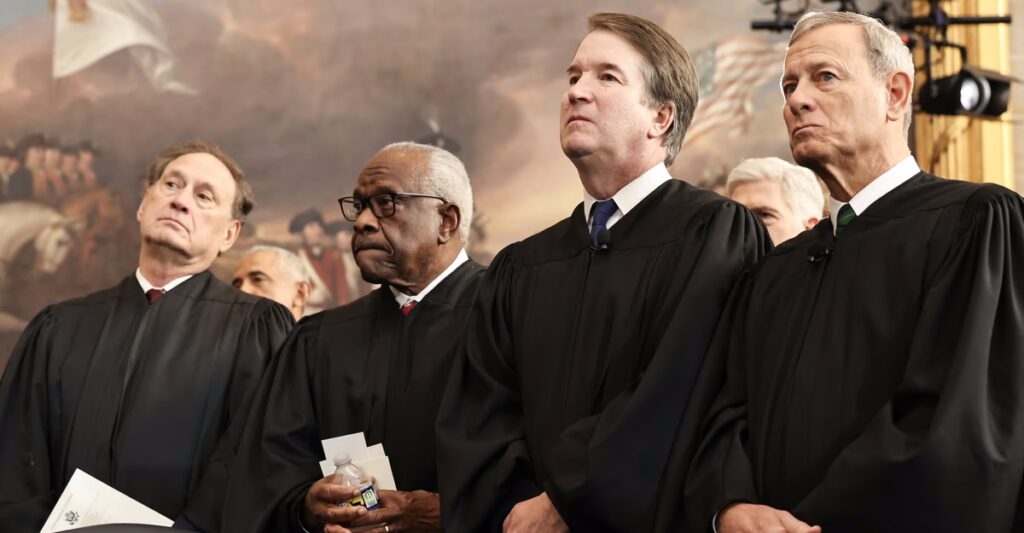
This week, the Supreme Court handed down the final seven opinions of its term. The rulings paint a complicated picture; some broadly affirm the president’s executive power, and others seem to rebuff his agenda. Today, the justices struck down the executive order that sought to end birthright citizenship for the children of noncitizens—but the vote was in some ways far closer than expected. In today’s newsletter, The Atlantic’s staff writer Quinta Jurecic breaks down the decisions.
Will Gottsegen: What surprised you most about the Supreme Court’s decisions this week?
Quinta Jurecic: The big-ticket items were Trump v. Slaughter and Trump v. Cook, which involved the president’s ability to fire Senate-confirmed leadership at independent agencies. And in those cases, the Court ruled that the president does have a very wide-ranging ability to fire, under a theory that is known as the “unitary executive.” But the justices carved out an exception for the Federal Reserve by ruling that Governor Lisa Cook can stay in her job for now. I don’t think anybody was surprised by either of those decisions.
I was similarly not surprised that the Court struck down Donald Trump’s executive order ending birthright citizenship for the children of some immigrants. What shocked me is that that ruling was, depending on how you count, 6–3 on the question of whether the executive order could stand, or 5–4 on the question of whether the Fourteenth Amendment requires a broad understanding of birthright citizenship. Very few people had thought that it would be anywhere near that close. I certainly did not.
Will: Brett Kavanaugh joined the liberal justices in striking down Trump’s birthright-citizenship order, but he joined the conservatives in saying that the order didn’t violate the Fourteenth Amendment. The Court also decided 5–4 yesterday that mail-in ballots postmarked by Election Day can be counted. What do the slim margins in some of these opinions say about where the Court is at today?
Quinta: After listening to oral arguments in April, I probably would have said that the Court would rule against the Trump administration in the birthright-citizenship case 8–1 or 7–2, with Clarence Thomas and possibly Samuel Alito dissenting. I did not get indications that Kavanaugh and Neil Gorsuch were going to go that way as well, and it’s notable because even though they’re both Trump appointees, whatever Trump wants tends to be less of a north star for them than it is for Alito and Thomas. And so the fact that Kavanaugh and Gorsuch voted this way, I think, says a lot about the extent to which the Court is willing to give Trump a pass.
Will: Trump has already said that he’ll continue to fight the Cook ruling. Is the door still open for him to fire other Fed governors in the future? And why is the Fed somewhat protected from his new power to fire top officials at independent agencies?
Quinta: It is not hard for me to imagine that Trump would continue to try to get rid of Cook, because the administration seems to really love touching a hot stove. I will say that the fact that the Court engineered this carve-out for the Fed pretty definitively suggests to me that the justices are firm in their desire to protect the Fed’s independence in a way that is not true for any other independent agency. But the justices really hedged on why. Their answer is basically, Because we said so.
So, theoretically, yes, there could absolutely still be efforts at interference. Practically speaking, it is a little hard for me to imagine that those efforts could actually succeed after this ruling.
Will: In a 6–3 ruling, the justices upheld two state bans preventing trans women and girls from playing on school sports teams that match their gender identity. This comes about a year after the Court ruled that states can ban trans minors from receiving gender-affirming medical care. Can you tell me more about how this Court has engaged with culture-war issues and whether any patterns or themes have emerged?
Quinta: As you say, the Court’s main involvement with culture-war issues this term has been through its rulings on trans-rights issues. Today’s decisions allow Idaho and West Virginia to exclude trans students from competing on sports teams aligned with their gender identity, under both Title IX and the equal-protection clause of the Constitution.
The majority opinion by Kavanaugh skirts any hard-core culture-warrior rhetoric—at the end, he includes a somewhat awkwardly phrased sentence declaring, “No student-athlete on either side of the issue, whether a biological female or transgender, deserves to be ostracized or vilified.” But Thomas’s concurrence has some fairly vicious language insisting that transgender women and girls are not women and girls “even if they believe they are.” Gorsuch, meanwhile, gets himself tied in knots trying to explain how his concurrence here is actually consistent with his previous opinion in Bostock v. Clayton County that Title VII’s prohibition on sex discrimination at work also prohibits discrimination against transgender people.
Will: How is the president’s power being affirmed by this batch of decisions? And how is it in some ways being undercut?
Quinta: The Slaughter case is a huge win for Trump and for the conservative movement. In his Truth Social post reacting to the decision, the president said that “90 years of precedent has been COMPLETELY AND UNEQUIVOCALLY OVERRULED, greatly increasing Presidential Power at a time when it is most needed!” He is making it very clear that This is great for me—it means that I get to do what I want. Where the conservatives on the Court have framed it as a matter of fidelity to the Constitution and to our constitutional history, Trump is more straightforward about how this helps him.
The birthright-citizenship case is certainly a loss for Trump. I would not interpret it as batting back his overreach, just because the ruling was so narrow. But there is no ambiguity about what the Fourteenth Amendment says, and the fact that the administration seems to have been able to convince four justices that there is some ambiguity there is troubling. It is a real warning sign for the influence of Trump and the far right on the Court.
Related:
Here are four new stories from The Atlantic:
- A false pretense of judicial modesty
- Ukraine’s plan to unnerve Putin
- A search through the rubble of two towers in Venezuela
- Hegseth, Rubio, and Caine had an auto-deleting Signal chat.
Today’s News
- The Supreme Court removed federal limits on how much political parties can spend on campaigning expenses in coordination with candidates.
- White House officials secretly awarded a no-bid contract worth up to $500 million to a construction company last year to build the East Wing ballroom, according to The Washington Post.
- Representative Thomas Kean Jr., a Republican from New Jersey who disappeared from public office without explanation for almost four months this year, announced that he had been away because he was diagnosed with and receiving treatment for depression.
More From The Atlantic
- The new (and slightly smelly) center of the AI boom
- An “originalist” Court overturns an originalist decision.
- The White House considers granting 250 pardons for the nation’s birthday.
Evening Read
The Incredible Freedom of Not Trying to Look Good By Ilana Masad
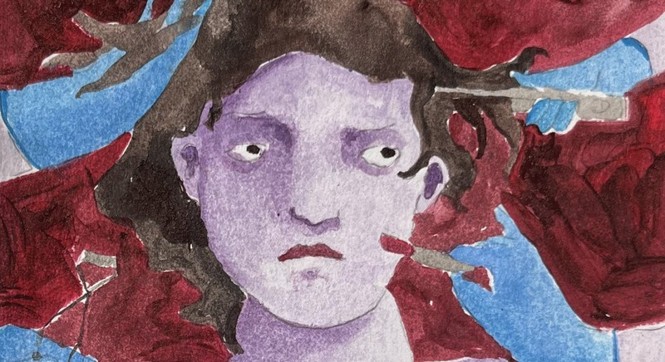
No one explicitly told me that long hair was beautiful, but even as a child, I knew it was. My Barbies had it. Disney princesses had it. The American Girl dolls I coveted had it. So I had it too, even though it was a literal pain. “One must suffer to be beautiful,” my dad would quip when I yelped and jerked away from my mother pulling a comb through my always-tangled hair. Cutting it short would have been more practical. But I wanted to be beautiful—of course I did …
Good looks and their benefits are widely known and openly discussed, but there’s far less talk about the experience of not being attractive. In 2022, the philosopher Thomas J. Spiegel wrote about the uncomfortable reality that discrimination based on looks is a kind of injustice, one with both psychological and material consequences. The writer Stephanie Fairyington has been thinking about Spiegel’s work, and the concept of attractiveness, for a long time. What, and who, is it all supposed to be for, anyway? What is it meant to achieve?
Culture Break

Consider this. AI doesn’t have to eviscerate the future of art, according to Holly Herndon and Mat Dryhurst. Spencer Kornhaber speaks with the two artists about why they believe the future doesn’t have to belong to slop.
Dig in. Rumors are flying about a possible Taylor Swift–Travis Kelce wedding this week—and fans are doing exactly the kind of sleuthing that the pop star has always encouraged, Julie Beck writes.
Stephanie Bai contributed to this newsletter.
When you buy a book using a link in this newsletter, we receive a commission. Thank you for supporting The Atlantic.
The post What the Supreme Court Rulings Mean for Trump appeared first on The Atlantic.