When the U.S. seized Venezuela’s autocratic president in a raid in January and demanded allegiance from his successor, President Trump was probably imagining all the upsides of turning Venezuela into a protectorate — control over the country’s oil, for instance, and the chance to rid the territory of rivals like China.
What he probably didn’t foresee was a pair of devastating earthquakes that have resulted in the worst natural disaster in Venezuela in decades. Today I’m writing about how Venezuela’s tragedy has become America’s problem, too.
What does America owe Venezuela now?
It’s never a good time for natural disaster to strike. But for Venezuela, last week’s back-to-back 7.2- and 7.5-magnitude earthquakes came at a particularly fraught moment.
Venezuela has had a disastrous past few decades. Falling oil prices, economic mismanagement, corruption and sanctions have turned a formerly rich country into one with a cratering public health system, a creaky electric grid and the world’s highest inflation rate.
It has also had a chaotic past six months. In January, the U.S. captured President Nicolás Maduro. In the months since, Venezuela has effectively been transformed into a vassal state — the Trump administration controls most of its export revenues from a Citibank account in New York — under a leader who depends on the U.S. to stay in power but who is also, eventually, supposed to hold free elections.
The result has been a complicated disaster relief process, shaped by politics and slowed by an ineffective state with few resources. The earthquakes have killed more than 1,700 people — a death toll that’s very likely to rise substantially over the next few days. They have become a test of the country’s new government, and its new relationship with the U.S.; the next few weeks will reveal a lot about where this strange new arrangement is headed.
“What comes next is harder”
The Trump administration has consistently held up Venezuela as one of its great foreign policy successes. It removed Maduro overnight; oil began flowing; Venezuelans were “happy.” (Even after the quakes hit, the U.S. president mentioned Venezuela’s oil in a speech, noting that “we’ve taken out millions of barrels of oil, and we’ve paid for the war many times over.”)
And in the aftermath of the earthquakes, it was quick to promise support. Secretary of State Marco Rubio swiftly pledged what he called a “whole-of-government response.”
“It’ll be big; it’ll be fast; and it’ll be effective,” he said.
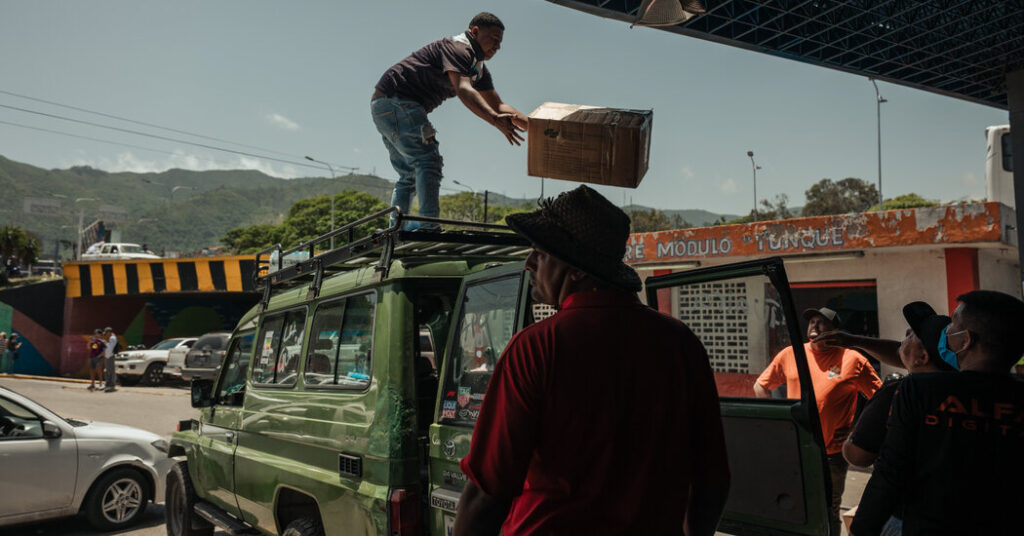
The administration organized a disaster assistance response team with more than 250 people, including three search-and-rescue teams. It has deployed a naval ship to provide medical support. And it has promised a total of $300 million in aid efforts so far.
I spoke to my colleague Anatoly Kurmanaev, who is in Venezuela.“The bottom line is, Trump now has to put his money where his mouth is,” Anatoly told me. “He’s been going on and on about what a great success Venezuela has been for the U.S.” That story, he said, is about to get a lot more complicated.
The U.S. is offering just a fraction of the post-earthquake funds Venezuela needs. As my colleague Simon Romero reports, estimates of economic losses from the quake range from $10 billion to $100 billion. To put those estimates into context, $10 billion is the equivalent of 10 percent of Venezuela’s total annual economic output, Simon writes.
At the moment, the disaster response is still in the search, rescue and recovery stage. It has been grim, but it’s also politically straightforward, Anatoly told me.
“Everyone has the same goal: Save lives,” he said. “What comes next is harder. How do you rebuild? Who do you work with? Who do you empower?”
In Venezuela, the fight for who eventually ends up running the country is ongoing. And the aftermath of the earthquakes is bound to play into it.
A hollowed-out state
My colleague Frances Robles reported a revealing anecdote last week.
Venezuela’s opposition party had mobilized volunteers to collect donations like diapers, bottled water and used clothing for earthquake survivors when it encountered an unexpected obstacle: the National Police.
Police officers tried to shut down a donation center in the state of Portuguesa, one opposition leader told Frances, saying that all donations had to be channeled through the government. Elsewhere, too, charity drives organized by the opposition could not display signs reading “Donation Center,” because those words were reserved for government-authorized drop-off sites — a sign of how politicized earthquake response efforts had already become.
Venezuela is, if not a failed state, very much a hollowed-out one. And the earthquakes have exposed that, Anatoly said. The government’s response has been dire. People are angry.
President Delcy Rodríguez, who took over with America’s blessing after Maduro was toppled in January, was never popular and is even less so now.
The U.S. has never seemed that interested in restoring democracy in Venezuela. Rather than demanding regime change, imposing elections or supporting the exiled opposition leader and Nobel laureate María Corina Machado, it backed continuity and stability under Rodríguez.
In the aftermath of a humanitarian crisis that has unleashed new anger at the government, though, it might not even get that. Or it might — but it may have to pay.
The latest from Venezuela: The search for survivors grew increasingly desperate yesterday as another aftershock rattled the area. Families have begun burying loved ones, but the full death toll could take weeks to emerge. Leer en español.
OTHER NEWS
-
Trump said yesterday that U.S. and Iranian officials would hold talks today in Qatar, signaling a de-escalation of tensions. Follow our live updates.
-
Andy Burnham, Britain’s likely next prime minister, promised a shift of power out of London in a speech outlining his political vision.
-
France recorded roughly 1,000 excess deaths during the heat wave last week, the country’s national health agency estimated.
-
Six people were killed and several others wounded when a gunman opened fire at a youth center in northern Germany, the local police said.
-
Afghan officials accused Pakistan of killing at least 36 civilians and injuring more than 160 in airstrikes in eastern Afghanistan.
-
China has emerged as a relative winner from the Strait of Hormuz crisis, a U.S. consulting firm said.
-
Les Mills, the New Zealand Olympian who grew his small gym into a global chain that helped popularize aerobics, died at 91.
TOP OF THE WORLD
The most clicked link in your newsletter yesterday was about a revamp of the Uffizi Galleries in Florence, Italy.
WORLD CUP
Brazil beat Japan 2-1, moving on to the round of 16. See the highlights of Germany’s match with Paraguay in Boston.
Japan’s ‘Little Brazil’: More than 200,000 Brazilians live in Japan. The tournament has tested their loyalties.
More on football
In Guanajuato State, Mexico, cartels are trying to control local football by any means necessary, gunning down spectators and players and co-opting a youth league. Watch our reporter explain how criminal groups are threatening one of the region’s few remaining joys.
LAUGH OF THE DAY
Gorilla guffaws
To learn more about the evolution of laughter, scientists tickled about a dozen apes and analyzed recordings of the sounds they made. They found that all great apes laugh, often in the same kind of regular, repeating rhythms that humans do.
MORNING READ
For years, Moscow has downplayed the consequences of its invasion of Ukraine with euphemisms. The war is a “Special Military Operation,” explosions are “claps” and killed soldiers are “deprived of life.”
But as the war increasingly comes home, the mismatch between the official narrative and reality is becoming a source of frustration for ordinary Russians. Even in some places recently hit by drones, officials have refused to disclose bomb shelter locations or use air raid sirens, saying such measures could cause panic. Read more.
AROUND THE WORLD
Burmese cuisine travels far
Much of the world is unfamiliar with the food of Myanmar, but an exodus from the country after a military coup in 2021 is changing that. In Brooklyn, one chef cooks up mohinga, a fish chowder that has moved his homesick compatriots to tears. In Melbourne, Australia, a struggling restaurant turned its luck around once word spread of its tofu nway.
Phyu Cyn, who hosts pop-up dinners across Asia and Europe, never travels without laphet, fermented tea leaves. “I use food as a tool to let people know that we still exist,” she said. Read more.
RECOMMENDATIONS
Watch: Our critics picked the best movies of the year so far.
Wind down: Here are some little rituals Times readers use to prepare for sleep.
Marvel: This seven-story building shaped like a woven basket is on sale for $8.5 million.
Go bare: Nude nails are everywhere — and are provoking a debate about status and cultural diversity.
RECIPE
Fresh apricots are available for just a few precious weeks each year. If you score some, put your bounty to good use in this Armenian apricot and lentil soup. Be sure to drizzle it with pomegranate syrup for a tart contrast.
WHERE IS THIS?
Where is this street?
TIME TO PLAY
Here are today’s Spelling Bee, Mini Crossword, Wordle and Sudoku. Find all our games here.
That’s it for today. See you tomorrow! — Katrin
We welcome your feedback. Send us your suggestions at [email protected].
The post What the U.S. Owes Venezuela appeared first on New York Times.