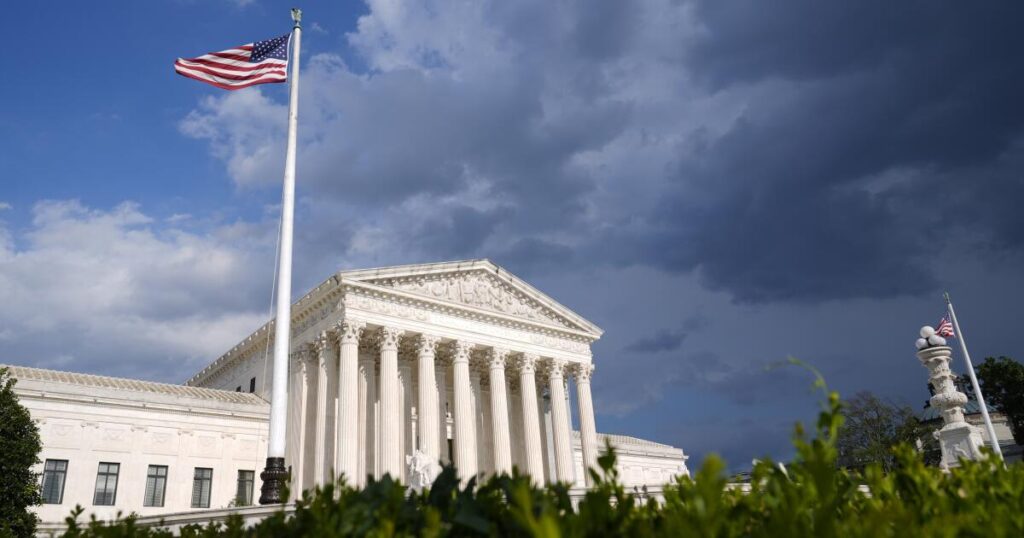
WASHINGTON — The Supreme Court cast doubt Monday on whether police may obtain cellphone data to find crime suspects.
In a 6-3 decision, the justices said this location information showing where a cellphone user has traveled is personal and private and subject to the protection of the 4th Amendment’s ban on unreasonable searches.
Justice Elena Kagan said these “records serve as a personal journal of a user’s movements.”
She said the information “resembles other private materials — think of emails, documents, photographs, or calendars—that even if stored on Google’s servers, a user reasonably views as his own…and reasonably expects to be shielded from the inquisitive eyes of the government.”
Because an “individual has a legitimate expectation of privacy in his cellphone location data,” she said police investigators need a valid search warrant from a magistrate.
The court stopped short of deciding the proper basis for a search warrant in such cases. Instead, the justices sent the case back to judges in Virginia.
But the outcome casts doubt on “geofence warrants.”
In recent years, police have gone to Google and cellphone companies seeking tracking data on cellphones that were at a crime scene. Sometimes, they have had a warrant from a magistrate.
Civil libertarians say the use of this tracking data raises the specter of mass surveillance on innocent people.
Police and government lawyers say no one has a reasonable right to privacy when they are walking on a sidewalk or driving down the street.
The case before the court arose from the armed robbery conviction of a Virginia man who stole $195,000 from a credit union in a small town near Richmond.
By the time police arrived, the robber had fled. But surveillance cameras showed he was carrying a gun and a cellphone.
Lacking other leads, detective Joshua Hilton asked a judge to issue a special type of warrant seeking information from Google. Referred to as a “geofence warrant,” it seeks data from phones in a particular area at a particular time.
The detective sought data on phones that were within 150 yards of the credit union within one hour of the late afternoon robbery.
After examining and paring down the data, the detective asked for the phone records of Okello Chatrie. Then, with a search warrant of his home, investigators found two robbery-style demand notes, a semi-automatic pistol and about $100,000 in cash.
A judge refused to suppress the evidence from an allegedly unconstitutional search, and Chatrie entered a conditional guilty plea. The full 4th Circuit Court of Appeals split evenly on the legality of the geofence warrant, and the Supreme Court agreed to decide the issue in Chatrie vs. U.S.
Usually investigators obtain warrants to search the home or vehicle of a known crime suspect.
The new and disputed geofence warrants seek to find a suspect by examining data on the cellphones that were at the scene of a crime.
The FBI used this cellphone data in 2021 to identify suspects who broke through police barricades on Jan. 6, 2021, and pushed their way into the Capitol to disrupt the official counting of electoral votes.
Chief Justice John G. Roberts Jr. and Justices Sonia Sotomayor, Neil M. Gorsuch, Brett M. Kavanaugh and Ketanji Brown Jackson agreed on the outcome in Chatrie vs. U.S.
In a 21-page dissent, Justice Samuel A. Alito Jr. said the court had “carefully set the stage for its planned performance: striking a pose as a great champion of privacy in the digital age. I cannot support this irresponsible escapade.”
Justice Clarence Thomas agreed.
Justice Amy Coney Barrett agreed in a one-paragraph dissent. “Chatrie had no reasonable expectation of privacy in data about his public movements that he voluntarily disclosed to Google,” she said.
The post Supreme Court limits police use of cellphone data to find crime suspects appeared first on Los Angeles Times.