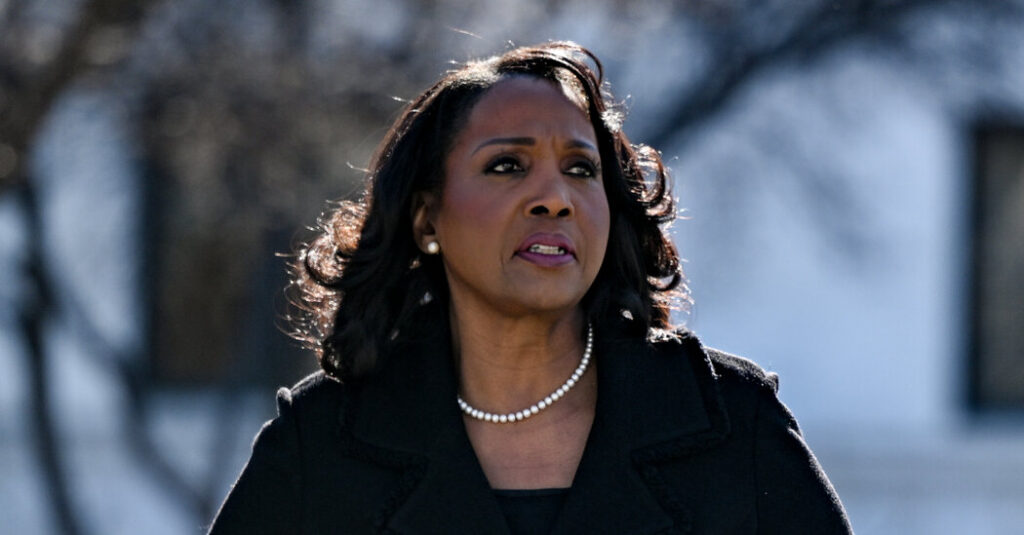
Shortly after the Supreme Court blocked President Trump from immediately ousting a sitting governor from the Federal Reserve, the president struck a defiant note, signaling he would not surrender his long-running fight to gain more sway over one of the most important stewards of the U.S. economy.
In the eyes of Mr. Trump, the 5-to-4 decision reached by the justices on Monday amounted only to a legal setback, not an insurmountable defeat. Even as the court acknowledged the century-old tradition of political independence at the nation’s central bank, it did not totally foreclose on the president’s ability to try to dismiss its officials in the future.
On one hand, the court concluded that Mr. Trump had erred when he first tried to oust Lisa D. Cook, a Fed governor, over unsubstantiated allegations of mortgage fraud last year. Siding with a lower court, which had allowed Ms. Cook to remain in her role while the case played out, a majority of the justices said the Trump administration should have afforded Ms. Cook the formal ability to contest the charges against her.
But the Supreme Court did not clearly articulate the full legal criteria that would allow Mr. Trump to fire Ms. Cook or one of her peers. Nor did the justices wager any opinion on the specific allegations levied against Ms. Cook, who has denied any wrongdoing.
The president did not hesitate to seize on that legal ambiguity. In a social media post, he described the decision as merely a “procedural” matter and vowed to “take appropriate action immediately to make sure that someone who has committed wrongdoing will not be making vital decisions concerning the Welfare of the United States of America!”
The outcome left many legal scholars on edge, particularly given Mr. Trump’s well-documented desire to install more of his supporters at the top ranks of the central bank as part of his pursuit for lower borrowing costs.
“It may look to be an attempt to quiet the temptation by presidents to meddle with the Fed, but I read it in the opposite direction,” said Peter Conti-Brown, an expert on Fed governance at the University of Pennsylvania. “It’s an invitation for more meddling.”
He added: “This saga is not over.”
Ms. Cook still found reason to celebrate on Monday, as she conveyed in a statement after the court’s decision.
“Today’s ruling affirms a principle that has underpinned sound economic stewardship for generations: that the Federal Reserve must make all its policy decisions guided by evidence and independent judgment, free from political interference,” Ms. Cook wrote. “I am grateful for this decision, not for my own sake, but for the sake of the American people, whose economic well-being depends on a central bank that answers to its mission, not political intimidation,” she added.
Those stakes loomed large over the Supreme Court as it wrestled with Mr. Trump’s power over the Fed, and they appeared to factor heavily into the opinion written by Chief Justice John G. Roberts Jr.
The liberal and conservative justices at one point cited the “ruinous financial panics” that had dotted the nation’s history, as they acknowledged the importance of a central bank that can operate free from political influence. And they channeled the country’s founders as they spoke to “the calamities that could arise from even the ‘suspicion’ of political manipulation of monetary policy.”
In addition to allowing Ms. Cook to keep her job for the time being, the split decision shot down the Trump administration’s argument that judges had no power to review its decision to fire a Fed official. It also undercut the premise that the president had nearly limitless ability to determine the conditions that would warrant such a removal.
Chief Justice Roberts said a decision accepting the view of Mr. Trump and his aides “would allow the president to remove a member of the Federal Reserve at any time, for any reason, without any notice before, and without any judicial check after.” That, the opinion said, “would turn for-cause protection into little more than at-will employment.”
For Scott Alvarez, the former general counsel for the Fed, the decision on Monday “helped to reinforce the court as a guardrail for Fed independence.” But it did not make the central bank impenetrable to further political encroachment.
For one, the Cook ruling was paired with a separate decision that vastly expanded the power of the executive branch by affirming Mr. Trump’s ability to fire all other independent regulators. In her dissent in Ms. Cook’s case, Justice Amy Coney Barrett said the decision to safeguard the Fed’s independence was “in serious tension” with the court’s ruling on the other agencies.
By invalidating the independence of those agencies, said Kathryn Judge, a Columbia Law School professor who was a Supreme Court law clerk for Justice Stephen G. Breyer, the central bank’s claim to that autonomy was more “precarious” given that for the last 90 years, “the Fed’s independence has really grown alongside the independence of other agencies.”
“There’s a path forward for the Fed to maintain meaningful independence, but it’s going to require more work to justify that independence in a way that really distinguishes it,” Ms. Judge added.
The Cook ruling was narrow in a number of ways. The justices did not explain the conditions that would allow Mr. Trump to fire an official for “cause,” the undefined criteria specified in the Fed’s chartering statute. They opposed Mr. Trump’s argument that presidents have uncontested authority to decide what qualifies as “cause,” but they also did not endorse Ms. Cook’s view that there was a high bar to meet.
Nor did the justices opine on the charges levied against Ms. Cook, citing the fact that she had not been afforded an opportunity to respond to the allegations, as required by law. That failure to give Ms. Cook the chance for rebuttal contributed heavily to the justices’ decision to allow her to continue serving at the Fed.
“To be clear, the ultimate question of whether the president can remove Cook for cause will depend in part on the underlying facts,” the majority wrote. “In this opinion, we have not addressed the facts, as they have yet to be found or analyzed under the relevant legal standards. Rather, we have simply addressed the parties’ arguments about the appropriate legal standards under which the facts must be evaluated.”
By leaving so many questions unanswered, the court gave Mr. Trump an opening to keep fighting, even if it is clear a majority does not want him to keep interfering with the Fed.
“This punt to the future is mostly a hope that the Trump administration and successive administrations will abandon this effort to meddle with the Federal Reserve,” Mr. Conti-Brown said.
The post ‘This Saga Is Not Over’: Court Victory Still Leaves Fed Vulnerable to Trump appeared first on New York Times.