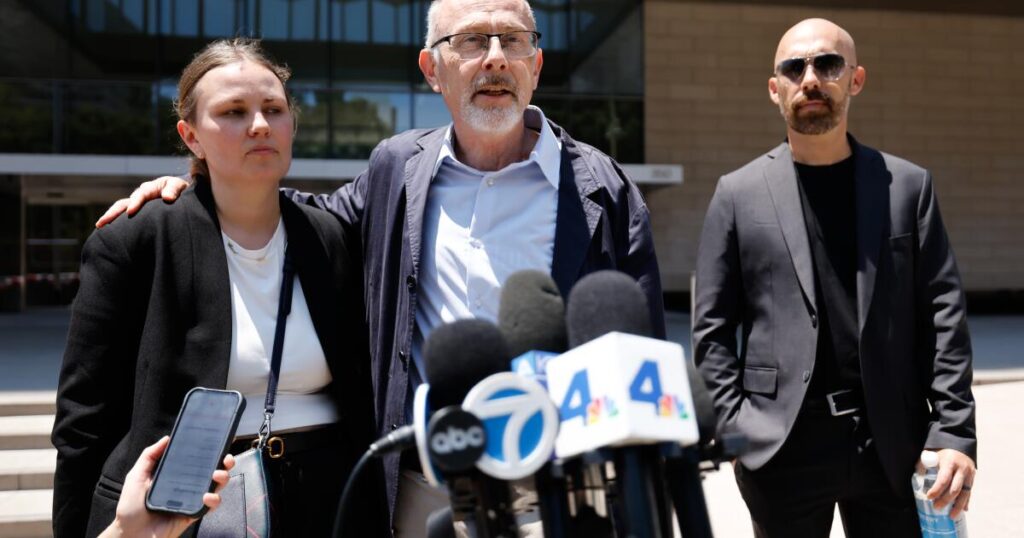
After a jury failed to reach a verdict in the trial of a man accused of starting the Palisades fire, First Assistant U.S. Atty. Bill Essayli quickly announced that his office would retry the case.
Observers say the jury’s 10-2 vote in favor of acquitting Jonathan Rinderknecht was a major blow to Essayli’s office. Some went as far as to say a retrial would be a waste of time and prosecutors should walk away from the case altogether.
“They don’t have the goods,” said Lisa Sweetingham, a longtime Palisades resident and journalist who attended the trial in federal court after losing her home in the fire. “Ten jurors saw that, and a lot of people in the audience saw that. They really don’t have the evidence to bring it home.”
Several defense witnesses poked holes in the prosecution’s theory that Rinderknecht deliberately started the Lachman fire on Jan. 1, 2025, which reignited on Jan. 7 into the Palisades fire, killing 12 people and destroying thousands of homes.
A Palisades resident said he saw several teens leaving the hill behind his house after the Lachman fire started, acting “boastful.” A Los Angeles firefighter testified that he saw flashes of light and heard loud noises that sounded like fireworks in the area around midnight. A defense expert testified that the most likely cause of the blaze was fireworks.
On top of that, Sweetingham said, Rinderknecht called 911 more than a dozen times on Jan. 1. She felt it was a stretch to hold him accountable for the rekindling six days later, after a series of mistakes by fire commanders and others in failing to put out the earlier blaze, a sentiment echoed by a juror who spoke publicly after the trial.
“We’d like to see the government put that much focus and money and human capital into examining the institutions and the infrastructure, and the various departments that failed us, from Jan. 1 through Jan. 7, rather than retry a 30-year-old Uber driver who may or may not have started this fire at all,” Sweetingham said.
In a civil lawsuit against the city and the state, Los Angeles firefighters testified about a series of communication failures and questionable decisions by higher-ups that led crews to leave the area prematurely.
Fire crews were ordered to roll up their hoses, despite complaints that a more thorough mop-up was needed. One firefighter picking up hoses on Jan. 2 found crackling red-hot coals in the dirt. A captain cautioned his chief that it was too soon to pick up the hoses. And crews did not walk the entire perimeter of the burn scar after a report of smoke in the area on Jan. 3. Fire commanders also failed to pre-deploy engines in the area on Jan. 7 despite dire warnings of extreme winds.
Los Angeles Fire Department spokesperson Stephanie Bishop said that internal and outside investigations into the Lachman fire response are ongoing.
“This department’s commitment to accountability and operational improvement is unchanged,” she said.
For many fire victims, the focus remains on the lawsuit, which gives them a shot at a payout to help rebuild their homes, said Alex Robertson, one of the attorneys handling the case.
“The prosecution of this defendant did nothing to help them rebuild their homes,” he said, adding that the state and the city have repeatedly pointed to the arson case in what he called an attempt to distract from their own liability.
“Of course, our position is we don’t care what ignited the Lachman fire — our case is all about what happened starting on Jan. 2,” Robertson said.
Legal experts were not surprised by the plan to retry such a high-profile criminal case, saying that prosecutors now know how witnesses will testify, what the defense will argue and how some of the evidence landed with the jury. And they can fine-tune their case accordingly.
“I think they need to do a better job rebutting the fireworks theory,” said Neama Rahmani, a former federal prosecutor now in private practice. “They really need to establish that causal link between Jan. 1 and Jan. 7 in a much more persuasive way.”
But Rahmani said he thinks the overwhelming vote to acquit is “a clear sign” that the case should be dropped and Essayli should move on.
Laurie Levenson, a former federal prosecutor who teaches at Loyola Law School, said that the second time around, prosecutors need better evidence — or to present it in a more convincing manner.
“Every aspect of this has to be closely examined, and done so from a position, frankly, of humility, realizing that it’s not a slam dunk,” she said. “It wasn’t the first time, and it will not be the second time.”
She pointed to the juror’s criticism of the prosecution’s focus on Rinderknecht’s ChatGPT history. The juror, who identified herself only as Syrena, told reporters that she uses the chatbot herself and was angered “that they were putting his character down for just being human.”
During the trial, prosecutors read aloud Rinderknecht’s prompts to ChatGPT, telling jurors that he had asked the chatbot to create images for him of a fire and expressed negative feelings “about wealthy people and his anger about society.”
“I don’t think you’re going to win this case just by attacking his character,” Levenson said. “He does seem like a really troubled individual that could do a crime like this, but the jury wanted evidence that he did do the crime. And that comes back to things like physical evidence, eyewitness testimony, expert testimony.”
Essayli, meanwhile, criticized jurors, saying they considered things that were not part of the trial — like the Los Angeles Fire Department’s culpability — in their deliberations.
“Regardless of how competent or negligent L.A. Fire was in responding, it does not absolve his guilt in starting the initial fire,” Essayli told KFI on Friday. “We will redo this trial, and hopefully get better jurors.”
But Robertson said that the omission of any testimony on the shortcomings in the fighting of the fire, after a ruling by the judge, was an elephant in the room that was clearly bothersome to jurors.
“There was so many people up there that said they did see smoldering, so why wasn’t it taken care of?” said Syrena, the juror.
E. Randol Schoenberg, an attorney who lost his Malibu home in the fire and is representing victims in the civil case, said the main issue for him as a resident is the lack of accountability at LAFD and the state for failing to extinguish the earlier fire.
“As for the civil case against the State, it makes no difference what caused the fire on January 1,” he said. “The only thing that matters is that the State knew it was dangerous and failed to do anything about it.”
The post ‘They don’t have the goods’: Residents criticize plans to retry Palisades fire arson case appeared first on Los Angeles Times.