This article discusses events through Season 5 of “The Bear,” now on Hulu.
“This organization has chosen stabilization,” says Richie (Ebon Moss-Bachrach) in the final season premiere of “The Bear,” as the title restaurant gears up for a make-or-break day of service. “And I think we need to choose maximation.”
I admire Richie’s vocabulary. (The Oxford English Dictionary confirms that “maximation” is a word, if a rare one.) But where the TV show “The Bear” is concerned, maximation has lately been exactly the problem. After a breakthrough first season and a glorious second, the series overloaded itself with detours, flourishes and digressions, stretching thin stories to the breaking point.
The final season has chosen — shall we call it minimation? Just as the restaurant, undersupplied in the middle of an epic Chicago storm, has to do more with fewer ingredients, the show is also on a kind of narrative diet.
It edits itself. It narrows focus. The action takes place — mostly — over the course of a single day. There are no extended flashbacks. No questionable romantic subplots. Even the dad-rock musical montages are gone, replaced by a straightforward score or none at all. There’s one setting, one workday, one goal, everything and everyone driving toward a point.
And for the most part, it hits the spot.
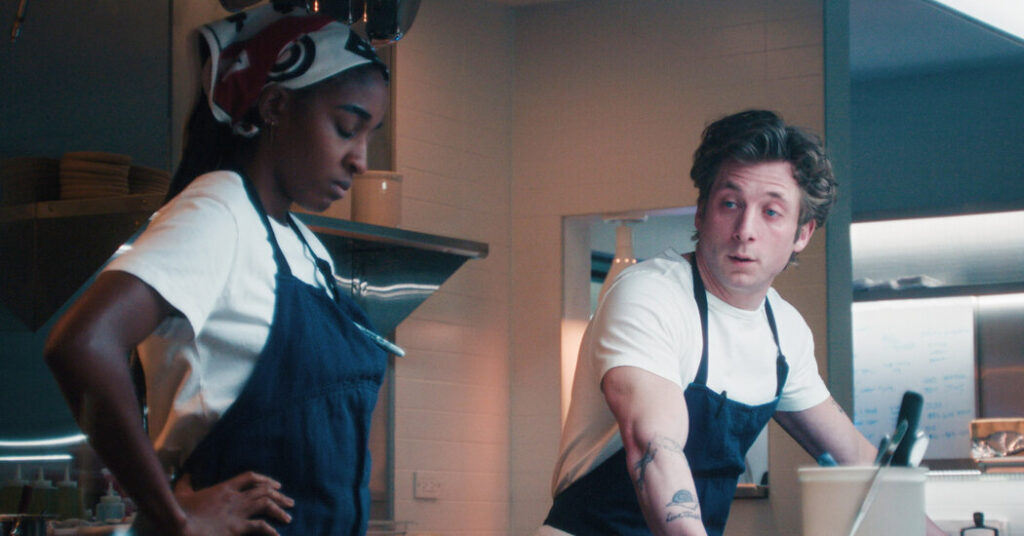
We return the morning after the surprise announcement by Carmy Berzatto (Jeremy Allen White) that he’s stepping back as top chef of the title restaurant and turning over the kitchen to Sydney (Ayo Edebiri).
The season begins with the rumble of thunder. The forecast calls for pathetic fallacy, as a relentless line of clouds barrel into the Chicago area to introduce literal sturm to the usual drang of the besieged kitchen.
The Bear has one more chance to save itself from failure, and it must do so under the worst of conditions. The rain is falling in sheets, deliveries are canceled, pipes are bursting and the reservation system has overbooked it with customers who may or may not show. Oh, and it appears that the long-awaited guest, a Michelin guide reviewer, is probably visiting that night. The crew must do more than ever, with less.
“The Bear” has always been its own best metaphor, the culinary triumphs and overreaches of the kitchen mirroring the creative arc of the series itself. So it is in the end. The scripts have often referred to the chef’s principle of “subtracting,” the equivalent of Coco Chanel’s fashion guidance to look in the mirror and take one thing off.
But the series, created by Christopher Storer, has not always done this, particularly in the third and fourth seasons. Storer’s approach in this one forces a back-to-basics compression, just as the bursting pipe ruins the dress uniforms and puts the staff in throwback “Original Berf of Chicagoland” T-shirts, calling back, typo and all, to the Beef’s origins as a family-owned sandwich joint.
The episodes, except for the penultimate one and the finale, run about a half-hour or considerably less. The frenzied service amid the deluge — and amid the peripheral machinations by the restaurant’s ownership to keep it, er, afloat — recalls the all-throttle-no-brakes kineticism of first-season episodes like “Review.”
For seven episodes, the story runs practically in real time. Over its run, “The Bear” has been analogous to a war story, an underdog sports movie and an indie art film. For its final service, “The Bear” is now “The Pitt.”
The stripped-down, no-time-to-waste approach first accomplishes the goal of making Sydney, if not the show’s protagonist, then the focal character among an ensemble. I was dubious, when last we left “The Bear,” that the series would step back from Carmy’s often overwrought personal drama simply because he said he was handing off control.
But it does. Giving us little time to look back, the season does little wallowing in his past family trauma or memories of working in toxic kitchens. When his issues do arise, it’s not in flashback but manifest in action — particularly in the seventh episode, when he drops a dish believed to be for the man from Michelin and all his nightmares of choking at a crucial moment in his career seem to come true.
Instead, Sydney is now the captain, even if the staff doesn’t immediately know the transition has happened. She is not perfect, nor perfectly controlled — we already know her to be a ball of nerves with an anxious stomach. But unlike Carmy, and the Berzattos both actual and honorary, she is able to master her emotions. We begin to get a glimpse of how she might operate a kitchen where co-workers “have each other’s backs and speak to each other cleanly, clearly, kindly and watching our language.”
The compression of the final season has its downsides. In some ways, it makes “The Bear” into a different show, without room for slow-burn character growth. As in “The Pitt,” we have to accept a wild amount of catastrophes in a single day.
We also don’t get the digressive single-character episodes which, while they might have slowed narrative momentum, made for its finest short stories, as when the pastry chef Marcus (Lionel Boyce) makes a pilgrimage to Copenhagen and Richie attends boot camp in high-end restaurant service. Instead, this approach was reserved for the amuse-bouche “Gary,” the preseason two-hander starring Moss-Bacharach and Jon Bernthal, as Carmy’s brother, Michael, whose death by suicide made him the ghost haunting the kitchen starting in Season 1.
But the trade-off was worth it for the climactic episode, “Caramel,” depicting the chaotic ballet of the night’s final service. It is tense, propulsive, funny, gorgeously shot. Even Neil Fak (Matty Matheson), the overused comic-relief character, is pulled back from the baby-like extremes of recent seasons to get a fitting hero moment.
It was here that I finally, and after too long waiting, regained the sense of wonder I had watching the first season: How did Storer make a TV show about a restaurant this exciting?
After all this, the finale comes across as more of an epilogue. It goes mostly where you think it will — the beef-sandwich franchise proposed by Ebraheim (Edwin Lee Gibson) gets approved, as seemed the obvious choice long ago — and provides the moments of closure you’d expect.
Without the narrative drive of the season that led up to it, the finale also lapses again into occasional long-windedness. Carmy spends an interview for an architecture internship unburdening himself of feelings about his restaurant career that the series spent five seasons showing us through action.
(His interviewer, played by Bonnie Hunt, also asks him if a restaurant kitchen is as shouty as they depict it on TV, which, combined with the season’s self-referential running gag of the foodie restaurant guest who keeps using terms like “Yes, chef,” makes me wonder if the show “The Bear” exists in the universe of “The Bear.”)
Carmy does, however, pull off one last bit of legerdemain, revealing that the crucial Michelin visit actually happened back in the Season 4 episode “Scallop,” sneaked in under our noses. (Well, some people noticed.)
And in the end, “The Bear” seems to acknowledge what it has done best. Richie was not the tormented young genius of the series, nor the aspiring talent who comes into her own. But whether by design or accident, he became the show’s heart.
Who doesn’t love a screw-up redeeming himself! Richie began the series as an explosive ne’er-do-well, set in his ways and going nowhere fast. He discovered, through work and discipline, that he had value and worth; his declaration that “I wear suits now” said more than a 10-minute monologue. Whether or not he could boil water, Richie made the restaurant what it became, by applying a common touch and realizing that guests want to feel surprised, delighted and welcomed.
Another way of saying that is that a good restaurant makes you “family” — a cliché whether it’s “The Bear” saying it or the Olive Garden. (The finale makes fun of this tendency, too, as Oliver Platt’s Uncle Jimmy grouses about the dysfunction of his and Carmy’s family — their actual family, he says, not the “kumbaya” one at the restaurant.)
But “family” is just a way of saying that a workplace is about people. It is probably also hacky to make everything and every story these days about A.I. But it’s notable that one of the most engaging shows of this ChatGPT era is about a kind of work that can’t be outsourced to a bot — work that is tactile and hands-on, that requires smell, taste, presence and care.
So “The Bear” turns over its final moments to the very human Richie as he engineers one last dining-room surprise, a birthday party for his daughter. A party is narratively convenient; it allows a kind of curtain call for a swath of characters and puts a button on their subplots. Above all, it’s the ultimate expression of why people gather with food, which is finally less about rare ingredients or trompe l’oeil wonders than about the pleasure of company.
For five seasons, “The Bear” dazzled and frustrated with dissonant flavors and ambitious menus. It ends, as a good meal should, with a little something sweet.
The post ‘The Bear’ Finale: I Hope You Saved Room for Cake appeared first on New York Times.