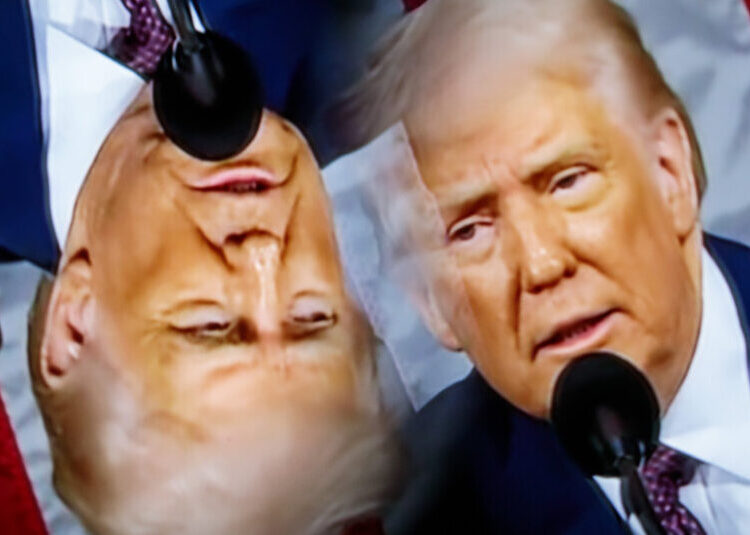
No one hates like President Trump. He hates expansively, ornately, aerobically. He hates in sprawling speeches in the middle of crowds in the middle of the day. He hates in social media expectorations in lonely moments in the dead of night. Most of Trump’s talents are exaggerated or invented, usually by him. They’re his con. Hate is his core, and he’s an undisputed master at it.
But I want to talk about Trump and love. That relationship reveals just as much.
“Love” jumped out at me from his loopy interview with Kristen Welker of NBC News several weeks ago, when he traveled a familiar arc from delusion to diatribe to meltdown. Along the way he “loved.”
“I love the farmers, and the farmers love me,” Trump told Welker, then went on to explain that during his first term in the presidency, he’d funneled many billions of dollars to them. “They never had a payday like that,” he said, “and the farmers love me.” It was that simple. That syllogistic.
It’s love as a transaction. A contract. A pact. I’ll stroke your back — lightly — if you give a deep-tissue massage to mine. We’ll call that love.
Nothing in Trump’s life comes any closer to it.
This evangelist of hate mentions love all the time, but not in stirring ways, not with exalted connotations. Roughly three months ago, during remarks about Iran in the East Room of the White House, Trump scanned the audience and seemed to spot someone associated with a television show to his liking. “I love this guy,” Trump said. “He’s so nice to me.” That was the sum of his beloved’s allure — not valor but flattery, not dazzle but deference.
“We’re not supposed to be seduced that way, right?” Trump continued, ever the philosopher. “But I am. When somebody’s nice to me, I love that person. Even if they’re bad people, I couldn’t care less.” There you have it: the unifying theory for his cabinet choices, his diplomacy and his pardons. Rob any jewelry store you like, so long as you kiss the ring. Worry not about skills, only about sucking up.
Sometimes Trump’s “love” is a deception. “You know what I really love?” he said early this month, when a reporter in the Oval Office asked him about the Consumer Price Index. “I love the inflation.” There was perhaps a dab of Trumpian logic in that declaration: Inasmuch as rising prices were connected to the Iran War, they were a noble hiccup. But mostly, loving inflation was Trump’s oratorical version of jazz hands, a show of breeziness and bravado that kept people from looking at anything else.
Trump uses “love” the way lazy cooks use salt — reflexively, promiscuously, unimaginatively. Why sweat something more original when it’ll do the trick? He doesn’t worry about cheapening love’s meaning, because he doesn’t worry about cheapening anything.
And he uses “love” incongruously, because congruousness has never been his thing. In 2016, during his first presidential campaign, he referred to his rallies as “lovefests,” though his speeches brimmed with nasty epithets for other politicians, assertions of a country gone to hell, resentments galore and recriminations ad nauseam. That is love? To Trump, yes — if enough people are listening and lapping it up. The crowd’s roar is the music of love.
He professed love for seemingly any and every constituency that might vote for him. “I love the poorly educated.” “I love the Mexican people.” “I love the Muslims.” When he was on the hunt for votes, he was in the mood for love. Never mind that his behavior often belied his blather, as those cherished Mexicans and Muslims can attest. Love is just shiny wrapping paper on an empty box. Only silly idealists see it as a commitment. Steely opportunists understand it as a come-on.
Don’t forget that Trump “fell in love” — his actual words — with Kim Jong-un, the North Korean leader, after Kim supposedly sent him gushing letters. A dictator can herd dissidents into labor camps, stage public executions, flaunt his nukes and still make Trump’s heart go pitter-patter. Just tell him what big presidential muscles he has.
For Trump, there has been a whole lot of loving like this. There has been less of other kinds. I’m hard pressed to recall many instances when Trump spoke lovingly, as opposed to boastfully, of his wife, Melania, or his children. He talks about how much other people love them. He brags about their acumen or poise or style or looks. They’re glittering ornaments that reflect his own stature, his own potency.
Shouldn’t that make them as lovable as retired U.S. Army Major Nicholas Dockery’s grandmother? Dockery received the Medal of Honor at a White House ceremony a week and a half ago, and when Trump rattled off the names of relatives of Dockery’s in attendance, he paused at his mention of “grandmother Mary.”
“Oh — Mary is something,” he said. He seemed to swoon. “I love Mary. She said, ‘I’m a big fan of yours.’”
There’s courtship for you. Not roses. Not chocolates. Not the recitation of a sonnet, the singing of a ballad, the scripting of a vow. Just “I’m a big fan.” More loving words have never been spoken.
Forward this newsletter to friends …
… and they can sign up for themselves here. It’s published every Monday.
Bonus Regan Picture!
I recently clicked on some article about whether people sleep better or worse with pets on their beds. Soon after, the internet’s algorithms deluged me with such fare. It presented contradictory information: I should welcome the comfort of a furry friend. I should beware the germs. My dog was probably disrupting my slumber in ways I didn’t remember later. My dog was possibly imbuing me with a serenity for which there’s no ready measure.
So many considerations. So much uncertainty. And yet no mention of the two best arguments for allowing my Regan on my bed: It obviously delights her. And it greatly amuses me to discover how, during the morning interval between my getting up and my return to the bedroom to wake her for her walk, she has repositioned herself.
What I’m Listening To, Watching and Writing
-
It’s often said that nothing triggers memories quite like scents do. But for me, music is the express train to the past. The other day the familiar melody of “Heaven Knows I’m Miserable Now,” by the Smiths, popped up on some playlist I’d long ago constructed and — boom! — I was back on the campus of my alma mater, the University of North Carolina at Chapel Hill, in the mid-1980s. Time travel isn’t a fantasy. It’s what happens to me anytime I listen to such popular songs from my college days as the Smiths’ “Heaven Knows” and “How Soon is Now?,” R.E.M.’s “Pilgrimage,” U2’s “New Year’s Day,” Kate Bush’s “Cloudbusting” and the Eurythmics’ “Here Comes the Rain Again.” There were ineluctable back then. They still give me great pleasure now.
-
I tried to join the “Widow’s Bay” fan club. Really I did. I savored many of its bursts of kookiness. I appreciated the tonal daring of its comedy-horror mélange. I admired the performances, especially those by Matthew Rhys and Kate O’Flynn. But this Apple TV show about a haunted New England island meandered, dawdled and mistakenly believed that paying homage to clichés and spoofing them made it OK to wallow in them. Not to the tune of 10 episodes, which is what the just-finished first season spanned. I won’t be taking the ferry back for Season 2.
-
In recent Times Opinion exchanges, Bret Stephens and I discussed Trump’s evasions of accountability and pondered the meaning of all the billionaires among us. Separately, in a collection of short essays by Times columnists and opinion writers about moments in American history that represent the best of what the country can be, I recalled the unlikely genesis and extraordinary impact of PEPFAR.
For the Love of Sentences
There has been a whirl of woe around the White House — and a wealth of memorable prose about it.
In The Times, Maxine Joselow chronicled the new green ordeal: “President Trump wanted the Reflecting Pool at the Lincoln Memorial to look pristine. Photosynthesis had other plans.” (Thanks to Jennifer Steinhauer of Chicago for nominating this.)
On Defector, David Roth examined the chromatic results: “The water is more or less the color of a sour apple Jolly Rancher now. It looks like they’re brewing Yodas in there. It is so uncannily green and visibly slimy that it feels inevitable that video will soon surface of Robert F. Kennedy Jr. splashing around in it with jeans on.” (Virginia Hudson, Berkley, Mich.)
In South Florida’s Sun Sentinel, Pat Beall described the ever-evolving shade as an “opaque lime Jell-O now, reflecting only the fact that somebody somewhere thought they were smarter than pond scum.” (Cynthia Mackinnon, Winter Park, Fla.)
In The Washington Post, Monica Hesse mulled the moral of the televised brawls and blatant merchandising at the White House on Trump’s 80th birthday: “The problem with Sunday’s broadcast wasn’t the fighting. The problem was the tonally incoherent emulsion of patriotism and bloodlust, history and buy-this-crap, an event happening for the people but tucked behind a Paramount+ paywall. We have always been a violent country, but have we always been such a shameless one?” (Stan Shatenstein, Montreal)
“At least no lions were killed,” wrote a commenter identified as Mainjane in The Post’s reader responses to a photo gallery of that event. (Uschi Wallisser, Stuttgart, Germany)
As for Trump’s capitulation to Iran, Graeme Wood in The Atlantic recognized: “Normally one would have to pay a lot of money to a discreet professional to be humiliated this badly.” (Chip Visci, Shell Beach, Calif., and Dan Woog, Westport, Conn., among others)
In her newsletter, Mary Geddry rolled her eyes at Trump’s triumphalism about the reopening of the Strait of Hormuz — which was closed because of his own actions: “This is a little like setting your kitchen on fire, holding a press conference when the sprinklers turn on, and announcing that your administration has achieved historic moisture.” (Miriam Bulmer, Mercer Island, Wash., and Bob Maier, Murfreesboro, Tenn.)
In The Times, Bret Stephens concluded: “Tehran took the measure of Trump’s courage. What it found was a bone spur.” (Alan Stamm, Birmingham, Mich., and Marion Kelly, Addis Ababa, Ethiopia, among others)
In a subsequent column, Bret implored Republicans to confront rather than rationalize Trump’s outrages: “For 10 years, I’ve watched my former political party work overtime not to cringe; to pretend that the Vesuvius of verbal infamies erupting daily from Trump’s mouth is either unimportant, or hilarious, or calculating and shrewd. Republicans turned their tolerance for the president’s mental goo into a shot-drinking contest — the more you drank, the manlier you were supposed to be.” He later added: “Ronald Reagan predicted, correctly, that the Soviet Union would end up on the ash heap of history; now it’s our turn to risk winding up on the ash heap of idiocy.” (Karl Wozniak, Salem, Ore., and Phillip Riback, Manhattan, among others)
Also in The Times, Thomas L. Friedman quipped that the foreign-policy fluency of Bill Pulte, whom Trump has appointed as the acting director of national intelligence, is confined to “the breakfast menu at the International House of Pancakes.” (Deborah Cinque, Long Branch, N.J., and Tim Hoffman, Boston, among many others)
Binyamin Appelbaum explored why urban housing is so limited and expensive: “Cities have largely lost the power to say yes to construction. To prevent officials from acting against the public interest, we have drained them of the power to act in the public interest. Every decision can be appealed, every complaint must be heard, every objection weighed. We are so committed to fairness that we have lost sight of the unfairness of doing nothing.” (Lynn Ward, Charlottesville, Va.)
In The Sydney Morning Herald, Richard Glover determined that designers of clothes and of lavishly mirrored clothing stores are clueless about the mind-sets and midsections of middle-aged men: “Some people recommend Buddhism as a means of dissolving the ego, but I find the same result can be achieved in 10 minutes visiting Just Jeans.” (Kevin Clarke, Sydney)
In his newsletter, The Loaf, Tim Kreider recalled how a college course first taught him “to despise advertising, the pretty smiling receptionist in the lobby outside the slaughterhouse of capitalism.” (Jo Henning, Cincinnati)
In The New Yorker, Sloane Crosley empathized with people who suffer from a hypersensitivity to sounds: “Who among us has not experienced an inability to ignore repetitive tapping, clicking, chewing, smacking and sniffling? Who among us has not lain awake, our consciousness pinched to attention by the nefarious silences between snores, with our earplugs like fallen soldiers on the battlefield of sanity? Who among us has not asked herself: How many potato chips could possibly be in one bag?” (Katherine Stenger, Encinitas, Calif.)
Also in The New Yorker, Justin Chang alluded to “E.T. the Extraterrestrial” to explain the shortcomings of the director Steven Spielberg’s latest movie, which is also about alien visitors: “Though ‘Disclosure Day’ teems with intelligent life, it also blurs the line — not the one separating us from them but the one between phoning home and phoning it in.” (Paula Maloof, Salt Lake City)
In a separate review with a bit of a spoiler (stop here if you’re worried) Chang took gentle issue with the shortfall of nerve in a new movie about what happens when two sexually bold neighbors drop in on a feuding couple: “I’m not saying ‘The Invite’ needed an orgiastic climax — only that it might have benefited, like any relationship, from less fidelity to a pre-existing script, and perhaps a drop more of its characters’ own courage. What happens onscreen isn’t just coitus interruptus; given how quickly the neighbors quit the premises, it’s more like a premature evacuation.” (Tim Brophy, Jensen Beach, Fla., and Barry H Epstein, Silver Spring, Md.)
To nominate favorite bits of recent writing from The Times or other publications to be mentioned in “For the Love of Sentences,” please email me here and include your name and place of residence.
The post Donald Trump’s Love Language appeared first on New York Times.