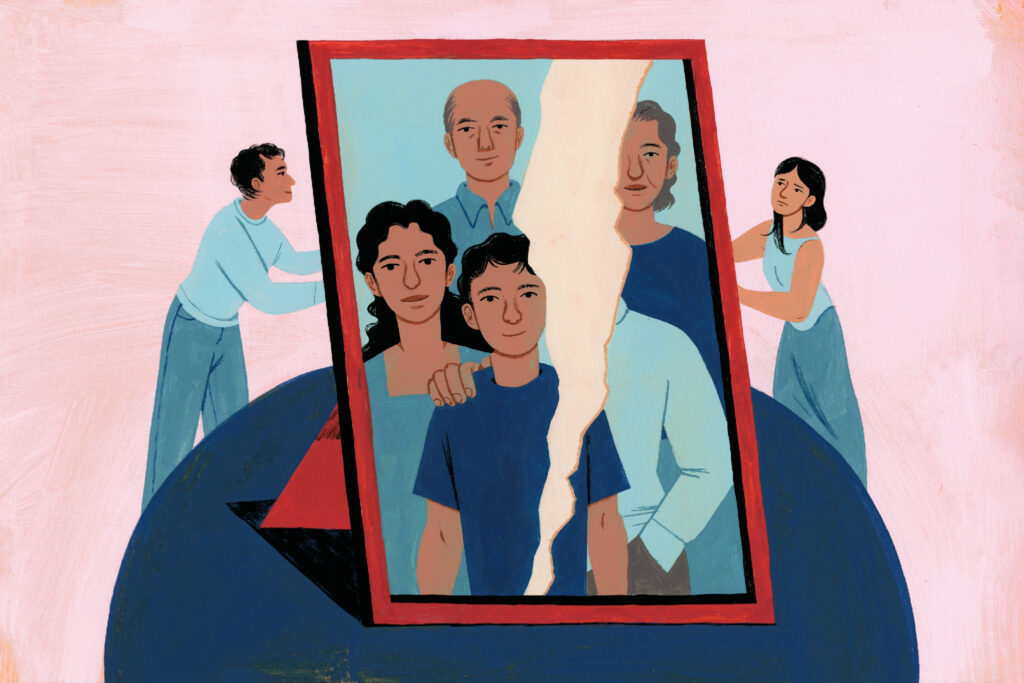
My patients who are dating sometimes ask me: Is it a red flag if a potential partner is estranged from their parents or adult children? While it can be, estrangement is often more complicated than people assume. In my research and clinical practice, I’ve seen many otherwise loving and reasonable parents become estranged for reasons that had little to do with their character or suitability as romantic partners. Sometimes estrangement follows the influence of the other parent after divorce, intense political polarization (“I can’t have someone in my life who voted for him!”), the influence of a child’s spouse, or simply a son or daughter’s desire for greater separation and distance.
Some also wonder whether it’s a bad sign when someone they’re dating has cut off contact with a mother or father. Here, too, there may be understandable reasons for the estrangement, including histories of abuse, neglect, addiction or chronic mistreatment. Given that, if a potential love interest no longer speaks to their parents, or has an adult child or children who no longer speak to them, it doesn’t automatically mean they are unsuitable for a healthy relationship.
In both cases, estrangement alone shouldn’t be treated as an automatic dealbreaker.
But whether someone is estranged or not, you probably won’t feel reassured unless you ask enough questions to understand who the person is — their history, their character, their values — and that’s where many people get stuck.
The importance of asking — and answering — tough questions
The promise, excitement and intensity of early romance can make us too eager to accept another person without sufficient curiosity or skepticism. An individual may become engaged without knowing how much debt their fiancé carries, or date a person divorced multiple times without ever asking what role they played in their failed marriages. When we’re first falling in love with someone, we naturally want to side with them. Yet, successful long-term relationships require the ability to ask tough questions of the person with whom you may spend the rest of your life.
A successful relationship also requires you to be able to respond respectfully and forthrightly to questions about you or your past. This doesn’t mean that you’re obligated to immediately disclose every painful aspect of yourself or your family history. If anything, it’s reasonable to take some time to get to know the other before revealing areas where you have shame or fears of rejection. However, you should, over time, be able to share parts of yourself without that fear becoming debilitating.
It’s also important to keep in mind that you don’t have to be perfect to find lasting love. Everyone has flaws, disappointments, regrets or complicated histories. It’s useful to find someone whose imperfections fit reasonably well with yours, and with whom you can communicate honestly about the problems that inevitably arise. Marital researcher John Gottman has found that even in long-term couples, 60 percent of their conflicts continued through the course of the marriage. What distinguished successful from unsuccessful couples was how they communicated or tolerated common and expectable differences around sexual desire, parenting and finances, to name a few.
Red flags to watch for
While some red flags are obvious, others require a deeper look. More obvious warning signs include someone who frequently loses their temper, abuses substances while denying it’s a problem, becomes intensely jealous without cause, tries to control your time or relationships, or takes no responsibility for the failure of prior relationships.
Less obvious warning signs may be reflected in how someone talks about conflict, disappointment and accountability. Do they show curiosity about their own role in problems, or only certainty about everyone else’s failures? Do they have the ability to respond respectfully to your questions or stonewall you whenever you ask?
Getting back to the question of whether estrangement is a red flag, the more important question is how much self-awareness the person possesses about the estrangement and whether the behaviors that contributed to it are likely to appear in a romantic relationship. If a person becomes estranged from family members because they’re chronically explosive, controlling, abusive or unable to manage substances, those same issues may well emerge in dating or marriage. Likewise, if someone is estranged from parents, siblings, former friends and romantic partners because they can’t tolerate disagreement, repair conflict or sustain closeness, that too deserves attention.
In general the following questions can be helpful:
How does this person explain the estrangement?
Do they show any ability to reflect on their own role in the conflict, or is every former partner, friend, sibling, parent or child described as entirely at fault?
What patterns led to the estrangement, and are they likely to show up in a romantic relationship?
Traits such as chronic anger, controlling behavior, substance misuse or an inability to tolerate disagreement rarely stay confined to one relationship.
Can this person repair conflict?
Healthy relationships depend on the ability to acknowledge mistakes, apologize, compromise and stay connected through differences. An estrangement may be less important than whether the person has learned from it and developed those skills.
Ultimately, the goal in dating isn’t to diagnose whether someone is “good” or “bad,” nor to determine whether estrangement itself automatically signals dysfunction. The more important question is whether they have the capacity for honesty, accountability, empathy, repair and reflection — because those are the qualities that help couples build trust, navigate inevitable difficulties and create lasting intimacy over time.
Joshua Coleman, PhD, is a clinical psychologist in the Bay Area, keynote speaker, author and senior fellow with the Council on Contemporary Families. His newest book is “Rules of Estrangement: Why Adult Children Cut Ties & How to Heal the Conflict.” His Substack is Family Troubles.
If you have a question for a therapist about mental health, relationships, sleep, dating or any other topic, email it to [email protected], and we may feature it in a future column.
The post Is estrangement from family a dating dealbreaker? A therapist weighs in. appeared first on Washington Post.