LITTLE ROCK — Kia Mills kept her latest diploma in a bag stuffed in her closet. The expensive piece of paper had little use as she uploaded yet another résumé while sitting on her gray couch on a recent gray day, a lone candle lit on her coffee table.
“Part-time customer service agent,” the description read, $16.61 an hour.
“Some money is better than no money,” sighed Mills, 35. She picked up her phone to text her friend, Aaliyah McShane. The job was at the airport and McShane, back when she had a steady career, loved to travel.
“Girl, let me get at that,” McShane, 29, replied.
Neither could comprehend how much desperation had replaced their ambition. McShane had two master’s degrees and had worked her way up to middle-management jobs in the state and federal government over more than seven years. She had been out of work since June 2025. Mills had left her administrative job about nine months earlier, thinking a newly minted master’s degree in criminal justice would make it easier to find a full-time job with a nice salary.
Instead, they found themselves fitting a description afflicting more people across the United States: Black. Educated. Unemployed. Over the past year, economists and civil rights leaders have observed the unemployment rate between Black and White Americans widening at a nearly unprecedented clip. And an unexpected group is finding itself left behind.
College-educated black Americans — especially women — have struggled to find jobs after the Trump administration made reductions to the federal workforce and the imposition of tariffs slowed hiring. Some of those looking for work worry that companies might be scared to hire them during a period when the government is actively encouraging White men to file complaints about workplace discrimination.
“I cannot find another period outside of a significant economic downturn when the Black unemployment rate has deteriorated this much, this fast,” said Marc H. Morial, president of the National Urban League. “It’s affecting every region of the country, and it’s taken out people who followed the script. They went to college; they climbed the corporate ladder and — voilà — they’re out of work.”
The economic script usually went like this: Since the 1970s, economists have noted that typically the unemployment rate for Black Americans is twice as high as it is for White Americans, a statistic that economists often cited to illustrate entrenched inequality. Morial took it as a sign of progress when the chasm began to narrow after the coronavirus pandemic. In the last month of the Biden administration, the ratio was 1.6 to 1, according to a Washington Post analysis of federal data.
But within a year, the 2-to-1 gap had returned, even though the White unemployment rate remained stable. By the end of 2025, 7.2 percent of Black people were unemployed compared with 3.6 percent of White people. The disparity has barely budged since.
Despite a complicated and volatile economic period with soaring gas prices and rising inflation, an unambiguous economic reality has emerged: White Americans are largely keeping their paychecks. Black Americans are losing theirs.
Almost no state in the country has seen the gap widen more than McShane and Mills’s home state, Arkansas, where mountainous green forests surround new high-rises in some of the country’s fastest-growing metro areas.
Arkansas’s Black unemployment rate in 2025 exceeded the national average, while unemployment among White people was lower than the national average.
Mills and McShane have found themselves cast out of such economic fortunes — not for lack of trying. They listened to podcasts giving interview tips, consulted ChatGPT on how best to tailor their résumés, memorized their strengths and weaknesses.
Mills calls herself analytical and detail-oriented. She prides herself on looking well put-together when she leaves the house, the foundation layered smoothly, lashes never too long or thick, eyebrows perfectly arched. McShane keeps her hair in a bun and is introverted but ambitious, a self-described “quiet storm.”
They became friends almost two years ago, originally bonding while knocking on doors ahead of the last presidential election, encouraging their community to vote in a state where they often felt marginalized.
Both had internalized the promise of America: that a good education would open opportunities and hard work would breed success. Even more so, they believed what their elders had told them about the promise of being Black in America, that triumph was still available to those who did not give up.
“Sometimes, I wonder, why is this happening to me?” Mills said. “If I got an interview, I hate to think that I have a terrible look that would keep me from the job. Sometimes I think I’m being blackballed. I don’t know. I try not to get discouraged because I believe in God, and I know He would never punish me. Sometimes, I don’t understand.”
“Girl, we got to keep going,” McShane would tell her, repeating a cycle of disappointment and support that has gone on much longer than they had ever imagined.
President Trump once loved talking about the Black unemployment rate. He spoke about the issue in 27 percent of his speeches delivered in 2018 and in 18 percent of his speeches in 2019, a Washington Post analysis of remarks catalogued by Factbase showed. When the jobless numbers were low, he cited them as proof that he has done “more for the Black community than anybody since Abraham Lincoln.”
During the 2024 campaign, Trump argued that the next president needed to be tougher on immigration enforcement because migrants were taking “Black jobs.” But in 2025, one of the biggest threats to Black jobs was the Trump administration itself.
As his Department of Government Efficiency (DOGE) sought to reduce the federal workforce, analysts such as Valerie Wilson at the Economic Policy Institute saw a rapid rise in the unemployment rate for Black workers, an increase only the pandemic and the Great Recession could surpass.
The exact number of Black employees who were among the 280,000 federal jobs lost was not immediately clear. It was hard to tell because agencies had stopped collecting employment data about race to comply with Trump’s executive order banning diversity, equity and inclusion practices.
But digging into the available statistics, Wilson noted that the large number of college-educated Black women losing their jobs would certainly be connected to government cuts. Nearly one-fifth of the federal workforce was Black, despite them being 13 percent of the population. And after President Harry S. Truman integrated the federal workforce in the 1940s, government jobs became a dependable pathway to the middle class for those who were Black and ambitious.
Frank Scott, Little Rock’s mayor, told The Post that he is proud of the strides his community has made. Its economy is the second fastest-growing in the South, with a riverfront offering free jazz music on Wednesdays and lanyard-wearing tourists riding Lime bikes downtown from the recently renovated convention center. Amid the progress, though, Scott said that the industries “highly reliant upon the whims and woes of federal legislation” were countering its success.
“I know tons of people who were middle-class individuals who had jobs at USDA for years and lost their jobs,” said Scott, the city’s first elected Black mayor. “I know folks who were enlisted soldiers and they decided to go civilian after they did a six-year stint, and then they lost their job.”
An hour outside Little Rock, Vivian Brittenum felt the squeeze working at a federally funded organization designed to help jobless residents connect with businesses that need them. Since the pandemic, they had seen tire manufacturers and chicken plants and paper makers and logistics companies leave the area, taking hundreds of working-class and middle-class jobs with them each time.
And there were fewer employees to help those who need help. Budget cuts reduced the number of workforce centers across the state from 30 to 21. After the U.S. Department of Labor sent less money to workforce programs, Brittenum’s team was whittled from nine to one. “We’re forging ahead as if nothing is going to happen and will keep doing the best we can, but our jobs are in limbo as well,” said Brittenum, who is Black and has a master’s in business administration. “I’m over here a nervous wreck. We might need to be looking.”
Clark Cogbill, a spokesman for the state’s department of commerce, noted that Arkansas’ unemployment rate is lower than the national average. When I asked Cogbill about the disparities between White and Black employment, he said that the state was “not aware” that the disparity existed.
When Black Americans began losing their jobs at a faster rate over the past year, Trump had nothing to say. In 422 speeches that Trump delivered in 2025, the Post analysis found, he did not mention the Black unemployment rate in a single speech.
Finally, in early June, Gerren Keith Gaynor of the Grio asked the president about the rising rate of Black unemployment.
“And where your Black worker is really going to do well is when those factories open,” Trump said. “So, I think they’re going to be great. We’ve, we’ve been doing well. It’s been a big focus for me.”
The following day, Trump falsely told the crowd at a rally in rural Wisconsin that “African American unemployment is now doing better than it’s ever done.”
“I don’t know where the hell that stat came from,” he said, “but we’ll take it.”
When Mills walked across the stage at the University of Arkansas in Little Rock to receive her master’s degree in June 2024, she dreamed of being an agent at the FBI or the DEA. Her goal was to make at least $55,000 annually, a new chapter for her family story.
She was born to a mother who struggled with drug dependency. An uncle adopted her and her siblings and raised them in Memphis. She left for college, also at the University of Arkansas, and in 2017, became the first person in family to earn an undergraduate degree.
Her first job out of school was an accounting clerk at the local courthouse, starting at $15 an hour, almost $2 less than the job she was now considering. She then had roles as a court clerk and, finally as a judicial assistant, making about $20 an hour.
She quit after she received her master’s to focus on landing a government job, figuring it would only take a few months to get one. But she did not get a single call back and, in 2025, she started trying to return to the court system. “Once you are in the courts, you could keep moving up,” she figured.
But Mills could not get back into the courts; nor could she get a public sector job at all. Furloughs and shutdowns made managers hesitant to hire. In Arkansas, there are 2,000 fewer government jobs — slightly less than 1 percent — than there were when she started looking into 2024, according to data from the Federal Reserve Bank of St. Louis. Mills noticed the dwindling opportunities. “I would have never resigned if I knew it would take me this long,” Mills said. “I have gone through the stress; it has made so unhappy.”
McShane tried to keep Mills positive. Back then, McShane was proud of her ability to ascend through government work. Raised in a small town on the Arkansas-Mississippi border, McShane started doing data entry at child support services in Little Rock. She rose and rose while earning her two master’s degrees — one in human resource management, the other in logistics systems from Webster University. She was just starting a $70,000-a-year job assessing disability ratings at the Veterans Affairs Department in early 2025 when her office was asked to process twice as many claims as they did before.
“There was a new administration,” McShane said, “and they did things differently.”
Unable to keep up with an increased workload in the new job, McShane was laid off last summer.
“Honestly, I was relieved at first,” McShane recalled. She had some savings built up, so she took a girls’ trip to the Bahamas and figured the market could not be so terrible when she returned. Who could deny a woman with two master’s degrees?
Turned out, everyone could.
“It feels like you’re not even given a chance,” McShane said. “You hand in a résumé, and AI just rejects it immediately.”
More of their friends were facing similar fates, cast out because of shifting economic and cultural mores. Shakia Jackson, 45, had been the deputy director of the state’s Office of Health Equity, overseeing about 10 employees who set up translation services and established a center to bring health care to Latino communities.
In 2023, Gov. Sarah Huckabee Sanders (R) sent an order instructing her office to stop using the term “Latinx,” and then, to remove pronouns from their email addresses. The phrase “pregnant people” was now offensive, and Jackson was asked to shut down a social media support group for breastfeeding Black mothers. These changes were a part of Sanders’s efforts to cut DEI efforts from the government.
The state renamed Jackson’s department the Office of Health Disparities Elimination to get the word “equity” out of the title. Half of her staff was eliminated. And then, in November 2025, the office shut down entirely.
“I grieved,” Jackson told her friends. “Because we got to be two times better than anybody. We got to work twice as hard, get these degrees. We got to do all the things, but they can just snap their fingers and throw you away, like it’s nothing.”
A fourth friend, Chemeka Cooper, warned that the private sector did not seem much safer. Cooper had a master’s of business administration but found herself laid off after working as a project manager at Blue Cross Blue Shield, which was trying to lower rising medical costs as the state kicked hundreds of thousands off Medicaid over the past three years. Cooper briefly found another job at a tech company, before she was laid off there, too, in summer 2025.
Since then, employers have consistently told Cooper that she was overqualified for a new job. She tried to get assistance from a career adviser, who told her she did not have any jobs that would meet her salary expectations.
“If I’m applying for the job, I need the job!” Cooper recalled telling her.
Meanwhile, employers told Mills — who has never been able to get a job using her master’s degree — that she needed more experience. McShane was cycling through job listings so many times that they had started repeating themselves, even though those employers had rejected her because they said the jobs were already filled.
“That’s happened to me, too,” Mills said.
“When you start seeing so many people in your circle, you wonder, what is it?” Cooper said.
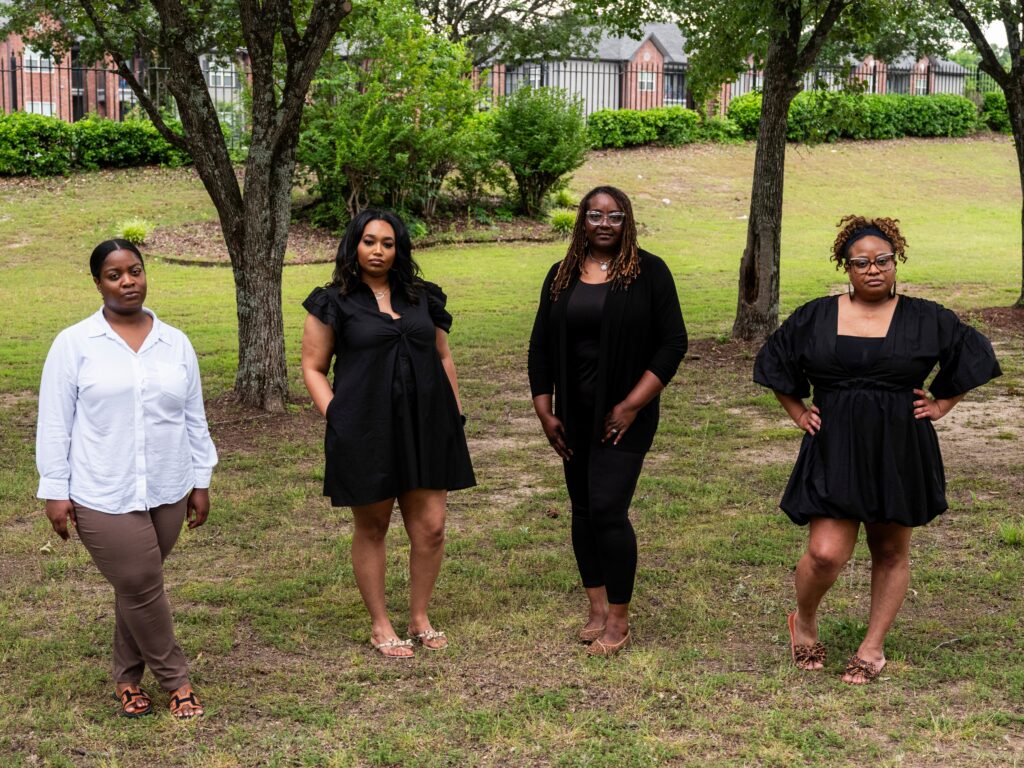
Hours after McShane and Mills applied for the $16.61 job at the airport, the four women met at McShane’s apartment building to provide each other as many “mm-hmms” and “it’s all rights” as they needed to stay motivated.
The building had large glass windows and art-deco style posters on its walls, a gym with a wall of treadmills and a large pool out back with black-and-white pool chairs. “Everyone says, ‘How can I stay in a building this nice if I’m struggling?’ McShane told her friends. “But if I try to move, they are going to run my credit and it’s suffering right now. I’d even leave Arkansas, but how can I leave? Every place is more expensive. I feel stuck.”
“I hear you, girl,” Mills responded.
Four Black women. Nine higher education degrees among them. Not one steady paycheck. All questioning everything.
Cooper, who worked in insurance, was changing the lessons she once gave her children about success.
“Now, I tell them don’t do things for the money,” Cooper told her friends, all of whom agreed. “That’s what I did. Look where I am.”
The hardest part for her had been limiting her middle child’s college ambitions. An honors student, Cooper’s daughter had hoped to go to a historically Black college out-of-state — a mark of academic excellence in Arkansas. No more. In-state tuition was all their one-income household could afford.
“I feel she has to settle because I couldn’t take care of it,” Cooper said, fighting tears.
Jackson, who once worked at the health department, held her hand, telling her it was okay to cry. She was going through it too, she said.
After losing her job, she moved in with her aging parents. It helped her save money and she no longer could rely on the U.S. Agriculture Department loan she had been hoping to use to fix the water damage in her home. During the DOGE cuts, Jackson said, staff working at the local office got laid off. All aspects of her life were becoming more difficult.
“Depression is a stigma in our community, but I’m glad I have a therapist,” Jackson said. She recommended antidepressants.
McShane jumped in.
“My mama had to help me out, that’s the thing I’m most embarrassed about,” she said. “I never had to ask for anything. My family is used to me being the one to take care of things, and to have me be that person …”
They were Black women in the South, carrying the history of being able to provide for their families, being the bedrocks of a community facing tumult. Mills grew up in Memphis, but the three other women had made their way to Little Rock from agricultural and rural small towns, where generations of Black residents dreamed of moving out of the fields and into offices like the ones they had.
But now, these women found themselves cobbling together ways to make the modern math of everyday living work. They drove Ubers. Cooper and McShane made pacts with one another to substitute teach, even though the students were rowdy and the buildings were sticky and the daily pay was $118. They tried to find the balance between cunning and compromise.
Cooper heard she was overqualified so often after she left her private sector jobs that she was removing lines of experience from her résumé. They all did. On certain applications, the women eliminated their master’s degrees.
“When I was a hiring manager, and all they needed was a high school diploma and I saw a master’s degree, I probably wouldn’t hire them,” McShane admitted. “I guess it depends on the individual.”
“I think God is teaching me how to be patient,” Mills said. “What’s meant for us, it won’t pass us by.”
About a week later, Mills got a job interview.
The offer came via text message from a regional carrier for American Airlines; she’d made the first cut for the part-time customer service job. There were two interview slots — one at 9 a.m., one at 11 a.m. For a moment, Mills felt like a job would not pass her by.
The text message suggested she dress casually, so she put on black slacks and black flats and a white shirt. She covered the blemishes on her face with a foundation by Urban Decay. Mills had chosen the 11 a.m. interview, and when she got to the airport, she walked to a large room right before the security checkpoint. She sat at a long white table among about 20 applicants and felt thankful that she had come so far — this interview was just her fifth in two years.
A representative in a blue uniform walked in and asked everyone to print their names on a blank sheet of paper. She would conduct group interviews, she said. But it would not be for the customer service position.
“That position,” the agent told them, “has already been filled.”
Still, the agent said there was another job opportunity that she wanted to discuss, and it offered the same pay. “We need ramp agents,” the agent said. They’d work outside on the tarmac, rain or shine. They’d clean planes. And, despite being a part-time position, they would have to come in at all hours, as needed.
“We treat this job as if it’s your primary job,” Mills recalled the woman saying. “If you have another job, if you are a caregiver, if you need to walk your dog at the same time every day, this job is not the one for you.”
Mills stood up. This job was not the one for her. A job cleaning planes felt like a step too far — especially if the schedule was so unpredictable that she would not be able to devote time to finding a job that used her skill set.
“Respectfully, you can take my name off the list,” Mills said.
She walked up and took some deep breaths, trying to get over the wasted time.
Mills called McShane to tell her about what happened. McShane was also upset. She had gone to a 9 a.m. interview, where she sat in the same room with nine other applicants —all of them Black women. The representative didn’t ask any questions about applicable experience or a challenge they overcame or any other question they discussed on the podcasts.
Instead, the representative asked one question: “If you could go anywhere in the world, where would it be?”
“I told them Bali,” McShane recalled, and that was it. The whole group interview took 20 minutes.
“What were they looking for? Was it your appearance?” McShane asked. “Because they never really interviewed us.”
“Well,” Mills tried to assure her, “they said they filled the position. Maybe you got it.”
Around midnight, an email dropped in McShane’s mailbox.
“We have decided to go with another candidate,” it read.
The school year was ending, which meant McShane could not keep earning money as a substitute. The payments for her student loans seemed unceasing. And she did not know how much longer she could rely on her mother to help.
“I am trying not to get into my head,” McShane said. She wondered if she should get a doctorate degree to qualify for more jobs — but she was already $70,000 in debt and could no longer hold faith that education was the answer.
“I am just not sure it was all worth it anymore,” McShane reflected. “I got to get a game plan.”
Jackson was encouraging her friends to think more broadly about employment. After state officials dismantled her office, she swore she would never work for them again and started a consulting business. She encouraged the others to do the same. More than 70 years after the Truman administration integrated the federal workforce, the women no longer deemed government work a tool to foster racial progress. Instead, they began to follow the practices of the generations of ambitious Black people before, forced to figure things out when they were so often denied.
“All of us here right now, with all our skills and all our talent, we could do so much,” Jackson said to the others. She looked at Cooper, who had an MBA. “Why are you not doing project management? Why are you not consulting?”
“It’s more of a fear of not being able to do something well,” Cooper said. “Several people have asked me why I’m not doing consulting, but it’s more like, what would I do it in? How would I approach it? Where do I start?”
Jackson grabbed her hand.
“We can do it,” Jackson said.
Mills felt inspired and when she went home and sat on her gray couch, she thought about her skills and talents and what brought her joy. She thought how friends always complimented her on her make-up and asked for advice. “Maybe I should step into entrepreneurship and become a makeup artist,” she said. “What if that’s the gift God wanted me to use?”
“I don’t know how to do it for other people, but I can learn,” she said. The 1st was coming up and the familiar worries about paying bills began to overwhelm her. She looked at a door and saw an affirmation written in white cursive she hung. “Be your own kind of beautiful,” it read. She had picked up her phone and texted an aunt who owned a hair salon, thankful she knew someone who could help.
The post Four Black women. Nine degrees. Not one steady paycheck. appeared first on Washington Post.