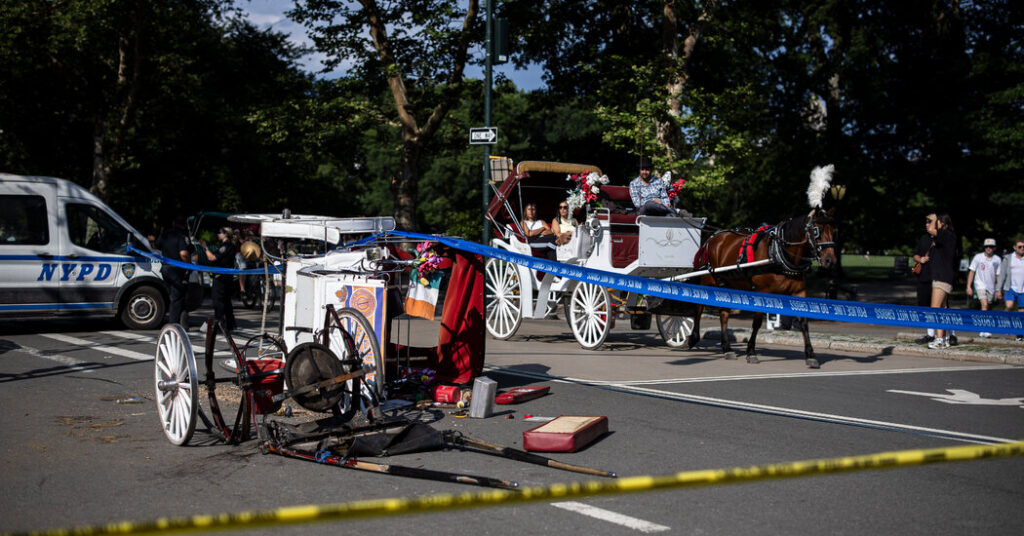
Christina Hansen was standing near a group of her fellow carriage drivers, brushing and feeding her horse, Joker, in Central Park on Wednesday afternoon when a man began berating the drivers and filming them, accusing them of animal abuse.
Joker moved, jostling the carriage forward and driving the critic to shout: “This horse wants to get away.”
Ms. Hansen, a spokeswoman for the drivers’ union, called the police on the man, who left on foot.
It has been a tense week in Central Park, where carriage drivers resumed providing passenger rides on Tuesday after a six-day voluntary safety shutdown. The drivers’ union called for the shutdown after an 18-year-old, Romanch Mahajan, fell off a carriage and died on June 17.
His death, which the Central Park Conservancy said is the first known human fatality in the park related to a horse carriage accident, has intensified the longstanding effort to ban horse carriages in New York City.
After Mr. Mahajan’s death, City Council Speaker Julie Menin said there would be a hearing in July to discuss a bill, introduced before the accident, to ban carriages by June 2028.
Mayor Zohran Mamdani said in a statement that he would work with the “City Council, union partners, carriage drivers, animal welfare advocates and community leaders to deliver a just transition that protects workers while ending horse-drawn carriages in Central Park once and for all.”
Several major cities including Chicago and Montreal have limited horse-drawn carriage rides or banned them altogether.
Mr. Mahajan was visiting New York from India with his parents and younger brother when the 7-year-old horse pulling the carriage carrying his family bolted while their carriage driver stepped away to photograph them, his father told The New York Times. Mr. Mahajan’s mother fell out of the carriage, and her son leaped out after her and hit his head on the ground.
Gaurav Mahajan, Romanch’s uncle, said in a text message that his nephew was full of energy that lit up a room. He said the family was insulted by the return of carriage rides so soon after the accident.
“Resuming these rides while the pavement is still marked by our tragedy proves that the city values tourist dollars over human life,” Gaurav Mahajan wrote. “Sending these carriages back into Central Park is a direct slap in the face to our agony and a dangerous gamble with public safety.”
There are 68 licensed carriage owners operating in the park, according to the union that represents the drivers, Transport Workers Union of America Local 100. The union and the Central Park Conservancy, which supports the ban, said they did not have data about how many people ride the carriages each year.
On Thursday, just over a week after the accident, Alma Guzman, 60, took her first carriage ride in 20 years.
Ms. Guzman, an E.M.T. from Bergen County, New Jersey, knew about Mr. Mahajan’s death, but she and her husband, Jesse Guzman, were not deterred. Mr. Guzman, 63, who is disabled, had a doctor’s appointment in Manhattan. The pair said they decided to “make a day” of it by splurging on the horse carriage ride.
“It gave us a real experience of seeing nature in a horse carriage,” Ms. Guzman said, while stepping out of a carriage near 59th Street. “It made it more beautiful.”
Mr. Guzman said that the hot sun made him worry for the horses. “There’s a lot of wear and tear on them,” he said.
But he did not support stopping the rides altogether, and expressed sympathy for their drivers. Mr. Guzman said he would like to see more stops and more water for the animals.
The city Health Department says it certifies the health and safety of the horses and conducts inspections at Central Park’s stables. It also requires drivers to stay with their horses so they do not roam freely, and trains drivers on this and other health and safety requirements.
Angel Hernandez and his horse, Harley, waited for customers on Wednesday at their red-and-white carriage. Mr. Hernandez, who has driven in Central Park since 2005, said he was devastated by Mr. Mahajan’s death.
“I feel really bad for the family,” Mr. Hernandez said.
Mr. Hernandez says he stays in the industry to support his family, including his two children, and for his love of horses.
“Just because a big accident happened, they just want to say that they can’t trust our industry,” he said. “I don’t think that’s the right thing to do. They should see what’s going on and try to make it better for us, because it’s a lot of people like me that we depend on this business.”
Ms. Hansen, the driver who was heckled last week, said drivers were misunderstood and that Mr. Mamdani’s support of the ban would change if he met with them.
The carriage drivers’ union held required training for its members after Mr. Mahajan’s death, including reviewing existing rules, the driver’s manual and other best practices, Pete Donohue, a union spokesman, said in an email.
The union said it also conducts “practical evaluations of drivers on their proficiency at harnessing, hitching, and unhitching horses.”
These measures are not enough for supporters of a ban, who have also been angered by the death of a horse earlier this month after it consumed a toxic plant in the park.
Edita Birnkrant, executive director of NYCLASS, an animal rights activist group that has long sought to ban the horse carriages, blamed the city for letting the rides resume.
“Why are they allowing them back out there after they killed someone?” Ms. Birnkrant said. “They’re in the same exact operational conditions that led to the death.”
On Thursday in Central Park, under sunny blue skies and lush tree leaves, Amber Eleazer stepped down from a horse-drawn carriage. Ms. Eleazer, an entrepreneur from Philadelphia, was with her youngest daughter, 5, and her oldest daughter, who was celebrating her 7th birthday.
Ms. Eleazer said the ride was wonderful. But she said she would support the city if it decided to make that ride the last one she ever takes in Central Park.
“We loved the experience,” she said (the birthday girl rated it a “10 out of nine”). “But if the City Council decides it’s in the best interest of the horses, we’ll support that. We’re against animal cruelty.”
Nate Schweber contributed reporting.
The post Central Park Horse-Drawn Carriage Rides Resume, as Push for Ban Intensifies appeared first on New York Times.