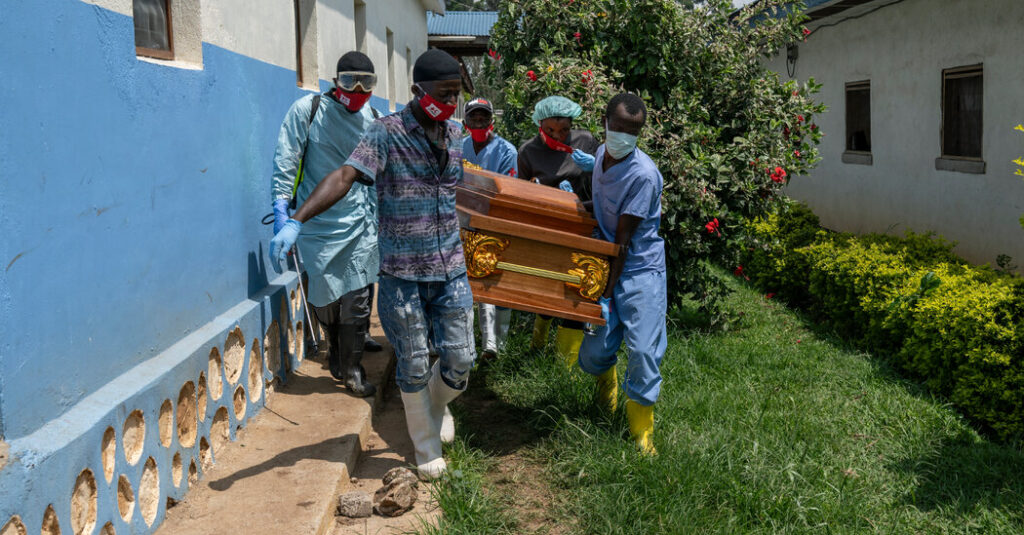
In an instant, the funeral erupted into chaos. Furious mourners threw punches and stones, breaking car windows and chasing after the Red Cross workers they accused of bringing Ebola to their town.
In the melee, Ramazani Bokwandela, 61, a Red Cross volunteer, dove into the bushes. Only a few weeks earlier, he had been selling bottles of gasoline for $1 from his roadside stall. Now, he was at the hard edge of efforts to contain the surging Ebola outbreak scything through his corner of the Democratic Republic of Congo — and he feared it was going to cost him his life.
“I thought I was dead,” he said.
But Mr. Bokwandela, who had raised 15 children and escaped bouts of conflict here in northeastern Congo, knew a thing about improvising. Plucking a snail from a leaf, he used its shell as a razor and sliced off the sleeves of his Red Cross tunic, he said, casting away its famous emblem. Then he snatched a clump of plants, to disguise himself as a farmer, and stole away from the fighting.
His fellow Red Cross volunteers were not so fortunate. Four of them were hospitalized after being badly beaten at the funeral. Yet, three days later, Mr. Bokwandela was back at work, risking his life to ensure the kind of safe burials that are so pivotal to containing the virus.
“I’m on the front line against this disease,” he said, wearing a new Red Cross tunic. “That’s my duty.”
Volunteers like Mr. Bokwandela are the ordinary heroes of Congo’s Ebola outbreak. More than a month into the crisis, the chronic shortages of even the most basic supplies that blighted the early response are starting to ease. International aid is beginning to flow into Congo, with planeloads of protective gear and disease specialists trying their best to save lives. But attending to the sick is not the same as containing the epidemic.
Outside the hospitals, the virus continues to rage in communities gripped by fear, confusion and, at times, denial. There, far from medical help, the outbreak expands virtually unimpeded, leading some experts to fear that this will become the world’s worst Ebola outbreak ever.
Frontline Congolese workers like Mr. Bokwandela and his fellow Red Cross volunteers hold the key to pushing it back.
Few jobs are as difficult or dangerous. A month ago, they were farmers, taxi drivers, tailors or gold miners. Now, they form close-knit teams that plunge into places seared by Ebola, navigating not only the threat of a virus that has neither an approved vaccine nor treatment, but also the trauma of fellow Congolese who often see them as the cause of their ills.
Their task is a gruesome one: To help break the chain of transmission by retrieving the highly-infectious bodies of Ebola victims and burying them, safely.
“It’s one of the riskiest jobs in the entire response,” said Dr. Chikwe Ihekweazu, the head of the World Health Organization’s emergency response unit.
Even with the scaled-up effort, the Ebola response still has major gaps. Severe cuts in American aid battered Congo’s health system, leaving it badly weakened before the outbreak struck. And despite more than 1,200 cases and 300 deaths confirmed, nobody knows the true scale of the outbreak, or how far it has spread.
What is urgently needed are ground-level efforts to follow the path of the disease and stop it from spreading even further — tasks that will largely be carried out by a small cadre of determined Congolese, often from modest backgrounds.
“I’m doing it for myself, my family and my community,” said Mr. Bokwandela, who lives down a muddy street in a two-room shack with no electricity.
“There is no treatment,” he added. “The treatment is us.”
Days after the turbulent funeral, Raphaël Olangi lounged on a plastic chair at the cramped Red Cross compound down a rocky street in Bunia, the capital of Ituri Province, in the heart of the outbreak.
Tall and soft-spoken, Mr. Olangi, 64, a divorced father of four, normally makes a living as a trader, buying plastic goods in the capital, Kinshasa, and selling them 1,100 miles east in Bunia. Now, he leads one of eight Red Cross teams that do the crucial work of handling the dead.
His crew was drawn from across Congolese society. Isaac Okele, 27, was a former gold miner and a lifelong musician, a onetime choirboy who now sang gospel, rumba and Afrobeats. Dorcas Lonu, 33, sold medicine and raised two teenage daughters.
Mr. Bokwandela, the gasoline peddler, had fled the city back in 2003, during a wave of violence, spending nine years in a camp with his family before returning. “We lost everything,” he said.
Around them, the once-sleepy compound bustled with a frantic energy. Red Cross officials from Geneva ran training sessions. Trucks arrived with crates of protective equipment. Vehicles jostled for space in the small yard.
Workers took everyone’s temperature at the gate, checking fevers that could indicate who had been infected.
“Papa Raphaël,” as the team called him, exuded a calm assurance. A volunteer for 10 years, he had trained for Ebola during a previous outbreak between 2018 and 2020. This new one did not faze him.
As he handled the dead, “I tell myself that I am killing the virus,” he said. “I’m not afraid of it.”
Even so, the rest of the team seemed shaken. Since the cemetery attack — spurred by fears that health workers were causing, not preventing, infections — one Red Cross volunteer had quit, and two others had been airlifted to Kinshasa for urgent treatment of their injuries. On their phones, those who remained showed graphic photos of what their colleagues had endured. One showed a volunteer named Dieudonné Walingi in the back of a vehicle, smeared in blood.
One of his eyes had been beaten shut.
The other was wide with terror.
During an Ebola outbreak, the dead can be more dangerous than the living.
The body of a victim teems with the virus, and just brushing against it can bring infection. But in Congo, people often honor the dead by touching or kissing their bodies. In an outbreak, that can turn a funeral into a superspreader event.
About 100 Red Cross volunteers in Ituri, divided into eight teams, work with others to make sure that does not happen. Using protective equipment and extreme caution, they retrieve Ebola victims — and all other deaths — from hospitals and homes, disinfect the remains, put them in heavy-duty body bags and place them in the ground.
Rallying after the attack, Mr. Olangi’s 10-person team squeezed into a pair of trucks and headed back into the fray, driving to a hospital in an Ebola-hit district, where Samuel Baseke was waiting.
The day before, Mr. Baseke’s younger brother David, 23, had been admitted with signs of serious illness. Five hours later, he died.
Ebola can snatch lives so quickly, especially once it reaches an advanced stage, that many patients die soon after getting to the hospital, deepening suspicions that medical workers are somehow responsible.
“We are stunned,” said Mr. Baseke, 46, who works for a Congolese intelligence body.
Mr. Baseke knew that Ebola was to blame. What worried him now was that the eight relatives who cared for David in his final days, including himself, might also be exposed.
The Red Cross team helped Mr. Baseke into a protective suit, and led him to an enclosure to identify his brother’s body. An empty coffin, sparkling with disinfectant in the sunlight, stood open.
Mr. Olangi, wearing a red mask and rubber gloves, resembled an orchestra conductor as he guided his team through the choreography of Ebola, waving his hands to ensure everyone followed procedure: walking in single file, spraying the body with chlorine, unzipping the body bag, always moving slowly and deliberately.
As the body bag was placed into the coffin, cries rang out among relatives who had gathered behind a barrier 50 feet away. Some clutched their heads in anguish. Mr. Baseke’s younger sister fainted, crumbling to the grass.
A Red Cross pickup, its rear window shattered in the cemetery fracas days earlier, pulled up, and the volunteers heaved the coffin onto its bed. The hospital gate swung open, and the pickup led a cortege of motorbikes to a cemetery, where Mr. Baseke was buried peacefully.
Apart from hospital workers, few others in the Ebola response work in such constant proximity to the virus, separated from it by only a few layers of rubber and plastic. The volunteers say they trust in their protective gear, their training and their God.
Even that is not enough for nervous family members.
Every evening, Ms. Lonu is greeted by a bucket of water left outside her back door by her daughters.
“They want me to wash,” she said. “They say they’re afraid I’m going to die young.”
Mr. Olangi reassures jumpy relatives with photos of his protective gear. “‘Don’t worry,’” he said he tells them. “‘Hold my hand.’”
Within the team, such perilous work forges a deep camaraderie, he said: “We watch out for one another.” They all know that a single slip — a torn suit, a bungled routine — could be fatal.
“I won’t lie to you, I can be afraid,” said Mr. Okele, the musician, who has one of the most dangerous jobs.
Using a swab, he reaches into mouths of suspected Ebola victims to take a sample for testing. “I work carefully, with my heart,” he said.
In those moments, he often thinks of his siblings back home. “One mistake, and I take the virus back to them,” he said. “Fear keeps me alert.”
This outbreak hit the Red Cross before anyone knew it was happening.
In March, three of its volunteers in Mongbwalu, a gold mining town 50 miles north of Bunia, carried out a regular burial with minimal protection. Weeks later, they had fallen ill, and by mid-May, when the outbreak was officially declared, they were dead.
Experts now believe the outbreak originated in Mongbwalu, where it circulated undetected for months. The town has suffered the greatest numbers of deaths. When I got there in the second week of the outbreak with Arlette Bashizi, a photographer for The New York Times, we found the Red Cross team in crisis.
Protective equipment was alarmingly scarce. Workers had borrowed an ambulance from the main hospital to transport the dead, and in between funerals, they dried out their rubber gloves by perching them on sticks in the sun. The volunteers, who included farmers, gold miners and teachers, said they had been hastily trained to deal with Ebola only a week earlier. On top of that, they were bearing the brunt of a wave of public anxiety and anger.
Townspeople either denied Ebola was real or turned to conspiracy theories to explain its existence. Some turned on the Red Cross, threatening its volunteers during funerals and pelting them with stones. Rumors coursed through town, accusing the volunteers of stealing the bodies, or harvesting organs, to somehow get rich.
“People say I’m making money from death,” said Jean-Bosco Nanga, a farmer.
In truth, the volunteers could barely afford food and water. When I met the team leader, Dieu-Merci Unega, he was carrying a small bag of cookies to carry him through the day. “It sustains me,” he said.
The teams are not formally paid, but members will receive a daily stipend of about $25 during the outbreak, said Bruno Michon, the Red Cross operations manager for this outbreak.
For some skeptical residents, that proves Red Cross workers are fanning the crisis in order to get paid.
“It’s too dumb,” said Daniel Kuwiro, a volunteer at the Red Cross base. “If I was earning that kind of money, would I have walked to get here?”
An extraordinary esprit de corps seemed to keep them going. Later that morning, a group of volunteers launched into an a cappella chorus inside their shabby base, clicking their fingers as they waited for the next burial.
The acute shortages are abating somewhat. In Mongbwalu, Doctors Without Borders is running a 66-bed Ebola center, with another 65-bed facility under construction, and the World Food Program is feeding health workers. Testing is expanding, with nine labs across the Ebola zone.
By June 25, the Red Cross had carried out 480 safe burials in Ituri, Mr. Michon said. Teams from the Congolese government and an American aid group, FHI 360, also carry out safe burials.
But big gaps remain. The outbreak, caused by the rare Bundibugyo virus, is still growing in the same hot spots as before, and some experts worry that the neighboring province of North Kivu is next.
To stop the outbreak, health workers say they need to trace almost everyone who has been exposed to the virus. But they are woefully short of that, tracking only about 30 percent, Dr. Jean Kaseya, the director general of the Africa Centers for Disease Control and Prevention, said Thursday.
Other basics are still lacking. Over the weekend, Red Cross volunteers in Mongbwalu said they briefly had to stop burials because protective equipment had run out again. Even when it is available, volunteers said, they don’t have enough vehicles to handle multiple burials at once, so grieving families sometimes perform risky ceremonies on their own.
All the while, the volunteers are grappling with their own tragedies.
Mr. Unega, the Red Cross leader, said his father died in recent days, only hours after reaching the hospital. Yet the family struggled to buy a coffin because prices had become so exorbitant.
More than 75 medical workers have been infected by the virus, and they are coming under attack, too. On June 10, an Ebola patient brandished a gun and a machete against a doctor trying to treat him, aid workers say.
But nothing matched the violence on June 1, when the team suffered the assault at a cemetery in Bunia.
At first, the funeral went smoothly. The dead man, Pathy Menea, was mourned at the graveside by members of the Kimbanguist church, a group with millions of adherents in Congo, and by guards from the security company where he was a supervisor.
As the Red Cross volunteers prepared to lower Mr. Menea into his grave, a security guard demanded to open his coffin, apparently believing that the volunteers had caused or faked his death. The team refused to comply, fearing a public health disaster.
“We came to stop the disease, not to spread it,” Mr. Kuwiro recalled saying.
The clamor intensified. A mourner pried open the lid, but could only see Mr. Menea’s church uniform, which had been laid on top of his body bag. Mistakenly assuming there was nobody inside, he issued an incendiary cry: “The coffin is empty!”
The frenzy that followed was captured in videos confirmed by The Times. In one, a Red Cross worker flees across the graveyard, pursued by mourners. In another, Mr. Walingi dives into a truck for safety, only to be beaten by a man in a security uniform.
A photo shows Mr. Menea’s body bag ripped open, exposing his infected body.
So much raw hostility is dispiriting, said Mr. Okele, the musician. He had once considered quitting, until his mother encouraged him to keep going. But experts warn the outbreak could last a year and, eventually, he feels the volunteers will be vindicated.
“Even if the community doesn’t understand me today,” he said. “One day they will.”
A few days after diving into the bushes to escape the assault, Mr. Bokwandela sat on a rock outside his home in a rundown Bunia neighborhood, readying for work.
At 61, his family was still expanding. Beside him, his wife, Josephine, breastfed their youngest, Clarice, 1. (The eldest of his 15 children is 38, he said with a smile.) A Red Cross volunteer of 20 years, he was philosophical about the risks of the job.
“Death can come in many ways,” he said, citing his Muslim faith. “None of us can escape it.”
The team soon drove to Nyankundae, a onetime mission station where an American, Dr. Peter Stafford, had been infected in the early days of the outbreak. Having been evacuated to Germany, Dr. Stafford had just been discharged after weeks of experimental treatment, said Dr. Charles Kashindi, the director of the 150-bed hospital where the American worked.
But the village where he got Ebola was still battling the tide of illness and death.
The Red Cross team came for Sarah Aendoa, 29, a mother of four who had just died. Ebola was decimating her family. She had arrived four days earlier with her husband, John, and two other relatives. All four had been caring for her mother-in-law, who had died weeks earlier.
They rushed to Nyankundae after hearing that Samaritan’s Purse, an American aid group, had built a new treatment center there, a relative said. But they were mistaken: The center was still under construction.
Mr. Olangi and his team emerged from the Ebola ward with Ms. Aendoa’s body, then puffed and strained as they carried her coffin to their battered truck.
At the cemetery, they met a familiar face: Mr. Baseke, the intelligence agent whose brother they had buried days earlier, now paying his respects to Ms. Aendoa. “She was my next-door neighbor,” he said.
The team buried her at the end of a row of fresh graves, near her mother-in-law. Female mourners stood in the long grass, slapping their thighs as they wailed. A pastor wearing rubber gloves offered hymns and words of consolation. “Jesus is here with us,” he sang.
Ms. Aendoa’s children — Johnson, 11; Johanna, 10; and the twins Jayden and Jeynice, 4 — looked on, bewildered. Over the next week, her husband, John, and two other relatives also died, leaving the children without parents.
As Ms. Aendoa’s coffin lurched into the grave, cemetery workers moved forward to seal it. Mourners picked themselves up off the ground, handing around small bottles of hand sanitizer.
The Red Cross team slipped quietly into their truck and pulled away, waiting for the next call.
Noella Mwanza contributed reporting.
The post Volunteers Are Risking Their Lives to Stop Ebola. They Aren’t Always Welcome. appeared first on New York Times.