Secretary of State Marco Rubio has for months been working to seal an agreement between the Israeli and Lebanese governments to clamp down on Hezbollah and allow Israel to withdraw its forces from Southern Lebanon. Then, last week, the future of Lebanon appeared front and center in the new agreement between the United States and Iran championed by Vice President Vance—giving Tehran a big say in Lebanon’s future.
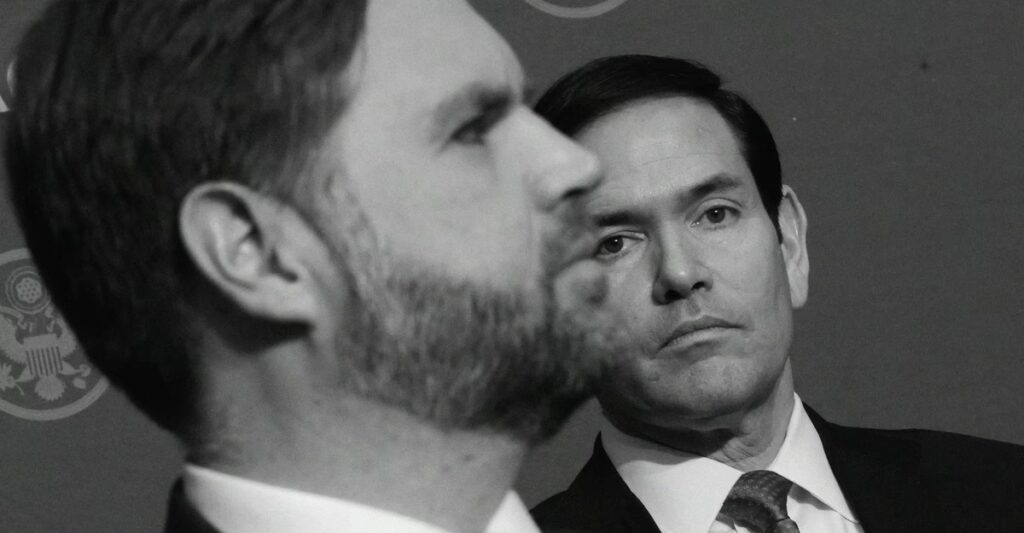
The result is that the U.S. is now negotiating over one country on two different tracks—led by two men with significantly different styles and worldviews. Rubio is more of a globalist and more conventional in his approach, emphasizing government-to-government talks and diplomatic process. Vance, who privately voiced his concerns about conflict with Iran in the lead-up to the war, is pugnacious and transactional. The president’s top-two emissaries also happen to be the highest-profile potential candidates to succeed him.
Vance and Rubio’s delicate diplomatic dance aims to solve an issue that has bedeviled generations of American peace efforts. Already, there is some confusion. Although the two men are working in close coordination, they have offered seemingly contradictory visions of where Lebanon fits into the puzzle. Yet their joint efforts could determine not just what happens in Lebanon but also whether fighting between Hezbollah and Israel scuppers the whole Iran peace process.
U.S. officials initially resisted including the conflict in Lebanon on the list of issues to solve with Iran, the most prominent of which is preventing Tehran from developing a nuclear weapon. But they conceded to Iran’s demand to include Lebanon on the agenda in order to restart negotiations and to address Iran’s use of proxy groups to carry out attacks across the region. The first paragraph of the 14-paragraph memorandum of understanding that President Trump signed last week mentions Lebanon three times, including: “The final deal will confirm the permanent termination of the war on all fronts, including in Lebanon.”
Vance is leading the negotiations with Iran, which include persuading the Islamic Republic to pull back its support for Hezbollah in return for financial relief. Neither Israel nor Lebanon is party to those talks. Rubio’s separate negotiations are designed to empower the beleaguered Lebanese government and provide Israel with enough assurance to withdraw.
Rubio’s efforts have yielded some progress. Top diplomats from Israel and Lebanon signed a framework agreement at the State Department yesterday after four days of talks, with Rubio looking on. A statement from the State Department described a “clear and structured process” to empower Lebanon’s government and disarm Hezbollah. The framework includes $100 million in humanitarian assistance in coordination with the United Nations, plus additional aid to Lebanon’s Armed Forces. “We don’t in any way underestimate the difficulty of the task ahead,” Rubio said.
Vance, meanwhile, has taken a more transactional approach in a bid to secure an end to a war that Trump is desperate to put behind him, according to people familiar with the president’s thinking. Vance also appears willing to muscle Israel into accepting whatever outcome the Iran talks deliver. He has been blunt that he expects the Israeli government to fall in line and stop criticizing U.S. efforts.
“Donald J. Trump is the only head of state in the entire world who is sympathetic to the nation of Israel at this moment in time,” Vance told reporters at a recent White House briefing. “If I was in the cabinet of the Israeli government, I might not be attacking the only powerful ally that I have anywhere left in the entire world.”
Any number of variables could sink their combined efforts. Israeli forces continue to clash with Hezbollah on the territory that Israel has seized. What if Israel, citing the need for its own self-defense, keeps launching strikes within Lebanon, or refuses to rescind its control of nearly one-fifth of Lebanon’s territory? (Prime Minister Benjamin Netanyahu said last week that troops would remain in Southern Lebanon for “as long as Israel’s security needs require it.”) What if Hezbollah attacks Israeli territory while Iran and the U.S. are still negotiating? What if Israel resumes attacks on Iran? What if Iran attacks Israel?
The Trump administration believes that its military and economic confrontation with Iran means that the conditions are ripe for the lasting peace that has eluded previous generations. And White House officials say that there is no daylight between what Vance and Rubio are each seeking to achieve. “There is one camp—President Trump’s camp—and the entire administration is fully behind the President’s efforts to ensure Iran can never possess a nuclear weapon,” the White House spokesperson Anna Kelly told me in a statement.
But history offers a warning. After Israel invaded Lebanon in 1982, then–Secretary of State George Shultz led a grueling diplomatic effort to broker peace between the two countries. The agreement, signed the following year, ended the war and was hailed as a diplomatic triumph. But it collapsed within a year amid fierce backlash in the region. Lebanon slid further into chaos, with Iran-backed proxies targeting U.S. forces. In October 1983, a suicide bomber killed 241 American service members in Beirut.
“Don’t underestimate the complexity of Lebanon and how it can burn different parties if they don’t respect all of these underlying dynamics and tensions that are at play,” Mona Yacoubian, the director of the Middle East Program at the Center for Strategic and International Studies, in Washington, D.C., told me. “It’s like a Rubik’s Cube: How do you align all of these factors?”
Israel and Lebanon have sat for negotiations four times since Israel’s founding, in 1948, and three of those talks, including the current ones, were brokered by the United States. The two sides agreed to a cease-fire at the end of 2024, in the waning days of the Biden administration, but hostilities simmered. In the months before the U.S. and Israel launched the war on Iran in late February, Hezbollah continued to launch drones and missiles against civilian targets in Israel, and Israeli air strikes on Lebanon surged in response, according to the Norwegian Refugee Council.
In early March, after the assassination of Iranian Supreme Leader Ali Khamenei, Tehran vowed retaliation and instructed members of its so-called Axis of Resistance—regional militant groups supported by Iran—to prepare for escalation. Hezbollah was the first to act, launching fresh attacks on Israel. Lebanese President Joseph Aoun accused Hezbollah of giving Israel “an excuse” to attack Lebanon. Israel invaded Southern Lebanon in March, an operation that has killed at least 3,500 people and displaced more than 1 million, according to the United Nations.
Read: [The Pentagon might win the lottery]
The flare-up quickly transformed Lebanon from a peripheral concern into a central question hanging over the Iran war and the nascent peace talks. Iranian officials argued that regional stability—including guarantees related to Lebanon—could not be separated from any lasting agreement with Washington and must be included in their negotiations.
Lebanon’s government has long been weakened by political divisions, economic collapse, and discredited state institutions. Hezbollah maintains its own paramilitary force and exercises significant political influence, giving it authority that the Lebanese government has struggled to dismantle on its own.
For weeks, Vance and Rubio maintained that Lebanon was a separate issue from the Iran negotiations. In April, Vance argued that Iran would be “dumb” to “let this negotiation fall apart, in a conflict where they were getting hammered, over Lebanon, which has nothing to do with them.” He also acknowledged that Israel had offered to “check themselves a little bit in Lebanon” to keep talks alive.
Vance’s remarks at the time were in response to Iran’s effort to rewrite the deal and incorporate a term into the emerging cease-fire agreement that hadn’t been previously agreed to.
Then, early this month, Iran attacked Israel, saying that Israel had violated the April cease-fire by attacking Lebanon. The episode was a turning point for U.S. negotiators, including Vance. They concluded that no deal with Iran would be likely if the fighting between Israel and Hezbollah wasn’t addressed, even if that meant importing the long-standing conflict into a short-term agreement that was principally designed to open the Strait of Hormuz and set the terms for talks over Iran’s nuclear program.
“The hope will be that, through these discussions, we’re able to help create a new angle in the direct Israel-Lebanon discussions that maybe provide a framework in order to help bring that situation to a better place,” a senior U.S. official told reporters in a call last week announcing the 14-point MOU. The official did not sound particularly hopeful. “So we’ll see,” he added. “Look, this is primarily about Iran’s nuclear, but one of the things we’ll discuss after nuclear is going to be regional stability.” Whereas Lebanon is repeatedly mentioned in the MOU, Israel is not named once.
Rubio, meanwhile, has been arguing that the question of Israel’s relationship with Lebanon needs to be handled separately because “Lebanon is a sovereign country,” he told reporters in Abu Dhabi on Tuesday, and any diplomatic engagement must be conducted with the Lebanese government.
Rubio has framed Iran’s role in supporting Hezbollah as an external issue rather than a core component of the negotiations he is overseeing. Negotiating with Iran at the table, in his view, risks strengthening Iran’s role in Lebanon and weakening Lebanon’s own government.
Regional officials and analysts I spoke with agree. They note that a broader U.S.-Iran agreement that delivers a cease-fire and requires Iran to rein in its proxies, including Hezbollah, actually gives Iran leverage by linking it, for better or worse, to the fate of Lebanon. Iran has an interest in preserving its foothold at Israel’s doorstep but can proffer its influence over Hezbollah as a bargaining chip, knowing that the U.S. will have to sell any final deal to both the Israeli and Lebanese governments.
Yacoubian believes that Rubio’s approach is necessary for any of this to work. “If this is done right, it could actually be a way to minimize Iran’s long-term influence in Lebanon by minimizing the role of Hezbollah” while strengthening the government in Beirut, she said.
But by excluding the Lebanese government from the U.S.-Iran talks, which Vance is overseeing, “you further weaken the Lebanese government, and you play into Iran’s approach, which is to essentially go over the heads of the Lebanese government and work directly with its proxy,” Yacoubian noted.
Vance and Rubio have taken steps to minimize mixing the messages, with Rubio publicly dismissing any suggestion that there is a contradiction in their efforts. They held a joint call this week with the Lebanese president, updating him on the status of the U.S.-Iran negotiations and on the potential for a joint “monitoring mechanism” to implement a recent, shaky cease-fire that aims to halt hostilities in Lebanon. (The State Department spokesperson Tommy Pigot said that depictions of the two men being on different pages is a “fake narrative.”)
Trump, meanwhile, has threatened to go back to bombing Iran if he doesn’t like what he sees. “Iran must immediately stop their highly paid PROXIES in Lebanon from causing trouble,” he said on social media earlier this month. “If they don’t, we’ll hit Iran very hard again, just like we did last week, only harder!!!”
Given how often Trump has threatened to resume the war without following through, and given his determination to move on, that prospect alone appears unlikely to intimidate Tehran.
Untangling what the U.S. and Iran are looking to accomplish has become more difficult as the list of grievances on the table stretches far beyond the nuclear issue. The terms of the MOU were put under even greater strain yesterday with Iran’s drone attack on ships in the Strait of Hormuz. Trump called the attack a “foolish violation” of the cease-fire, and U.S. forces launched strikes yesterday evening on Iranian military sites.
All of that complexity makes Trump’s stated goal of securing a nuclear agreement with Iran that he regards as stronger than the Barack Obama–era nuclear deal substantially harder to achieve.
Read: [The Meltdown]
The negotiations that produced the highly technical 2015 Joint Comprehensive Plan of Action took years to finalize, and Tehran faced not only the United States but also Britain, France, Germany, Russia, China, and the European Union across the table. The deal focused overwhelmingly on constraining Iran’s nuclear program in exchange for gradual sanctions relief.
Trump ripped up that deal in 2018 and has been obsessed with besting it with his own. But Vance and Rubio’s diplomacy is taking place under very different circumstances. Iran has been emboldened by its ability to survive weeks of fierce U.S. and Israeli bombings. And Washington is negotiating largely on its own, with a much wider set of problems to address.
The lesson from the Obama years was that even narrowly focused talks over Iran’s nuclear program are a grueling exercise. The lesson of decades of past efforts is that no Middle East conflict exists in a vacuum. The next few weeks will signal whether Vance and Rubio can defy the odds.
The post Vance vs. Rubio: Iran Edition appeared first on The Atlantic.