If there’s one message that Robert F. Kennedy Jr.’s campaign to redefine healthy eating has imparted, it’s that Americans need to eat their beef. In January, the health secretary rolled out the new food pyramid—with a marbled rib eye in the pole position. Weeks later, Kennedy modeled good beef-eating behavior, posing for a pic on his 72nd birthday while tucking in to a bone-in steak decked out with candles. In February, he dropped by the trade show CattleCon and begged the assembled ranchers to increase the size of their herds. “I eat beef every day, twice a day,” Kennedy boasted to the hooting crowd.
The secretary’s beef-intensive diet, which is shared by other members of the Cabinet, including Vice President Vance, is informed by the idea that people should be eating as our prehistoric ancestors did. When the Department of Health and Human Services put out its update to the food pyramid, it also published a 90-page document laying out the “scientific foundation” for the new advice. The report cited several papers on the benefits of the Paleo diet. One specifically endorses eating wild game, and argues that every person should strive to change their diet to “become a 21st-century hunter-gatherer.”
This mode of thinking can be traced back to at least the 19th century, but its current incarnation—the version that has wormed its way inside the U.S. government—dates to the 1970s, when the growing plague of heart disease and obesity was starting to receive sustained attention on Capitol Hill. That’s also when a Seattle gastroenterologist named Walter Voegtlin published a pale volume with a drawing of a loincloth-wearing hominid on the cover. His book was called The Stone Age Diet, and on the title page was a modest proclamation: “It’s Safe, It’s Sane, It’s Simple, and It Really Works!”
Voegtlin’s approach to nutrition may not have been any of those things, but it set the model for the glut of Paleo-diet books that were to come. The book laid out its author’s odd ideas and strong opinions, such as his profound loathing of “baleful salads” and especially the garlicky Caesar, which he regarded as a “gastric atrocity.” Beef, on the other hand, is an excellent source of protein, Voegtlin said. He noted that the man who eats a roast-beef sandwich gets all the amino acids he needs while the peanut-butter-sandwich eater does not. But Voegtlin wasn’t wedded to any single flavor of carnivory. In fact, he had some beef misgivings. Eating cows might not be sustainable, he argued, in a world teeming with billions of slavering Homo sapiens.
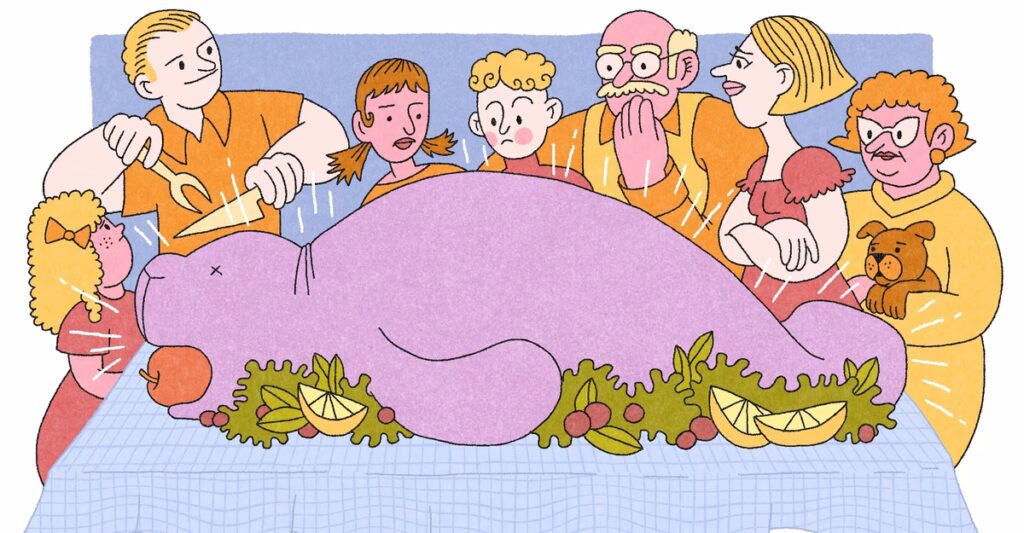
Perhaps another beast could be used for making hamburgers instead. Voegtlin had a notion: Instead of land cows, we should eat sea cows, or manatees. And he was not the first American scientist—and far from the most famous one—to hit on this very notion. In fact, schemes to radically expand the nation’s deli counter have been a strange motif in U.S. history.
Voegtlin’s book laid out the premise for the modern Paleo diet. According to its basic theory, Homo sapiens as a species moved so rapidly from hunting and gathering to buying food at supermarkets that our genes never caught up. We’re Stone Agers on the inside, built to eat whatever could be plucked from the bushes or clubbed to death on the savanna, but now we’re marooned in a sickening landscape of nachos and pizza. The goal, for Voegtlin and the people he inspired, was to get back to eating whatever it was that our primitive ancestors ate. The challenge was to figure out what exactly appeared on the caveman food pyramid.
Given the patchy nature of Paleolithic evidence, this matter has provoked many disagreements, which began long before the publication of The Stone Age Diet. In his 1913 book, My Life With the Eskimo, Vilhjalmur Stefansson, an Arctic explorer and anthropologist, described how he believed an Inuit community he’d met in Canada’s far North provided a window into the lifestyles and dietary habits of our Stone Age ancestors. Stefansson’s polar adventures made him famous, especially for the all-meat diet he ate while camping in an igloo: seal flipper and whale tongue; raw and boiled caribou; grizzly-bear jerky and polar-bear steaks; blood soup and tallow-dipped ptarmigan feathers; and, on one desperate occasion, his own bootlaces.
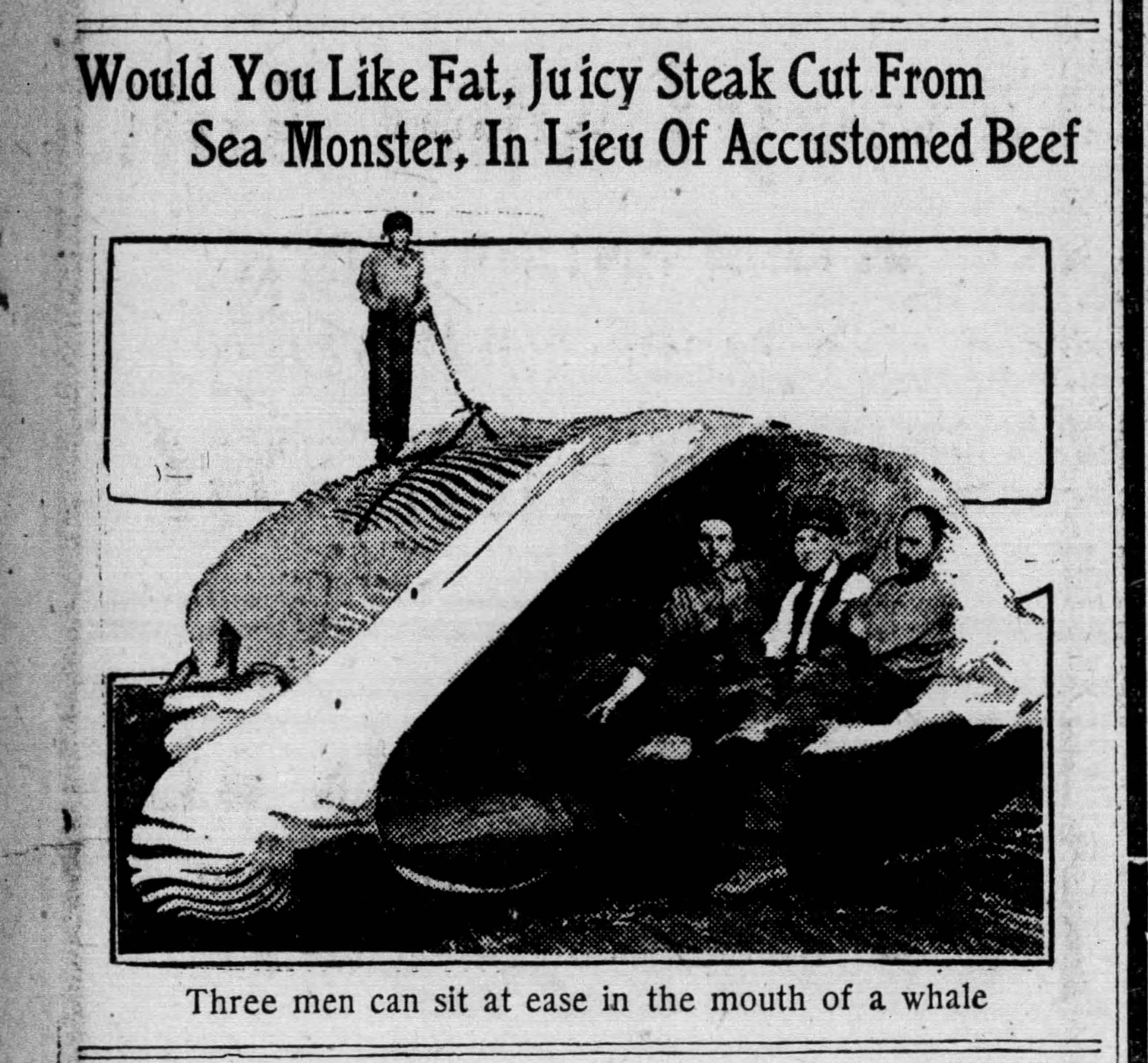
Tales of Stefansson’s gastronomical feats circulated at a moment when Americans were also exploring new kinds of food. The First World War brought meat shortages and a national austerity campaign, launched in 1917, that encouraged “Meatless Tuesdays” and “Porkless Thursdays.” For years, naturalists with the American Museum of Natural History, which funded some of Stefansson’s expeditions, had been arguing that Americans should really eat more whale. During the war, the U.S. government got on board, promoting the consumption of fresh and canned leviathan and explaining that because these sea monsters were mammals, their flesh tasted like beef or venison, not fish. The feds published a bulletin with 32 cetacean recipes, including “Stuffed Roast Whale,” “Whale Croquettes,” and “Corned Porpoise.” And the museum hosted a widely publicized “whale steak luncheon,” which more than one newspaperman described as sweet revenge for poor Jonah.
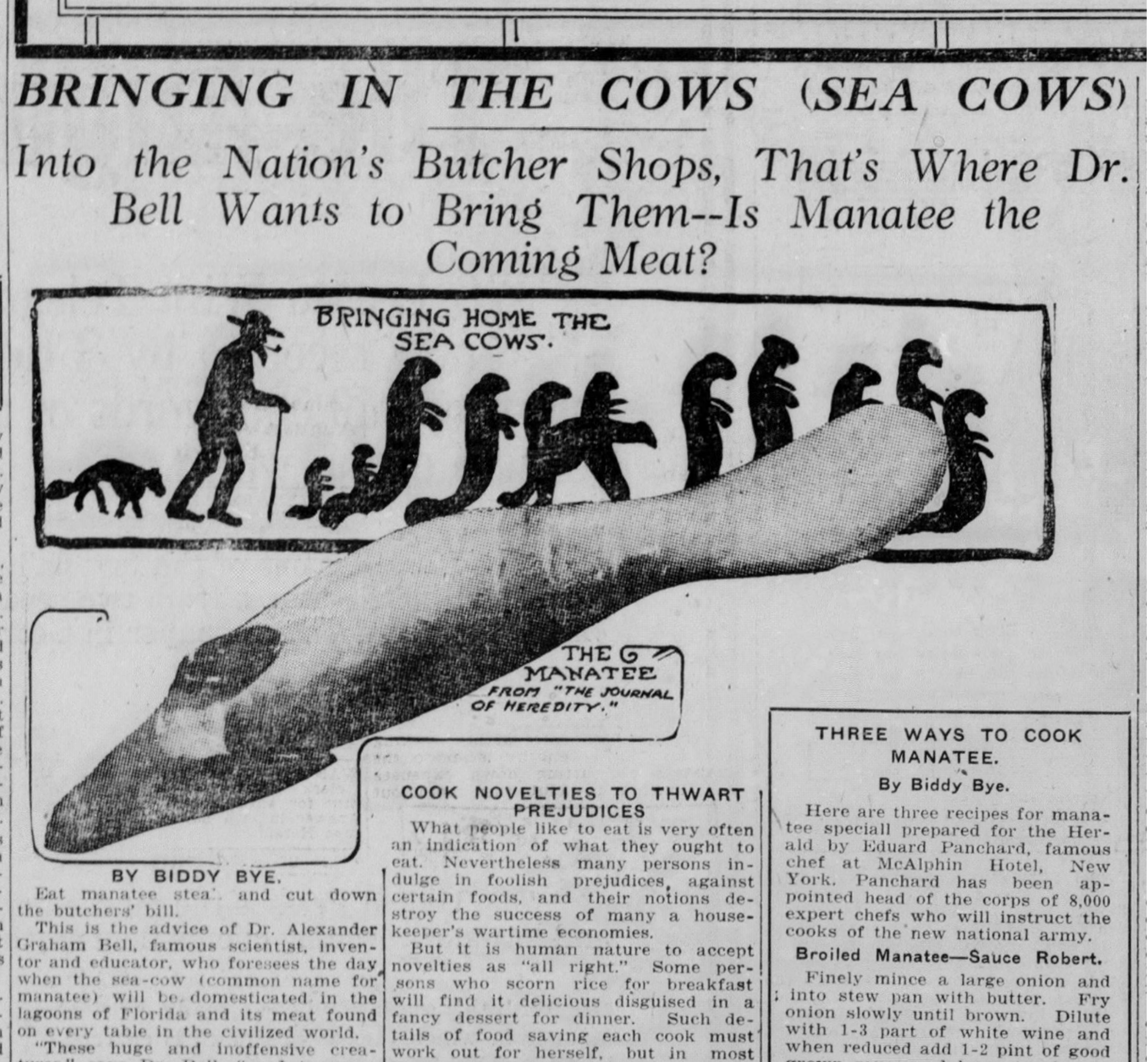
Meanwhile, Alexander Graham Bell, the renowned inventor and a co-founder of the American Telephone and Telegraph Company, was out with a related plan for solving America’s meat crisis. In a statement published in the Journal of Heredity, Bell suggested that the government should look into the possibility of domesticating manatees. Although Florida lawmakers had recently criminalized the killing of these charismatic animals, which one 1891 children’s-book author had called “as amiable, mild, gentle, playful, kindly a creature as ever drew breath,” Bell noted that the sea cow offered “many points of superiority” over even such a promising candidate for husbandry as the pygmy hippopotamus, which the journal had previously considered. “Dr. Bell wants to see the south dotted with manatee ranches,” The Augusta Herald reported in an article about the idea that included recipes for broiled, stewed, and curried manatee, and explained that the sea cow’s tail was usually pickled and served cold.
This was not a bonkers notion. Manatees had been a coveted food source for the Seminole peoples and for southern Americans extending into even the 20th century. “The fattest, juiciest Tennessee beef is by no means equal to it and I doubt if there is anything in the animal kingdom that is so utterly delicious,” one manatee enthusiast wrote in 1885. Bell’s scheme, presented in a journal devoted to eugenics and geared toward optimizing dietary protein, would later resurface at another moment of food anxiety, when Walter Voegtlin was inventing the Paleo diet in the 1970s.
After training as a doctor and specializing in gastroenterology, Voegtlin had devoted most of his career to trying to find a cure for alcoholism. But on the side he was a nutritional contrarian, arguing in talks that human digestion is better suited to a diet rich in fat and protein than one based on carbohydrates. To prove this point, he cited Stefansson’s tales of Stone Age eating and his own early lab research on dogs.
Voegtlin’s anti-starch opinions spread, at first, on the basis of these lectures. By the 1950s, they were being touted in Prevention, a magazine known for its back-to-nature ethos and openness to vaccine-skeptical views. The Stone Age Diet, his first and only published work on caveman nutrition, did not come out until 1975, just months before his death. Voegtlin saw Mother Nature’s food chain in simple terms: Herbivores eat plants, and carnivores eat herbivores. Humans are in the latter group, with digestive tracts that are “practically identical” to those of dogs, he said. (Voegtlin conceded that omnivores exist, but he argued they are merely “transitional forms.”) But if man is a “pure carnivore,” as Voegtlin claimed, he is flexible as to what kinds of meat ought to go in the tank. Bugs, snails, worms, snakes, leeches, monkeys, lizards, the stomach contents of sharks: All are regarded as delicacies by some human societies, according to the book.
Indeed, for Voegtlin, the future of the species might depend on man’s willingness to broaden his horizons with respect to meat. Writing at a time when concerns about the impending human “population bomb” were widespread, Voegtlin thought the world was not harvesting enough protein to fend off malnutrition. He argued that people might need to start eating up the world’s predators, because they competed with humans for flesh. “There are four thousand tigers left in India and each tiger eats six thousand pounds of meat each year,” Voegtlin noted with alarm. Alligators, crocodiles, lions, tigers, and bears might have to become supper. Ocean predators such as the seal, whale, dolphin, and walrus would be hunted down and made into supermarket steaks. And in the brutal, man-eat-dog world of the book’s imagination, human populations, too, would need to be controlled: Voegtlin proposed that reproduction should be limited to “superior types of individuals” under the watch of an “omnipotent Bureau of World Census.”
As for nature’s mermaid—the gentle, seagrass-chewing sea cow—she might carry on her lineage in water farms, domesticated as a novel form of floating livestock. “This marine mammal, as does its dry land counterpart, eats only vegetation, totally unfit for human consumption,” Voegtlin noted. Sea cows are superior to land cows, Voegtlin suggested, because land cows eat grains, which humans could survive on in a pinch. Since manatees live on baleful sea-salads and don’t deplete the world’s meat supply, they could live alongside humans in peace—until such time as they were ground into meatballs.
Voegtlin’s book did not initially garner much attention. One of its few reviews, in the journal Medical History, described it as full of “opinions that oppose accepted belief and substantiated fact.” Academics who promoted Paleolithic nutrition in the 1980s called for plenty of plant foods in the diet and ignored Voegtlin, perhaps on account of his endorsement of eugenics. But by the time the Paleo world was coalescing online in the ’90s, Voegtlin’s book was cited as a pioneering work. Its message would be channeled through the 2010s as the Paleo lifestyle became associated with zealous meat-eating and an emerging band of popular “meatfluencers.”
But as it turned out, the archaeology would prove Voegtlin wrong: It wasn’t true that Stone Age humans never touched a processed grain. Starch residue found on 30,000-year-old grinding stones indicates that Paleolithic peoples may have eaten bread. Ancient bits of DNA suggest that genes for starch-digesting enzymes might have been proliferating as early as 800,000 years ago, when cave-chefs started roasting primordial potatoes. Marlene Zuk, an evolutionary biologist and the author of a 2013 book that debunked some of Voegtlin’s arguments, recalled how the Paleo community dealt with this evidence that challenged their largely carb-avoidant worldview. “They liked the word tuber,” Zuk told me. “The word tuber was very popular because it sounded more caveman-y.”
[Read: How close are manatees to extinction?]
Even for its time, The Stone Age Diet missed the mark with its sharp dichotomy between herbivores and carnivores (and its bizarre denial of omnivores). These distinctions can be fuzzy: Crocodilians, for example, may eat kumquats and pond apples in the wild, while cows and sheep will snack on baby birds. Even the kindly Florida manatee, connoisseur of bayou seagrass, sometimes flies into a carnivorous rage, snapping up fish and gnashing them in its terrible teeth.
Yet no branch of science has debunked the idea that humans are neglecting lots of opportunities for ingesting animals. Indeed, the notion that we should be eating strange meats has been backed by a range of influential authorities. Voegtlin got his vision of sea-cow cuisine not directly from Bell but from Scientific American, which had proposed that we domesticate not just the manatee but also the “palatable” capybara, and from The Journal of the American Medical Association, which lent its weight to the idea of building enormous blue-whale farms in the Pacific Ocean, fenced in by coral reefs. More recently, advocates of livestock alternatives have zeroed in on smaller animals: In 2013, the United Nations released a report on global food security that argued for the mass cultivation of edible insects. The report noted that various groups have made a habit of consuming beetles, caterpillars, wasps, mealworms, and dragonflies.
I’m not here to suggest that the logic of evidence-based nutrition demands that we consume more manatee meatloaf or chili con capybara or dragonfly dumplings. But there’s something ho-hum about the fact that a norm-breaking MAHA administration, led by a carnivorous health secretary who has boasted that he’s a “very adventurous eater” and will “eat virtually anything,” has stuck so monotonously to beef. It’s not as if beef has been shown to be healthier than any other meat. Examined through a political lens, though, Kennedy’s bovine-forward dietary approach makes perfect sense, Amy Bentley, a food historian, told me. The burger is the quintessential American meal, and beef-related imagery calls to mind the virile cowboys who drove cattle and made America great by filling its larders with sirloin. There’s a resonance between this sentimentality for the Old West and the Paleo-nostalgia that animates the carnivore community, she said, in that both are romantic fantasies about a time when men were unapologetic warriors. “When gender roles are being questioned, there’s often renewed interest in the vitality-giving properties of animal flesh,” Adrienne Bitar, a food scholar who has written about Voegtlin, told me.
Proposals to put manatees or mealworms on the food pyramid would face challenges. On the left, a plan to farm sea cows would enrage conservationists, even though Trichechus manatus has in recent years been downgraded from “endangered” to “threatened.” On the right, the UN’s edible-insect report sparked an “I will not eat the bugs” campaign from skeptics of climate-driven policies. Perhaps that’s why, for all of the MAHA bluster about remaking the American diet, the architects of our new dietary guidelines have turned out to be picky eaters when it comes to meat. We’re all a bit afraid to try new things. That tendency, which may have been with us since the Stone Age, today serves the interests of our cumbersome friends in the Florida Everglades. For now, at least, pickled manatee tail is off the table.
The post The Original ‘Meatfluencers’ Had Some Strange Ideas appeared first on The Atlantic.