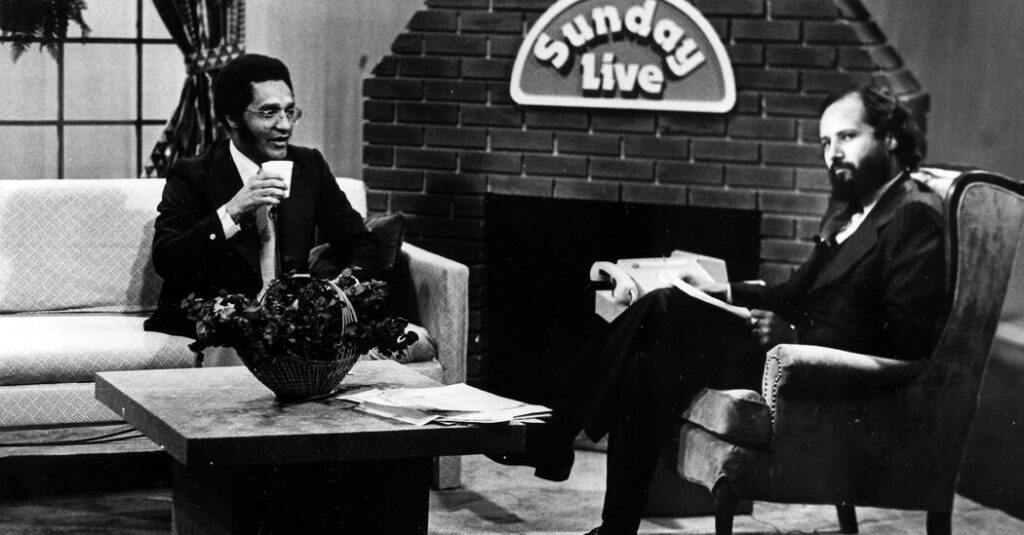
Tony Brown, the pioneering host and producer of “Tony Brown’s Journal,” a long-running public affairs television show aimed at Black audiences that was notable for its candid and often contentious discussions about race and other politically charged issues, died on June 17 at his home in Newport News, Va. He was 93.
Mr. Brown’s death, from coronary heart disease, was announced on Friday on his Facebook page.
By the time his PBS show went off the air in 2008, Mr. Brown estimated that, over the course of nearly four decades, he had interviewed more than 1,000 guests, including Lena Horne, Jesse Jackson, Angela Davis, Bill Cosby and Sammy Davis Jr.
While he had no favorites, he said, he singled out an exchange with Ms. Horne that not only captured the frankness that his program encouraged, but also hinted at his broadcasting mission. He recalled asking the well-known singer why she had married a white man — the composer and conductor Lennie Hayton — and her reply: “I was not woman enough at that time to marry a Black man. As a woman, I should have been looking at myself first.”
An intense and impeccably dressed former social worker with hardscrabble West Virginia roots who was blessed with a silken baritone, Mr. Brown acknowledged that he made programming decisions “on the basis of one thing — will it help Black people?”
He told the Congressional Black Caucus at a hearing in 1972 that the exclusion of Black people from executive jobs in the media had led to a “totally brainwashed” Black population “drilled to think like whites,” resulting in a “general disrespect and misunderstanding by whites about Blacks, and Blacks about themselves.”
To remedy the situation, he urged that public broadcasting stations assemble staffs that resembled the ethnic makeup of their audiences.
Two years earlier, after a brief stint at Detroit’s public television station, WTVS, Mr. Brown had moved to New York City to become the executive producer and host of an award-winning monthly public TV show called “Black Journal.” Mr. Brown’s bluntness and flair for broadcasting enhanced the ratings, and soon it had a weekly slot on the schedule.
An interview with Mr. Davis offered an example of the uncommon insights that viewers came to expect. The entertainer, known for his chumminess with white celebrities like Frank Sinatra and other members of the Rat Pack, shared stories of the racism he had experienced in the Army and on the road, where hotels refused to put him up for the night. He also expressed regret for working so hard at “emulating white stars.”
By 1995, five million viewers were tuning in each week to the program, which had been renamed after its host.
Mr. Brown’s provocative show was not universally well received. A 1971 episode on the prison experiences of Ms. Davis and the Soledad Brothers, three Black inmates of a facility in Soledad, Calif., who were accused of killing a guard, was criticized by the New York Times television critic John J. O’Connor, who cited a failure to present counterpoints from white officials or prison guards and an assumption that all Black inmates were political prisoners.
Mr. O’Connor also criticized an episode on the roots of white racism in Christianity, in which one speaker contended that Jesus was Black and another claimed that there were no white Madonnas in European churches until the 16th or 17th centuries.
Mr. Brown countered that his intention was to show positive images of Black people rather than images that fed into white stereotypes of the Black community.
When the public television station WNET planned to air a Swedish documentary that portrayed a Harlem overpopulated with prostitutes, drug peddlers and street hustlers, Mr. Brown organized civic groups and Black station employees in protest, arguing that “a bigoted sector of white America will have its prejudices frozen in place and reinforced.” The documentary was pulled from the schedule.
Another Times television critic, Jack Gould, suggested that the show’s value lay in educating whites about the Black perspective, and Mr. Brown responded angrily. “Racism is a big, powerful white-establishment newspaper setting up a white television God system interpreting to Black people what they have seen on a program produced for Blacks by Blacks and about Blacks,” he wrote in a letter published in The Times in 1970.
Over time, Mr. Brown and his program mellowed, and many years later, Mr. O’Connor admonished him again — but this time from the opposite standpoint, saying that Mr. Brown’s show had shifted from being “militant and abrasive” to being a Black version of the “The Tonight Show Starring Johnny Carson,” complete with segments on fashion by Black designers.
By 1982, Mr. Brown was giving President Ronald Reagan a platform to trumpet the number of Black men and women in his administration.
In a newspaper interview the same year, Mr. Brown seemed pleased that the program had three white viewers for every Black viewer. And by 1991, he revealed that he had joined the Republican Party because he supported its “basic concept of market economy and self-help,” while Democrats had a “philosophy of dependence on government.”
“A mentality of affirmative action and civil rights is not going to get you anywhere in the 21st century,” he told Michel Marriott of The Times in 1995. “If you only believe that you’re going to be a leader in the world if white people are going to have a preference program for you, brother, you just get out your cotton-picking clothes, because that’s what you’re going to be doing.”
In line with his advocacy of self-reliant Black capitalism, he set up a council in 1985 that encouraged African Americans to patronize merchants of their own race.
Eventually, he began publishing self-help books — among them, “Empower the People: A Seven-Step Plan to Overthrow the Conspiracy That Is Stealing Your Money and Freedom” (1998) and “What Mama Taught Me: The Seven Core Values of Life” (2003).
He also praised his employer, Channel 13, in a video posted on the station’s website, for enabling “remarkable progress” for Black, Latino and Asian members of staff. Recalling the monochromatic makeup of television when he began his career, he said: “I never dreamed I’d work in television.”
William Anthony Brown was born in Charleston, W.Va., on April 11, 1933, the youngest of five children of Royal and Katherine Brown. His father left before he was born, he told The Times in 1995, and from the age of 2 months, he was raised by Elizabeth Sanford and her daughter, Mabel Holmes, two women who weren’t relatives but were concerned about his welfare. (He referred to them as “angels” in the dedication to his 1995 book, “Black Lies, White Lies: The Truth According to Tony Brown.”) By the time he was 12, they had died and he was once again living with his mother.
A complete list of Mr. Brown’s survivors was not immediately available.
In school, he excelled in English and drama, and struggled to overcome his shyness by reading the works of Shakespeare on a local radio broadcast. He enlisted in the Army in 1953 and then studied at Wayne State University in Detroit, receiving a bachelor’s degree in sociology in 1959 and later a master’s degree in psychiatric social work.
In June 1963, Mr. Brown helped organize a march in Detroit led by the Rev. Dr. Martin Luther King Jr. that some regarded as a dress rehearsal for the March on Washington two months later. The same year, he began working for The Detroit Courier, a predominantly Black newspaper, eventually serving as its drama critic and city editor.
In 1968, he moved to Detroit’s public television station, where he worked as a programmer and produced the station’s first show for African Americans, “Colored People’s Time.” When William Greaves, a host and executive producer of “Black Journal,” left in 1970 to make films, Mr. Brown was brought in to replace him. At the time, there were only a few nationally broadcast shows aimed at Black audiences.
When the show was renamed “Tony Brown’s Journal” in 1977, Mr. Brown made a deal with PepsiCo to sponsor it, and it was syndicated on commercial television for some 19 years, at one point appearing on 80 stations.
Mr. Brown served as the first dean of the Howard University School of Communications from 1971 to 1974, until holding both jobs proved onerous. For a while, he also wrote a weekly column syndicated in 130 newspapers and hosted a call-in radio show four times a week on WLIB-AM.
During his time as the host of “Tony Brown’s Journal,” he encouraged the development of Black production talent, he said, partly because he recognized the potency of the media in transforming the image — and self-images — of African Americans.
“Once we break the back of television as an insidious one-eyed monster that teaches us to hate ourselves,” he told The Times in 1970, “we will break the back of white racism.”
The post Tony Brown, Host of Public Affairs Show Aimed at Black Audiences, Dies at 93 appeared first on New York Times.