Survivors clawed through mountains of brick and concrete with their bare hands across Venezuela’s earthquake-shattered north on Friday, hushing each other to listen for whispers of life and praying to reach people still trapped under the ruins.
At a small hospital in La Guaira, the worst-hit state, Juan David Arsia, 17, said he had spent 21 hours under rubble. “I was there with my mom, and I could hear her screaming,” he said. “I would yell to her, ‘Don’t give up, mom, have faith — don’t give up.’”
Under the wreckage with a fractured leg, Mr. Arsia could hear other trapped people screaming, he said, until the sounds stopped in the middle of the night. Hours later, he heard people moving above the rubble and began shouting for help, leading his neighbors to pull him and his mother free.
Rescue teams from at least 10 countries were racing to help Venezuela in its search-and-recovery efforts after devastating twin earthquakes on Wednesday, but they faced stark hurdles even reaching the disaster zone. The 7.2- and 7.5-magnitude quakes damaged the international airport, split open roads and overwhelmed Venezuela’s hollowed-out emergency services.
The country’s infrastructure had already been weakened by corruption and a decade-long economic depression. With little heavy machinery to clear rubble and few medical supplies to help the wounded, many survivors found themselves on their own.
Many lacked even a safe place to rest, as hundreds of aftershocks rolled across the north, jolting the remnants of apartments, stores and offices. Faced with the choice of entering unstable buildings or sleeping in public plazas or by a highway, many residents stayed outside.
Arsenia Beatriz Mayora, 70, and 10 members of her family joined dozens of other families in seeking shelter on a baseball field in La Guaira, where there was little sign of government support when a New York Times photographer visited on Thursday afternoon. Most of the supplies at the location had been dropped off by residents on bikes and in trucks. Ms. Mayora said it would have been impossible to stay in her home.
“It was completely destroyed,” she said. “All that was left was the facade.”
Jorge Rodríguez, the leader of the Venezuelan National Assembly, said on Friday that the death toll had risen to 920, with more than 3,360 injured. At least 172 people are believed to still be trapped in the rubble, he said, and thousands have lost their homes.
Mr. Rodríguez, brother of President Delcy Rodríguez, added that more than 1,400 buildings had been damaged, including 13 hospitals and 25 shopping centers.
Ms. Rodríguez has announced that she would “militarize” La Guaira, north of the capital, Caracas. She did not say what that meant or explain whether soldiers would patrol the streets or enforce a curfew. But she said Venezuelan troops were in La Guaira to help, and that workers had cleared many roads there.
The first 24 to 48 hours after an earthquake are crucial for finding survivors, although it is possible for people to survive longer, said Dr. Jarone Lee, an associate professor at Harvard Medical School. Other experts said that there was a 72-hour “golden” window during which the most lives can be saved.
So far, rescue workers from Colombia, Ecuador, the Dominican Republic, El Salvador, Mexico, Spain, Switzerland and elsewhere, have landed in Venezuela, according to Pedro Infante, the first vice president of Venezuela’s National Assembly.
The Trump administration said it was also mobilizing support for a country over which it now exerts significant control, and a Venezuelan official said that more than 300 U.S. rescue workers were now in the country.
Less than six months ago, U.S. forces raided Caracas, captured Venezuela’s autocratic leader, Nicolás Maduro, and took him to New York to face drug-trafficking charges. Since then, the Trump administration has backed the interim government led by Ms. Rodríguez and has cleared the way for American energy companies to pump Venezuelan oil.
On Thursday, Maj. Gen. Kevin J. Jarrard of the U.S. Marine Corps landed in Caracas to coordinate the American military’s relief efforts, U.S. Southern Command said. The military said that it was deploying significant resources, including transport planes, Navy ships and helicopters, to help search-and-rescue teams and deliver aid.
The U.S. State Department said that it would provide $150 million to aid groups in Venezuela and the Treasury Department said it had temporarily lifted sanctions on Venezuela to help its government conduct financial transactions related to earthquake relief.
Facing criticism from residents that it was not doing enough to help, the Venezuelan government said it had dispatched more than 100 heavy machines to clear debris. Carlos Alvarado, Venezuela’s health minister, said the government had also mobilized more than 5,000 health workers.
But the scale of suffering and devastation in the country was stunning.
On Friday morning, families searching for relatives flooded a state morgue in Caracas, called Bello Monte. The atmosphere was one of shock. A few people were weeping, but most stood in silence, vacant stares on their pale faces. Loud sobbing occasionally erupted, as someone confirmed a death.
Stuart Pinto, 49, was waiting to receive the body of his son, Deyker Pinto, 34. His son’s mangled body had first been taken to Vargas Hospital — where Mr. Pinto was able to identify him — and then to the Bello Monte. Mr. Pinto said he had cried the day before, but now he was dry-eyed. He simply wanted to lay his son to rest in the cemetery so he could grieve, he said.
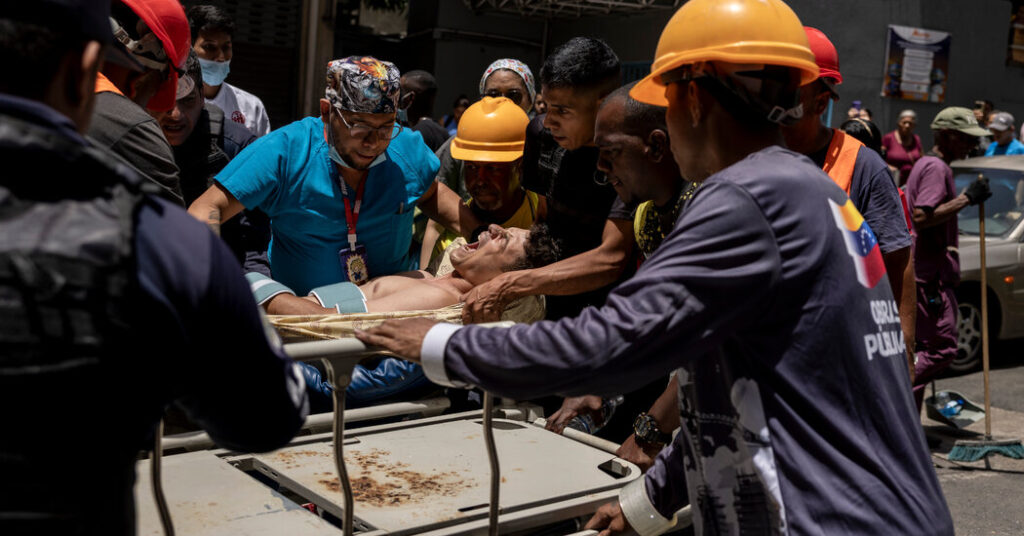
With few ambulances available, residents of Caracas were driving earthquake survivors to a hospital on Friday. As one car squealed to a stop, passengers poured out and started calling for help. A young man emerged, his face anguished, and he screamed in pain. From another car, a woman, looking lost, was guided inside by men in red helmets.
Two lists were taped to a wall outside the hospital. One, written in black, had the names of the injured. The other, in red, recorded the dead.
Reporting was contributed by Isayen Herrera, Max Bearak, Frances Robles, María Victoria Fermín, Alan Rappeport, Zane Irwin and Michael Levenson.
The post Rescue Teams and Residents Alike Race to Save Survivors of Venezuela’s Earthquakes appeared first on New York Times.