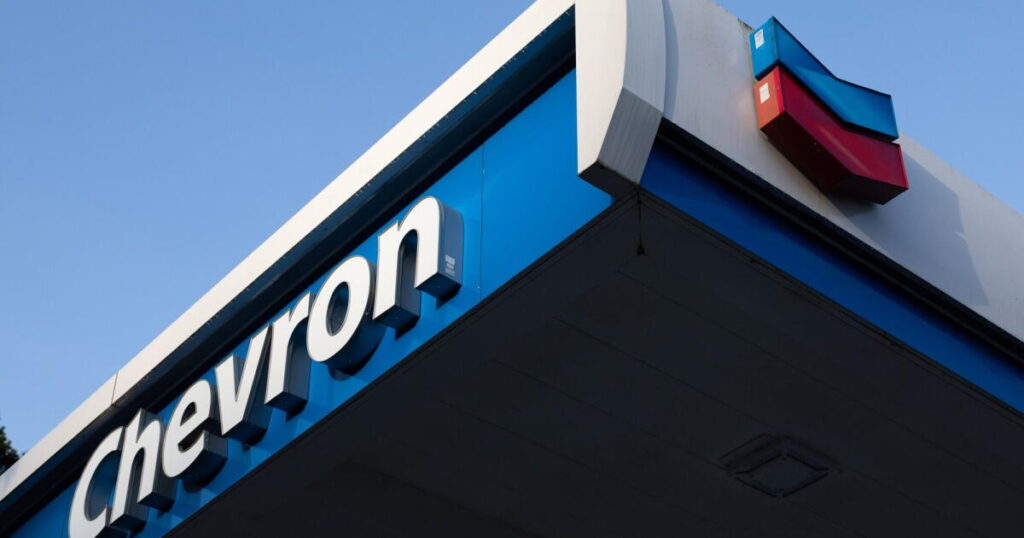
Chevron Corp. plans to invest $7 billion over the next five years through its joint venture partnerships to more than double crude production in Venezuela, the largest financial commitment so far in a U.S. government-led push to revive the Latin American country’s oil industry.
Houston-based Chevron won the right to develop two giant oil fields in the Carabobo area of the prolific Orinoco Belt, it said in a statement on Wednesday. The fields, Carabobo 1 and Carabobo-2-South-A, are located next to Chevron’s Petroindependencia joint venture, in which it has a 49% stake.
Bloomberg News reported Chevron’s move for the two fields earlier this week.
“We’re building a very formidable position in what we consider to be some of the best geology in the country,” Chief Executive Mike Wirth said in an interview. “This is multiple billions of barrels of resource in place.”
The deal represents the most significant capital investment by an oil major into the country since U.S. special forces captured its former leader Nicolás Maduro in January. Venezuela holds the world’s largest reserves, but its fossil fuel industry has been worn down by years of mismanagement, corruption and sanctions.
The U.S. government separately negotiated earlier this week for a 35% stake in North American Blue Energy Partners, a privately held company granted 100-year concessions in 17 Venezuelan oil fields.
Wirth declined to comment on the U.S. investment in NABEP, but said he appreciates the Trump administration’s commitment to “commercial solutions” that will benefit both countries. “The administration recognizes Venezuela’s energy resources can be an engine for both American energy security and Venezuelan economic recovery.”
He said Chevron has “significant protections” built into the deal to safeguard its investments, but declined to go into detail about the contracts. The company expects to add some of Venezuela’s reserves back onto its books after taking a write-off some years ago, he said.
Until now, smaller private companies have been leading the U.S. charge to negotiate oil deals in Venezuela. Progress has been slow, and they don’t have the same financial power as Chevron for the large-scale drilling and production equipment needed to ramp up output.
Chevron expects to be producing about 600,000 barrels of oil a day from Venezuela by 2031, more than double its current levels. The country’s deep resource potential will last for “decades,” and total costs are expected to be less than $20 a barrel, the company said in the release.
Brent crude traded for about $94 a barrel Wednesday, implying a significant profit margin. Chevron typically exports its Venezuelan crude to refineries on the U.S. Gulf Coast, which turn it into products such as gasoline, diesel and jet fuel.
Chevron’s additional 300,000 barrels a day over the next five years represents a nearly 30% uplift in Venezuelan production of about 1.1 million barrels a day. Even so, without further investment, the country would remain significantly below the nearly 3.5 million barrels a day it was producing in the late 1990s, before former President Hugo Chávez nationalized the industry.
Rivals ExxonMobil Holdings Corp. and ConocoPhillips quit the country in the mid-2000s after their assets were nationalized. But Chevron chose to stay, instead negotiating deals that allowed the company to keep pumping crude. It was an unusual arrangement that drew criticism in both the U.S. and Venezuela.
American critics accused the company of funneling money to a corrupt regime, while some in Venezuela saw it as an enduring symbol of U.S. imperialism. Chevron’s operations were limited for much of the past decade due to on-again, off-again U.S. sanctions. That mostly constrained it to maintaining equipment and reclaiming debt owed by its partner, state-owned Petróleos de Venezuela SA, known as PDVSA.
Chevron, for its part, said its presence helped stabilize Venezuela’s economy, providing dollars at a time of hyperinflation and economic disarray, while also supplying crude to the global oil market. It also left Chevron in the pole position when the Trump administration removed Maduro earlier this year.
The deal today benefits from the good condition of the company’s existing operations in the country, Wirth said. “That is due to the dedication and commitment of these good people that worked through years of uncertainty and anxiety.”
Crowley writes for Bloomberg.
The post Chevron’s $7-billion Venezuela gamble aims to double oil output appeared first on Los Angeles Times.