There was no chance Bookda Gheisar was going to miss Iran’s World Cup game against Egypt in Seattle. Born in Tehran, Ms. Gheisar, 60, lights up at the mention of Team Melli, as the Iranians are known, and she could not hide her enthusiasm for the chance to see the team play in her home city.
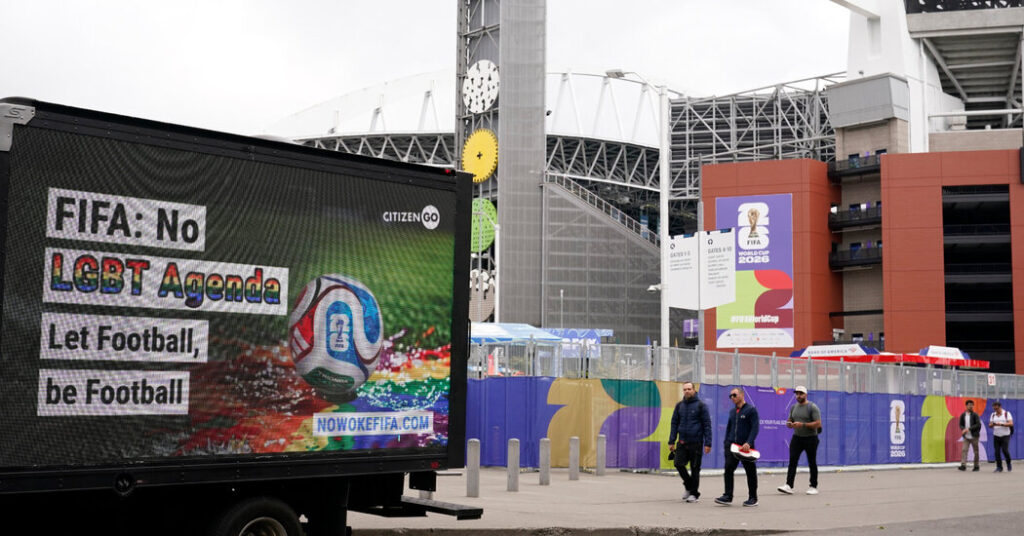
But Ms. Gheisar is gay, and she has not been able to avoid the more fraught topic of Iran’s and Egypt’s opposition to the game’s designation by the Seattle organizing committee as the “Pride Match,” a touchstone in the city’s celebration of Pride Month.
Homosexuality is illegal in both competing countries, and their soccer federations have for months been lobbying FIFA, soccer’s governing body and the World Cup organizer, to prevent any overt celebrations linked to Pride at the game.
FIFA has tried to delicately thread a needle between the desires of the teams and the local organizers. FIFA had no say in the game’s designation, the organization has said, and as far as it was concerned, the game would be just another World Cup contest. However, it noted that “general statements of human rights, including rainbow flags and other flags representing sexual orientation and gender identity, are permitted” inside all venues.
Ms. Gheisar, a senior director in the office of equity, diversity and inclusion for the Port of Seattle, said she understood the sensitivity of the situation but felt World Cup visitors should be expected to respect the culture of host countries and cities, just as the authorities and organizers requested during the 2022 tournament in Qatar, where homosexuality is outlawed and alcohol sales were banned.
“It is our tradition, it is our culture as gay people, to celebrate and be visible,” Ms. Gheisar said in an interview.
Iran’s federation has issued multiple statements about the Pride Match issue, including one day before the game. “Our position is that no ceremonies, or promotional activities associated with this movement, should be present inside the stadium or as part of the match environment,” it said in a statement to The New York Times, adding that its view “reflects the values and beliefs shared by the people of both countries.” Egypt has also complained to FIFA.
At a news conference before the match, Iran’s coach, Amir Ghalenoei, said that he did not want to discuss the matter. A team official at the conference shook his head several times when reporters brought up questions. Egyptian officials also said that they wanted to answer only questions about the game.
This is just the latest controversy for Iran at this World Cup. The team’s previous games have seen anti-government protests from their own fans around the stadiums, with more expected at the game in Seattle on Friday, which kicks off at 11 p.m. Eastern time. The team has also endured multiple obstacles as a result of its military conflict with the United States.
“I’m really sensitive to the difficult position that the players must be put in right now, and I think that if they personally want to not wear, for example, a Pride armband, that should be respected and understood because they have to go back and live in Iran,” said Ms. Gheisar, who also spoke at an event hosted by Pride Match organizers in Seattle on Thursday.
She came out in 1988, and said that she had long grappled with what it means to be Iranian, American and gay. Her struggles, she said, will be mirrored inside the stadium.
“There’s so much excitement about Pride, and so this has to coexist,” she said, adding that “my own struggles over the last 40 years, of identifying as a lesbian and also as an Iranian American, have been to bring these two realities together and to continue to identify as Iranian, but also as queer.”
Organizers have been in touch regularly with FIFA about their plans, and speaking to FIFA about the cultural and legal norms of Seattle, said Hedda McLendon, the senior vice president of legacy for the Seattle World Cup organizing committee. “I think the big place where we had to remind FIFA and clarify is that in Seattle, the stadium is a public building,” she said.
“Uniquely in Seattle and Washington State, sexual orientation and sexual diversity is a protected class here, which means that in a public building you cannot discriminate against protected classes,” she added. “So the rainbow flag is allowed, and frankly, not allowing the rainbow flag would be illegal in this state.”
The post ‘Pride Match’ Celebration Proves Awkward for Iran-Egypt Game in Seattle appeared first on New York Times.