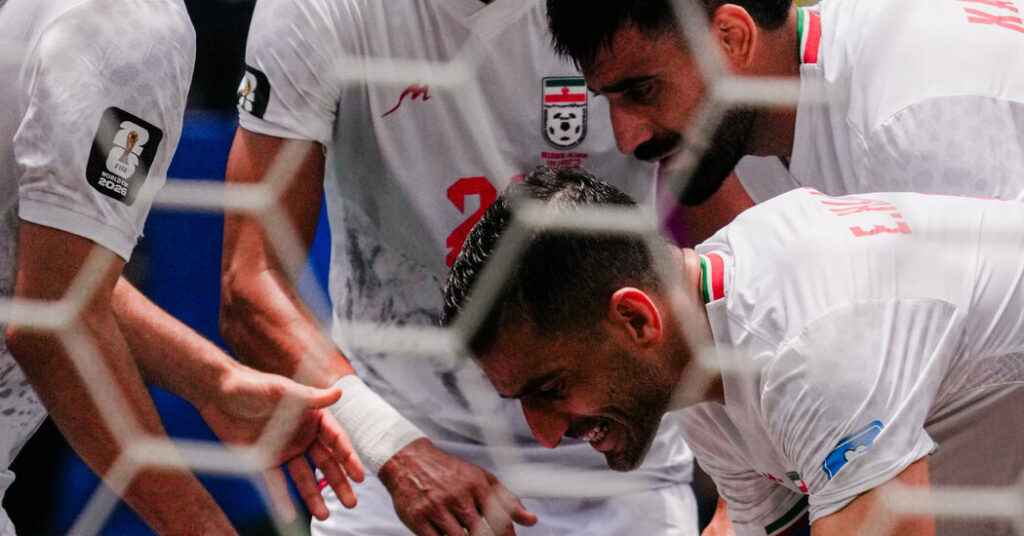
For Iran’s national soccer team, Saturday is a critical juncture in a long, winding and obstacle-laced journey the team has been on since the end of February and the start of the U.S.-Israeli war on their country.
Lose, and the team returns to Tehran, failing once more to make the knockout stages of the World Cup. Win, or even draw, and Team Melli will make history as the first Iranian squad to advance past the group stage.
The team’s tournament has unfolded against a backdrop of war rarely seen in the World Cup’s 96-year history. Iran’s participation was in doubt until the team touched down in North America, and should its against-the-odds run continue, it is certain to remain a focus of curiosity.
The team’s presence has drawn Iranians in their thousands to its games in ways that have confounded players and fans alike, as both have grappled with questions of identity, patriotism and the future of their country. Caught in the middle is a squad of 26 men playing in the defining event of their careers.
Inside and outside Iran’s first two games — both played at So-Fi Stadium near Los Angeles — the atmosphere has been unlike anything surrounding other teams. Anti-regime protesters, largely drawn from Los Angeles’s Iranian diaspora, set up staging areas where they bellowed chants against the regime and even the team.
The divisions were clear even among those wanting the same outcome: the fall of the Iranian government.
“I want them to lose,” said Sarah Jahansouz, speaking above protest songs blaring from loudspeakers before the first game. The team was “representing the Islamic republic, not the Iranian people” she said, and she would not be taking a seat inside the stadium.
Yards away, another protester, Shariyar Shoejahei, saw it differently. “Of course I support the team because that’s the Iranian team; that’s not the Islamic republic team,” he said before cheering Iran on against New Zealand.
That tension has defined Iran’s World Cup. Loud boos greeted the national anthem before quickly giving way to raucous, sustained cheering that propelled Iran to come from behind twice against New Zealand and then hold Belgium to one of the most celebrated results in the team’s history. Thousands of fans wore T-shirts and flags bearing symbols of pre-revolutionary Iran, even though they are forbidden inside World Cup stadiums.
“We play for all the Iranians in Iran, outside Iran, with whatever ideology, whatever preference they have,” the forward Alireza Jahanbakhsh said.
On Thursday, Iran expressed displeasure that its next game was marketed as a “Pride Match” by local Seattle organizers and that fans would be bringing rainbow flags to the stadium.
Political divisions among the fan base are just one burden Iran’s players and staff have carried. Of more direct concern have been the conditions imposed because of the war. The team struggled to find opponents willing to play pretournament friendlies, faced a lengthy wait for United States visas and, when those arrived, found that about a dozen members of the delegation had been rejected.
Members of the team also learned they would not be based in the United States as planned, but in Tijuana, Mexico.
Coaches and officials have repeatedly complained about the back-and-forth travel between games, with the team limited in how much time it can spend on American soil. At their Marriott Hotel base in Tijuana, officials and staff barred from the United States gather to watch matches and await the team’s return.
For Friday’s game with Egypt, played as the United States and Iran continue peace discussions, the team has been permitted to travel earlier, granting the coach the extra time he requested. Still a group will remain in Tijuana.
It will not be alone, as the Mexican city has embraced the team. The local soccer club has opened its practice field to the group and created slogans in its red and black colors, in English and Farsi. Every day, crowds of well-wishers gather outside the hotel hoping for jerseys, photos or autographs. Iranians from Southern California and beyond have also made pilgrimages to boost the team’s morale, bringing with them bouquets of flowers and requests for selfies.
Mexican politicians have visited the team’s base and attended practice sessions. Inside the hotel, protected by masked, heavily armed members of the national guard, a wall features a replica of a friendship treaty signed between Iran and Mexico in 1902.
The support has delighted the players. Mr. Jahanbakhsh grinned broadly and broke into a chant in Spanish the team has heard. “It’s just unbelievable how welcome we were there, and the hospitality there is amazing,” he said. “I would like to say, muchas gracias.”
But for all that warmth, the players have largely been confined to the hotel when not making the short ride to practice. It is here, said the midfielder Saeid Ezatolahi, that they have leaned on each other for therapy as much as friendship.
“We sit and talk, and speaking among each other helps” overcome the tensions of Iran’s strange and strained World Cup, he said.
A win or draw on Friday, and that journey continues.
The post Iran’s Long, Strange World Cup Trip appeared first on New York Times.