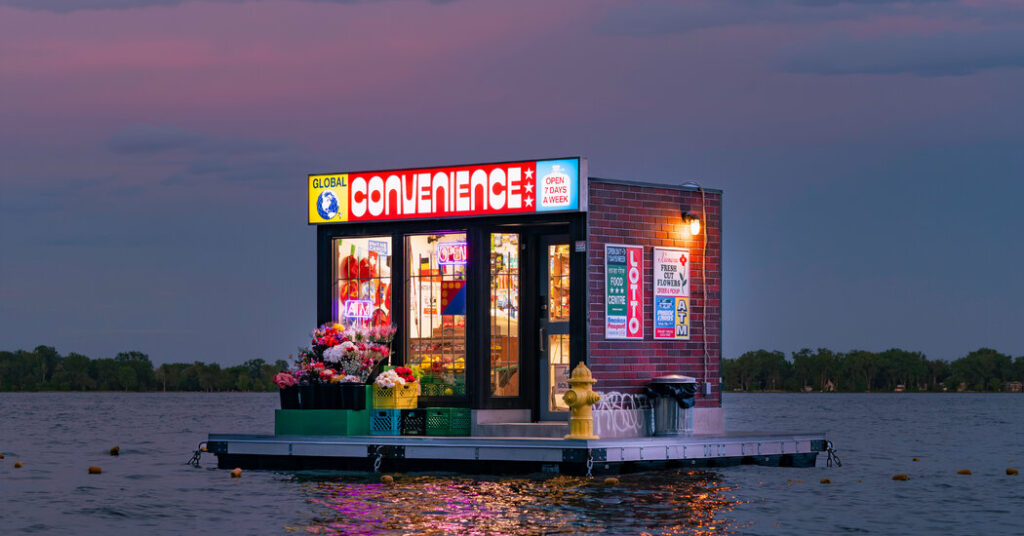
The small convenience store that appeared in downtown Toronto this month is in many ways unremarkable. It’s open 24 hours a day, seven days a week, and is stocked with all manner of consumables and domestic essentials, as one would expect from a big-city bodega.
There are rolls of paper towels and toilet paper, of course, but also shrimp puffs, ketchup-flavored Lay’s chips and various microwavable noodle bowls. There is Krazy Glue and Tiger Balm.
Though you can go inside, none of the items are for sale and there is no one behind the counter.
That’s because the store is an art installation floating 60 feet offshore in the Harbor Square Basin near the CN Tower.
It’s the product of a collaboration between two local artists and a design firm, and the latest in a series of public art projects from Waterfront Toronto, the organization responsible for revitalizing the city’s lakeside area.
Unsurprisingly for a store bursting with lifelike detail and floating on the placid waters of Lake Ontario, “Global Convenience,” as the project is called, has attracted considerable attention, at least locally, since it appeared on June 12, with people gathering to gawk and take pictures from the shore.
And at least one person has been unable to resist taking a closer look.
On June 19, the Toronto Fire Services rescued a person from a “floating art installation resembling a convenience store” and transferred the person to the paramedics, according to a statement from the services on Thursday.
News reports suggest that a man swam out to the store and became stranded. Word is he didn’t take any snacks.
The store isn’t meant to taunt hungry Torontonians, but rather to provide an “artistic interpretation” of the city’s role as a World Cup host, according to Waterfront Toronto.
As Trevor Wheatley, one of the artists behind the store, and Rashad Maharaj, the managing director of the design studio Puncture, who served as the project’s producer, described it, “Global Convenience” was inspired by the idea of convenience stores as everyday places of cross-cultural exchange.
Such exchanges are amplified in a global city like Toronto during the World Cup, they said.
“When we were thinking of convenience stores, you know, there’s these daily interactions; you hear different languages, you see the same people, you start talking,” Mr. Maharaj, 39, said during a joint phone interview with Mr. Wheatley on Thursday.
The World Cup, Mr. Maharaj said, “kind of has that same thing, where you might not know the person, but due to it, you kind of like start speaking to each other and you start building those kind of personal interactions.”
In deciding to anchor the store 60 feet offshore, Mr. Wheatley and his collaborators — who also include his longtime artistic partner, Cosmo Dean, and Spencer Cathcart, Puncture’s creative director — tried to balance the need for people to see the store’s design details with the desire to dissuade them from jumping in the water to appreciate them up close. (Swimming in Toronto Harbor outside designated areas is illegal.)
But Mr. Wheatley stressed that he was unconcerned by the stranded swimmer and others like him; someone else, he said, swam out to the store and graffitied it in the days before the rescue, despite the keep-off signs on the store’s barge.
“Just because it’s 60 feet offshore of one of the most populated cities in North America, you can’t really expect it to be exempt from the happenings of the city,” Mr. Wheatley, 38, said, adding, “It’s just one more honest interaction that’s happening.”
Mr. Wheatley and Mr. Maharaj said “Global Convenience” was inspired by “an amalgamation of different spaces” in Toronto as well as other bodegas they had been to.
Mr. Wheatley’s favorite is the Queen Fresh Mart in the city’s Parkdale neighborhood, where he lives. A woman who works there loves his dog and notices when he gets a haircut, Mr. Wheatley said.
Not everything about “Global Convenience” is legit, strictly speaking.
Questions of weight and buoyancy had to be considered, so the little yellow fire hydrant is not a real fire hydrant (it’s sculpted from foam); the white ice box is not a real ice box (it’s largely made of scrap plywood); and those are not real flowers for sale out front.
The items in the store, however, are very real, and sourced from all over the world, Mr. Maharaj said.
Among the many locals who have made a point of stopping by the floating bazaar is Chatelaine Cheung.
On Wednesday evening, she led members of the Portland Runners club on an eight-kilomenter (nearly five-mile) run to the Harbor Square Basin after seeing another running club posting online about the convenience store that morning.
Ms. Cheung, 39, said in an interview that she was “delighted” by the store.
“It has all those elements of a convenience store, but it is inconvenient to get to,” she added. “I find that dichotomy interesting.”
Ms. Cheung, who lives nearby and works in tech, said she was thinking of going back to the store on her own.
“Maybe I’ll swim out to it myself,” she said.
She has until October, when the installation closes, to do it.
The post A Floating Convenience Store Appears in Toronto, Attracting the Curious appeared first on New York Times.