First came President Trump’s “complete and total endorsement” of Abelardo De La Espriella, the right-wing candidate in Colombia’s presidential election.
Then came the support of Republican members of Congress, who asserted that Mr. De La Espriella would have U.S. interests in mind and helped mobilize Colombians abroad, who tend to lean conservative, to vote.
Then, just days before the election, U.S. immigration authorities detained an activist critical of Mr. De La Espriella and who had urged Colombians in the United States not to vote for him. The activist, according to a memo signed by Secretary of State Marco Rubio, had been interfering with U.S. foreign policy.
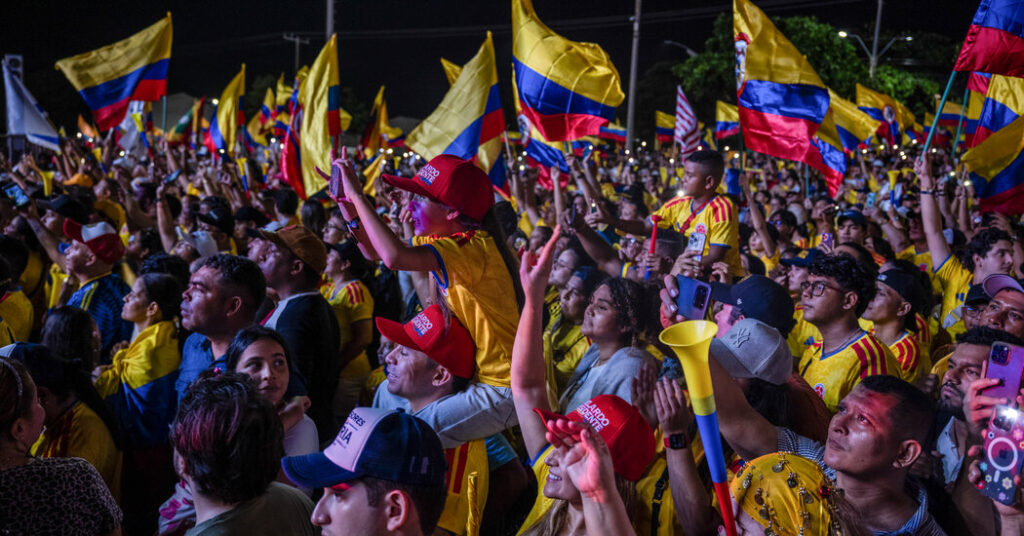
Mr. De La Espriella won Colombia’s presidential vote on Sunday by a razor-thin margin — helped by ballots cast outside the country — and will take office in August. Experts say that even in an era when meddling in foreign elections has become increasingly common, the recent involvement of the Trump administration and its allies in Colombia’s election has been heavy-handed.
The detention of an activist who opposed a candidate endorsed by Mr. Trump was particularly striking, experts said.
“The attempt to quash dissent in a coordinated manner with the Trump administration, extending from Colombia to U.S. soil — I can’t think of anything in recent times, in the 21st century, that resembles that,” said Alexander Main, the director of international policy at the Center for Economic and Policy Research in Washington.
The State Department did not respond to requests for comment about the detention of the Colombian activist.
Mr. Espriella, a lawyer who had never held office, energized millions of Colombian voters, and he appeared likely to win even before Mr. Trump’s endorsement.
But in Colombia, President Gustavo Petro, a leftist and political opponent of Mr. De La Espriella, seized on Mr. Trump’s endorsement as he sought to sow doubt in the result, claiming that American involvement amounted to “cheating” that undermined the vote. This, in turn, set those in his inner circle rushing to stop the president from flat-out rejecting the result and calling for mass protests.
The day after the election, Mr. Petro flew to Panama for an event, but was in such a frenzy over Mr. De La Espriella’s minuscule lead over his party’s candidate — about 250,000 votes, or less than 1 percentage point — that his top ministers convened an emergency meeting in Bogotá to address what Mr. Petro believed were irregularities, according to two people with direct knowledge of the events who spoke on condition of anonymity to discuss a sensitive matter.
All the while, Mr. Petro kept sending messages to his millions of followers on X, and supporters streamed into the streets of the capital for a march called “Electoral Steal,” even as his party’s candidate, Iván Cepeda, counseled calm.
On Wednesday, Mr. De La Espriella’s political opponent, Mr. Cepeda, conceded the election after electoral authorities completed a customary vote verification process.
Since Sunday, scattered protests have broken out in Bogotá and the city of Cali, with reports of vandalism and isolated clashes with the police, but there have been no large demonstrations.
The election pitted Mr. De La Espriella, a wealthy lawyer, against Mr. Cepeda, a senator, peace negotiator and stalwart of the left. Mr. De La Espriella used AI-generated images of a tiger as his campaign avatar, promised to “disembowel” political opponents, crush “narcoterrorists,” and strengthen ties to the United States. He lived in Florida for more than a decade and was recently naturalized as a U.S. citizen.
Esteban González Pons, the head of the European Union Electoral Observation Mission in Colombia, told reporters on Tuesday in response to a question about Mr. Trump’s endorsement and the presence of U.S. lawmakers in Colombia that claims of international interference were “absolutely irrelevant” to the election because “the Colombian people had voted freely.”
On Election Day, two members of the U.S. Congress were in Colombia to stump for Mr. De La Espriella. Representative María Elvira Salazar of Florida, speaking in the city of Barranquilla, on Colombia’s Caribbean Coast, told reporters, “We know very well that Cepeda will be Petro no. 2, so that’s why we’re with De La Espriella,” adding that a “profound closeness” with the United States was vital for Colombia’s prosperity.
Senator Bernie Moreno, a Republican from Ohio who was born in Colombia and has emerged as Mr. De La Espriella’s biggest champion in Washington, also traveled to Barranquilla as an election monitor. He had raised alarms for weeks over Mr. Petro’s fraud allegations and supposed vote-buying by the left.
The Republican lawmakers had spent weeks encouraging Colombians in the United States to vote, which analysts say helped tip the results in Mr. De La Espriella’s favor. In an election that saw a record-high turnout, the diaspora vote was, by most calculations, the decisive factor: Mr. De La Espriella received around 65 percent of the total overseas vote and around 80 percent in the United States.
On Monday, Mr. Moreno, after meeting with Mr. De La Espriella, appeared to dangle a carrot: If Mr. Petro behaved for the next several weeks and did not interfere with the peaceful transfer of power, Mr. Moreno told a Colombian news outlet that it was “quite probable” that the U.S. Treasury could remove him from a sanctions list. He was placed on the list last year after objecting to the Trump administration’s military strikes on boats it has said are carrying drugs.
The administration has not publicly commented on the case of the progressive Colombian activist detained last week by U.S. immigration authorities. In an interview with a prominent Colombian journalist on Wednesday, the activist, Franklin Humberto Coral Garrido, better known as Beto Coral, said he had an open asylum case in the United States that gave him the legal right to remain in the country.
Speaking from a detention center in Louisiana, Mr. Coral called his arrest “political persecution,” and added that “my political activism focuses on Colombia, nothing related to the internal politics of the United States.”
Mr. Coral was arrested by immigration authorities the same day Secretary of State Marco Rubio signed a memo that said he could be deported from the United States.
In the memo, a copy of which was obtained by The New York Times, Mr. Rubio noted that Mr. Coral arrived in the United States in 2015 on a tourist visa and had a pending asylum application. But “Coral Garrido has used his presence in the United States to conduct political activity in support of the Petro government” and has advocated against a candidate for president, Mr. Rubio wrote.
The efforts by U.S. officials and members of Congress to shape Colombia’s election have stirred outrage among rights groups and Democrats in Congress, who last week wrote a letter to top officials calling out what they said was “brazen interference.”
It was once considered taboo for heads of state and other politicians to make public statements on foreign elections. Increasingly, though, such public intervention is becoming a regular part of global politics — on the right and the left — with Mr. Trump playing a major role in that trend.
The U.S. president has endorsed Viktor Orbán of Hungary, and paid particular attention to elections in Latin America — supporting right-wing candidates Nasry Asfura in Honduras and Javier Milei in Argentina.
Mr. Milei and President Daniel Noboa of Ecuador, both supporters of Mr. Trump, have also jumped in to endorse Mr. De La Espriella. Jennie Lincoln of the Carter Center, which monitors elections around the world, called this foreign involvement in the Colombian vote part of “an egregious trend of interference.”
Ms. Lincoln is the head of a mission in Colombia to observe the vote, and she pointed out that the Organization of American States, a regional body, prohibits foreign interference in domestic affairs.
Mr. Trump, who had repeatedly posted about Mr. De La Espriella on Truth Social, said on Monday that he had spoken with him by phone to congratulate him.
“He’s going to be a great president,” Mr. Trump told reporters at the White House, adding that the U.S. relationship with Colombia would be “much better.”
Genevieve Glatsky and Luis Ferré-Sadurní contributed reporting.
The post Trump’s Heavy Hand in Colombia’s Right-Wing Victory appeared first on New York Times.