President Trump shocked transit officials last year when he said that he would seize control of the long-delayed renovation of Pennsylvania Station, one of the busiest and most maligned transit hubs in the world.
The Metropolitan Transportation Authority, the state agency that had been in charge of the project and frequently found itself at odds with Washington, offered a surprising response: It’s all yours.
Now, federal officials may need the cooperation of that same agency, which controls a large portion of the space, if it intends to keep its promise to break ground on the Penn Station revamp by the end of next year. And the partnership is not off to a good start.
On Monday, Janno Lieber, the M.T.A.’s chief executive, wrote a scathing letter to Amtrak, the national rail company that owns Penn Station, and the U.S. Department of Transportation, whose overtures he described as a lot of “blah-blah” and “gamesmanship.”
“When the Trump administration announced it was taking over the reconstruction project, we were cautiously optimistic, despite the typically gratuitous (and fact-free) snipes U.S.D.O.T. and Amtrak took at the M.T.A.,” he said. “But the process since then has been simply bizarre.”
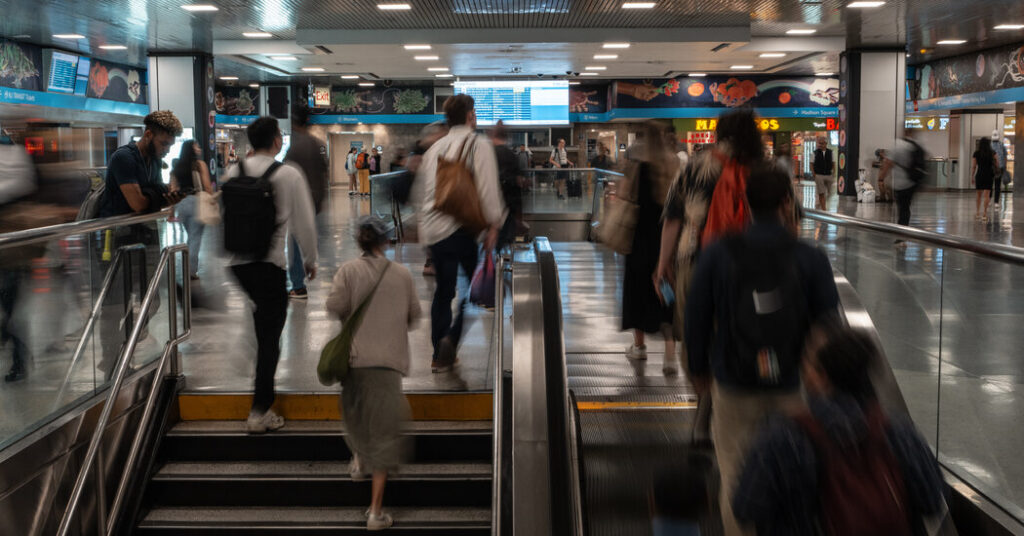
At the center of the dispute is a web of tangled stakeholders. While Amtrak owns Penn Station, the M.T.A. is its busiest tenant, accounting for two-thirds of the riders who pass through each day. They use it to board the subway system and the Long Island Rail Road, both of which are operated by the M.T.A. New Jersey’s rail network, NJ Transit, also runs service there. The labyrinthine station sits beneath Madison Square Garden, the famous arena controlled by James Dolan, a close friend of Mr. Trump’s.
Amtrak announced in April 2025 that it would proceed with a plan to make room for a new, classically inspired train hall, but has yet to disclose the cost. Sean Duffy, the U.S. transportation secretary, has said that the federal government could spend $8 billion on the project.
Mr. Lieber said that the renovation plan had the “appearance of impropriety” because the process to select a developer was opaque. The winning proposal involves a plan to buy and demolish a portion of the arena called the Infosys Theater, and replace it with a grand entrance on Eighth Avenue. Amtrak has yet to disclose what it might pay Mr. Dolan for the privilege.
In October, Amtrak sent the M.T.A. a “collaboration agreement” that it said would help expedite renovation decisions by granting the federal government more oversight. But the M.T.A. has not signed on to the arrangement, arguing that the deal could compromise an existing and much stronger contract — a prepaid lease that gives the agency more latitude in station design decisions. That pact doesn’t expire for 160 years.
Mr. Lieber said that the agreement offered last year by Amtrak would limit the M.T.A.’s ability to influence design decisions, constrain the ways it communicates changes to riders and cede other rights.
“Not interested,” he wrote.
Mr. Lieber’s letter this week was a response to a missive from Andy Byford, a former head of the M.T.A.’s transit division. He had been nicknamed “train daddy” by his supporters because of popular changes he put in place. Mr. Byford left the transit agency after a public dispute with Andrew M. Cuomo, who was governor at the time.
But Mr. Byford, who has occasionally had a tense relationship with Mr. Lieber, is now in charge of Mr. Trump’s federal takeover of the Penn Station redesign.
“It is disingenuous for some to continue to assert that M.T.A. has been ‘frozen out,’ ‘sidelined,’ or ‘excluded’ by Amtrak. Rather, it has been M.T.A.’s repeated choice over the past year to opt out of participating in the project,” he wrote in a letter sent on Sunday to reporters — a day before the M.T.A. received it.
Like most landlord-tenant relationships, this one is fraught. The M.T.A. in October blamed Amtrak for delaying by three years an expansion of railroad service in the Bronx, because it did not grant enough access to their shared infrastructure. In April, Amtrak sued the M.T.A. for refusing to let some of its new trains ride on the transit agency’s tracks. (A judge sided with the M.T.A.) And for months, the two groups have clashed over the repair schedule for tunnels under the East River that provide service to Penn Station.
On Wednesday, after an M.T.A. board meeting, Mr. Lieber said that he was willing to work with Amtrak, but not at the expense of protections guaranteed in their lease, such as the right to challenge construction decisions that could affect L.I.R.R. service.
“The idea that we should give away rock-solid rights in favor of a lick and a promise, a hope and a prayer that they might agree to do what we think are the important things to do, is not realistic,” he said.
Mr. Byford said in a statement that Amtrak had already made amendments to the agreement, and insisted that the contract would not “water down” the M.T.A.’s lease. NJ Transit has already signed a version of the pact.
M.T.A. officials have raised concerns that the Penn Station redevelopment plan, led by the companies Halmar and Skanska and designed by the architecture firm PAU, could generate costs that might be borne by New York transit riders.
In an interview on Wednesday, Mr. Byford insisted that the plan would not require ticket surcharges or fare increases for passengers who use Penn Station.
“That’s not how budgets work,” he said, calling that fear unfounded. But he left open possibly finding other ways to fully pay for the project.
The M.T.A.’s reluctance to sign the agreement may cause friction with Gov. Kathy Hochul, who effectively controls the agency. She has said that she supports Mr. Trump’s takeover of Penn Station, provided that the cost is not passed on to New Yorkers.
Ms. Hochul received a presentation last week from Penn Transformation Partners, the private consortium of developers and architects that the federal government selected to lead the redesign, according to three people familiar with the meeting.
Sean Butler, a spokesman for Ms. Hochul, said the governor believed that delivering a better Penn Station “is too important to not work collaboratively and constructively with all partners.”
When asked about the M.T.A.’s response, Mr. Byford said that he liked Mr. Lieber, and that the two of them had a good working relationship when they led different divisions of the agency.
“This is just a professional disagreement,” he said.
But on Wednesday, in a statement attributed to Mr. Byford, Amtrak said that the redesign of Penn Station will continue, with or without the M.T.A.’s help.
“We don’t need them to sign; we will proceed regardless,” Amtrak said. “Governor Hochul gets that, the M.T.A. does not, it would appear.”
The post Trump Administration and the M.T.A. Clash Over Penn Station Redesign appeared first on New York Times.