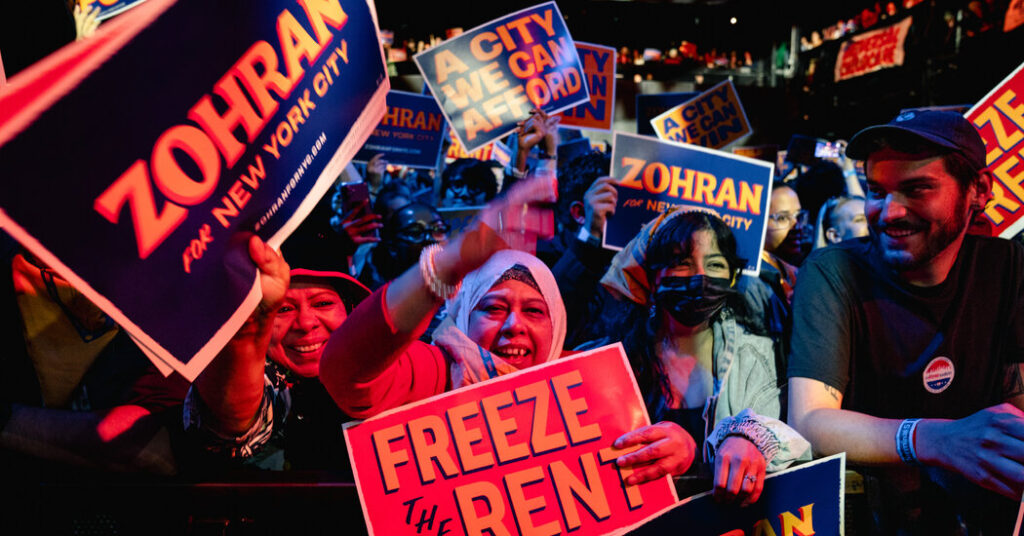
About a year ago, the succinct and memorable phrase “freeze the rent” helped vault Zohran Mamdani to the mayoralty in New York by casting him as a champion of affordability in one of the most expensive cities in the world.
On Thursday, a city panel will decide whether to turn that pledge into reality. If the panel votes for a rent freeze for the city’s nearly one million rent-stabilized homes, as both Mr. Mamdani’s supporters and opponents expect, it would be a major victory for the mayor — during a week that established him as a political power broker after three candidates he endorsed won congressional primaries.
The real estate industry says freezing rents will bankrupt landlords and worsen conditions in older apartments. Many economists also view rent regulation as a flawed policy: government overreach that distorts the market.
And a vote for a freeze would almost certainly prompt legal challenges.
Here’s what to know.
What is rent stabilization?
Rent stabilization is predicated on the idea that the city’s housing shortage — a vacancy rate of 1.4 percent, according to the last city survey — is so extreme that it constitutes an emergency. Without regulations limiting rent increases each year, the logic goes, the shortage could embolden landlords to price-gouge renters who have few options.
Today, the roughly two million people living in rent-stabilized housing in the city are more likely to be Black or Latino, and poorer or older, than those living in market-rate housing. An analysis released on Monday by the anti-poverty nonprofit Robin Hood and Columbia University’s Center on Poverty and Social Policy found that about 140,000 people who live in rent-stabilized homes would sink below the poverty line if they lived in comparable market-rate apartments.
Between 2014 and 2023, the median rent in a stabilized apartment grew from $1,485 to $1,500 in inflation-adjusted dollars, according to data from the New York City Housing and Vacancy Survey. The median rent in a market-rate apartment grew from $1,856 to $2,000.
What did Mr. Mamdani promise?
He pledged to freeze rents for rent-stabilized apartments, which make up about 40 percent of all apartments in the city. About two-thirds of New York City residents are renters.
Mr. Mamdani figured he could secure a freeze by stacking the panel that makes the decision, the Rent Guidelines Board, with people sympathetic to renters. He said during the campaign that he would appoint only members who “understood landlords are doing just fine.”
He has appointed a majority of the members now serving on the board.
Even though the panel is chosen by the mayor, it is supposed to be independent. In a preliminary vote last month, it signaled an openness to a freeze.
How does the board decide?
The nine members of the Rent Guidelines Board comprise two people representing landlords, two people representing tenants and five “public” members, including one person who serves as the chair.
Traditionally, the two tenant members push for freezes and the two landlord members push for higher rent increases, with the vote being decided by the other five, who are considered to be in the middle. The chair, in particular, is thought to have the most sway.
Four of the five public members are Mamdani appointees, including the chair, Chantella Mitchell, a former city employee who is the program director at the New York Community Trust, a foundation that funds projects in areas including housing, transit and education.
The board held more than a dozen public hearings in the spring and its staff members produce annual reports about the economy and housing and labor markets.
Why not freeze the rent?
It has been done before: Under former Mayor Bill de Blasio, the board froze rents on one-year leases in 2015 (the first time in its 46-year history), and again in 2016, 2020 and the first half of 2021. Many renters, dealing with other rising costs, would welcome such a move again.
But the board is also supposed to consider the financial health of rent-stabilized buildings, and there are many signs of growing distress. High inflation is affecting landlords’ ability to maintain buildings, and landlords are also feeling the effect of tenant-friendly laws that the state passed in 2019 that curbed their ability to raise rents.
An annual report released this spring by the Community Preservation Corporation, a nonprofit lender, found in a survey of its borrowers that in 2024, nearly one-third were not making enough money from their rent-stabilized buildings to pay their mortgages. That was nearly three times the number in 2022.
Critics of rent stabilization also argue that the program doesn’t do the best job of helping those with the greatest need, as many rent-stabilized apartments are occupied by higher-income people. About 7 percent of rent-stabilized households — tens of thousands of people — earn between $150,000 and $200,000, according to an analysis of city housing data by the Citizens Budget Commission, a nonprofit fiscal watchdog.
What kinds of homes are rent-stabilized?
Some rent-stabilized homes are modestly priced units in buildings that have a mix of market-rate apartments, shops or other commercial spaces. Some are pricey and sit alongside even pricier market-rate units in new buildings. A recent report from the credit rating agency Moody’s found that the effect of a rent freeze would be muted, largely in this segment.
But almost half of such apartments are in buildings constructed before 1974, where more than 90 percent of the apartments are stabilized and the median rent in 2025 was about $1,400, according to the New York University Furman Center, a nonpartisan research center. These buildings’ income, after adjusting for inflation, dropped between 2019 and 2025, while property taxes rose.
Another chunk — more than 200,000 homes — are subsidized by the state or the city. This segment also faces rising costs and declining revenues, according to the Furman Center analysis.
One member of the board, Arpit Gupta, who was appointed in 2022, has suggested narrowly targeting a freeze to buildings that landlords have let significantly deteriorate, while allowing some rent increases on other buildings.
“The underlying premise of this motion is that a single number cannot be uniformly applied across a million units,” he said.
The post Mamdani’s Rent Freeze Could Become Reality Today. Here’s What to Know. appeared first on New York Times.