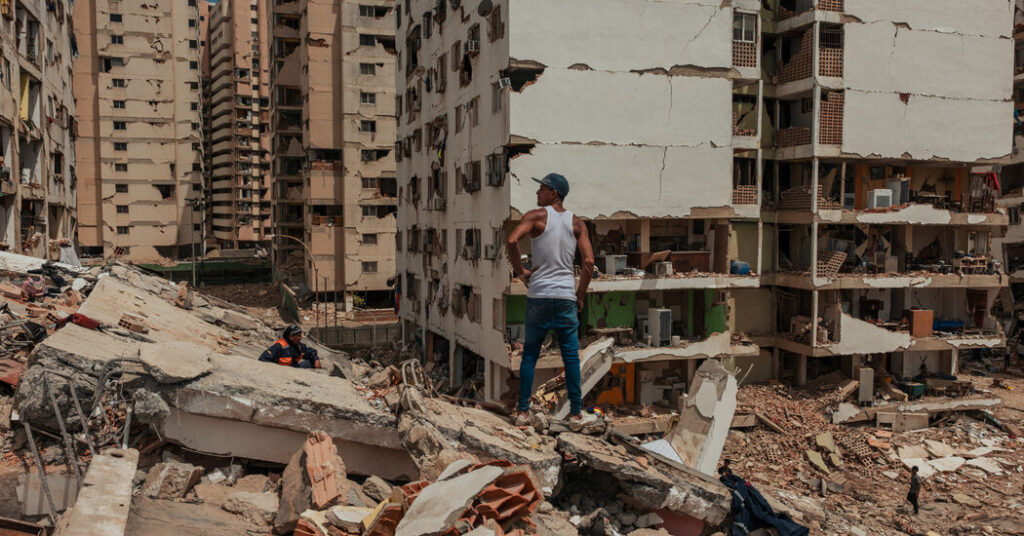
Rescue workers and desperate residents dug for survivors in the rubble of large apartment buildings and flattened homes on Thursday after back-to-back major earthquakes struck Venezuela, a country already reeling from decades of economic and political upheaval.
The Venezuelan government said that at least 188 people had been killed and more than 1,500 injured in the two quakes. The first, with a magnitude of 7.2, struck west of the capital, Caracas, on Wednesday just after 6 p.m. local time. It was followed by another, much stronger one measuring 7.5 just 39 seconds later.
The rare one-two punch, known as a doublet, was one of the most powerful tectonic events to strike Venezuela in the past century, and the death toll was virtually certain to rise as rescuers began to reach hard-hit areas and remote hillside towns.
La Guaira, a port city north of Caracas, appeared to have taken one of the heaviest blows. Entire buildings there had crumbled to the ground. Some apartments had only walls remaining, making them look skeletal.
When Yorliana Colmenares stood near one building that had been reduced to rubble, she heard tapping noises on Thursday morning.
Her boyfriend was trapped inside, she believed. But no rescue workers, firefighters or medical workers had arrived, so residents were digging by themselves though crushed walls and knotted wire and dust.
“They’ve pulled out a lot of dead people,” Ms. Colmenares said. “Injured people, children, animals.”
Outside another building, a couple searched for their 8-year-old son. He was playing basketball when the quakes hit and had not been seen since.
The disaster came at a critical moment for Venezuela.
Less than six months ago, U.S. forces captured the country’s autocratic leader, Nicolás Maduro, and took him to New York to face drug-trafficking charges. Mr. Maduro’s removal transformed Venezuela from a U.S. adversary into what is effectively a satellite state led by his former vice president, Delcy Rodríguez. She has been backed by the Trump administration and has been facing popular discontent.
Since it arrested Mr. Maduro, the Trump administration has demanded that Venezuela open its oil sector to foreign companies (especially those from the United States), work with U.S. security and intelligence services, cut ties with American adversaries and free political prisoners.
The earthquakes and the long road to reconstruction ahead will test how much the Trump administration is now willing to support Venezuela as it continues to turn the country into an economic protectorate.
Ms. Rodríguez said in a televised address on Wednesday evening that the quakes had caused widespread damage, especially in Caracas and La Guaira. She said that there had been power outages in both Caracas and La Guaira, though the electricity grid continued to function in the rest of the country.
“Dozens of buildings have collapsed, and right now we are in very arduous rescue operations,” Ms. Rodríguez said. She called it “a true tragedy.”
The U.S. Geological Survey said that many people in the quake-affected region live in vulnerable structures made of brick and adobe. Similar weaknesses existed in 1967, when an earthquake in Caracas killed hundreds of people and officials attributed the deaths to faulty construction.
Venezuela sits on the edge of the South American tectonic plate, where it abuts the Caribbean plate, and earthquakes commonly strike on or near such boundaries. But the 7.5-magnitude quake on Wednesday was the largest to hit the country since Oct. 29, 1900, when a 7.7-magnitude earthquake was recorded near the country’s coast.
Residents described shock and confusion as the violent shaking leveled homes, rattled windows and knocked out power.
“I felt the most terrified I have ever felt in my entire life,” said Luisa Martínez, 68, who lives in Valencia, Venezuela’s third-largest city, about 100 miles west of Caracas. “The noise, the windows slamming open and shut, and everything creaking like never before — it was horrifying. My husband, my son, and I hugged each other and I started to pray, crying out to God to save us.”
Officials shut off gas supplies in the affected areas and water service was disrupted in parts of Caracas and several northern states, including Miranda, Falcón, Yaracuy, Zulia and La Guaira, Ms. Rodríguez said.
Subway and rail services were suspended, and the Simón Bolívar International Airport, which serves the capital, was closed after it sustained heavy damage. Ms. Rodríguez said schools would be closed for the rest of the week.
Early Thursday, no lights were on in parts of Caracas, especially in the west of the city, and streets were flooded from burst water pipes.
In La Guaira, more than 100 buildings had collapsed, according to the United Nations’ main humanitarian agency. Residents there said they needed heavy machinery that could move rubble and were frustrated that only civilian rescue workers in flimsy helmets had arrived.
“My sister lived here!” cried one woman who stood by a damaged apartment building as workers scraped away rubble. “I see no one here! This is the government’s neglect!”
Angie Reyes said that she was desperate to find a co-worker, Daniel Vivas, 43, who lived in a sixth-floor apartment in La Guaira. She said she feared that no one would reach him in time.
“We’re stuck like this until the international community arrives,” Ms. Reyes said.
La Guaira is no stranger to disaster. In 1999, mudslides there led to at least 15,000 deaths. They occurred just months after a divisive new government took power, becoming the first major crisis for President Hugo Chávez, Mr. Maduro’s predecessor.
In her televised address on Wednesday night, Ms. Rodríguez stood next to the interior minister, Diosdado Cabello, whom the Trump administration accused of “narco-terrorism” in the same indictment that it secured against Mr. Maduro.
“I ask that we act in national unity, with calm, and that we know that together we are going to overcome this tragedy,” she said.
Secretary of State Marco Rubio said on Thursday that he had spoken to Ms. Rodríguez and that the United States was deploying search-and-rescue teams from Fairfax County, Virginia, and Los Angeles. Speaking to reporters while traveling in Bahrain, Mr. Rubio said that other teams would follow, and that the United States was also providing Venezuela with overhead imagery of hard-hit areas.
He said that the Defense Department would coordinate aid flights because of damage to the main airport in Caracas.
“No matter what, the United States has always responded to humanitarian crisis, especially in our own hemisphere,” Mr. Rubio said. “That’s what we’re focused on now.”
In a social media post on Wednesday night, Mr. Trump wrote that he had instructed federal agencies to “get ready to move quickly,” and said that “we will be there for our new and great friends.”
Many other countries also promised to help, including China and India, as well as Latin American nations like Chile, Argentina, Colombia, Panama, Brazil and El Salvador.
Venezuela is rich in oil, but still trying to emerge from a decade-long depression that wiped out most of its economic production and prompted millions to leave the country. Its rescue services have been hollowed out, infrastructure has been left to rot and inflation has reached record highs.
Those problems will likely compound the challenges of recovery.
On Thursday, workers used heavy machinery to lift large chunks of rubble from a flattened six-story building in the El Paraíso neighborhood of Caracas, hoping to find seven residents who had been reported missing.
Vladimir Navas stood nearby, looking for his in-laws, Freddy Carrero, 86, and Eliana Hernández, 82. He believed they were home watching a World Cup game when the quakes struck.
“There’s no possibility that they got out,” Mr. Navas said. “You can’t hear anything. If anyone is alive in there, it’s a miracle.”
Reporting was contributed by Frances Robles, Sheyla Urdaneta, Genevieve Glatsky, Tibisay Romero, Fabiola Ferrero, Robin George Andrews, Amy Graff, Judson Jones, Leo Sands, Edward Wong and John Yoon.
The post Hoping for Miracles as Venezuela Digs Out From Massive Quakes appeared first on New York Times.