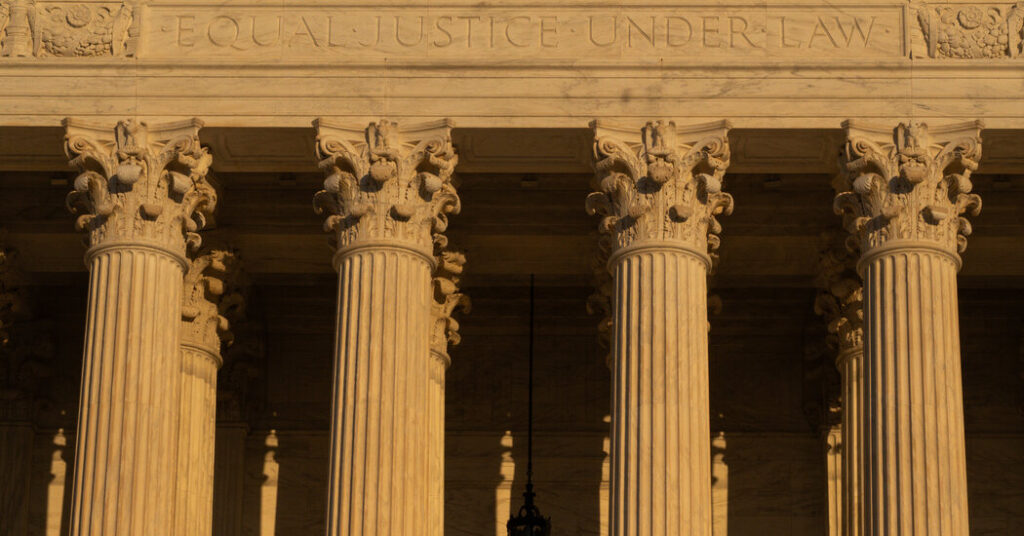
Hello! The Supreme Court has a dozen cases left to decide and only a few days left in its term. Almost every remaining case is a blockbuster, as our handy tracker shows.
Starting on Thursday, we’ll learn whether President Trump can do away with birthright citizenship, fire the leaders of independent agencies on a whim and undermine the independence of the Federal Reserve. We’ll also get major decisions on voting by mail and money in politics. And we’ll hear whether transgender athletes can compete in school sports and whether some protections for refugees can be withdrawn.
In other words, by the middle of next week, the justices may rebalance the separation of powers, rewire the machinery of democracy and reduce protections for more than a million immigrants.
Then they will rise for their summer break, one that extends to the first Monday in October.
“Only Supreme Court justices and schoolchildren are expected to and do take the entire summer off,” a young lawyer in the Reagan White House observed in 1983. He added that there is an upside to the long break: “We know that the Constitution is safe for the summer.”
That lawyer, John Roberts, would go on to be chief justice of the United States.
Monkey Business in Plea Deals
In the last weeks of the Supreme Court’s term, as the bombshells explode, quirky but important decisions can get overlooked. One of them, issued last week, featured eight references to orangutans and a caustic assessment of plea bargaining from an unlikely trio: Justice Neil Gorsuch, a Trump appointee, joined by the court’s two most liberal members.
The question in the case was whether prosecutors can use the threat of a long prison sentence to extract not only guilty pleas but also promises not to appeal any aspect of the resulting punishment. Such “appeal waivers,” Justice Gorsuch said when the case was argued in March, would forbid challenges even if the judge “let an orangutan pick a sentence out of a hat.”
The case concerned Munson Hunter, who, to hear the government tell it, used fraudulently obtained Social Security numbers to open 14 bank accounts, acquire at least 18 credit cards and apply for loans from the Small Business Administration, costing financial institutions nearly half a million dollars.
He pleaded guilty in 2024 to a wire fraud charge and waived his right to appeal.
His sentence turned out to include an order to take any mental health medications prescribed to him, a command that he later said violated his constitutional rights.
Justice Elena Kagan’s majority opinion said appeal waivers can be challenged when judges impose sentences marred by “egregious errors.” She gave a few examples: imposing a longer sentence than the law allows, taking account of the defendant’s race in meting out a sentence or imposing one “without ‘some minimum of civilized procedure’ as in, yes, the ‘12 orangutans’ case.”
She was referring to a 1985 decision by Judge Richard Posner of the federal appeals court in Chicago, in which he posited that “if the parties stipulated to trial by 12 orangutans, the defendant’s conviction would be invalid.”
The Supreme Court on Thursday sent Hunter’s case back to an appeals court to decide whether he could clear Justice Kagan’s new test, what she called a “high bar” requiring proof of “a miscarriage of justice.”
In his concurring opinion, Justice Gorsuch, joined by Justices Sonia Sotomayor and Ketanji Brown Jackson, set out a broader critique of plea bargains, which have almost entirely supplanted the criminal trials contemplated by the Constitution.
“In our times,” Justice Gorsuch wrote, “the jury trial has given way to a conveyor belt of plea bargains,” which account for some 95 percent of convictions.
Though he joined Justice Kagan’s majority opinion, Justice Gorsuch seemed to suggest that her bar was too high. The court’s approach, he wrote, could embolden prosecutors to ask for all sorts of things in plea deals, including waivers of defendants’ right to object to unconstitutional searches.
He could not resist one more reference to monkey business. (I know: orangutans are apes and not monkeys. But “ape business” makes no sense.)
“What if a judge goes so far as to allow an orangutan to pick the defendant’s sentence from a hat?” Justice Gorsuch asked, now in writing. “As the government tells it, a defendant with an appeal waiver has no way to correct any of these errors on appeal (yes, even when it comes to the orangutan).”
Other Things Worth Knowing About
-
After throwing into the trash a copy of the court decision protecting Rastafarian prisoners’ right to keep the dreadlocks called for by their faith, guards in Louisiana shaved Damon Landor’s head to the scalp. The Supreme Court ruled on Tuesday that Landor, a Rastafarian whose dreadlocks had fallen nearly to his knees, could not sue the guards for money under a federal law meant to protect prisoners’ religious rights, Ann Marimow reported,
-
In a rare and troubling move, federal prosecutors issued subpoenas to compel reporters at The Washington Post and The Wall Street Journal to appear before a federal grand jury. The Justice Department backed down after the news organizations fought them in sealed filings, Devlin Barrett reported.
-
In “The Living Declaration,” the historian Ted Widmer assembles and interprets scores of documents illuminating the Declaration of Independence. The foreword is by Gordon Wood, the pioneering scholar of the American Revolution who died this month at 92.
-
In “The Lost Founder,” a biography of James Wilson, Jesse Wegman, a former member of The New York Times’s editorial board, makes the case for a colorful, influential and often overlooked figure who signed the Declaration of Independence, helped draft the Constitution and served on the Supreme Court.
Mailbag
Legal Challenges to Partisan Gerrymandering
I live in North Carolina, a state where it takes the vote of our legislature to get on the ballot for amendments to the state constitution. Having successfully gerrymandered not only our federal seats but our state seats, there is little to no way for us to achieve any kind of relief from gerrymandering without an amendment to our Constitution. But the Republicans will never open up our Constitution to set up a prohibition, or at least a limitation, on gerrymandering. Is there a federal claim that could be made that these roadblocks to amending the state constitutions are in fact in violation of the federal Constitution? — Eileen Pruette
That’s a good, smart question. Maybe I’m missing something, but I can’t see one.
One consequence of partisan gerrymandering, the practice in which the party that controls the state legislature draws voting maps to help elect its candidates, is a lock-in effect that can prevent a majority of voters from reclaiming control. But possible legal challenges to such gerrymandering, which both parties have engaged in, all look like dead ends.
In 2019, in Rucho v. Common Cause, a case that, as it happened, concerned North Carolina, the Supreme Court closed the door to federal challenges to voting maps warped by politics.
Chief Justice Roberts, writing for the majority, noted that some states allow voters to bypass state legislatures and use ballot measures to amend state constitutions to require independent redistricting commissions or other nonpartisan mechanisms to draw voting districts. But fewer than half of the states give voters the power to put such initiatives on the ballot, and North Carolina is not one of them.
The chief justice also said that state courts remain free to address partisan gerrymandering. But the North Carolina Supreme Court, which is dominated by Republicans, ruled in 2023 that it is powerless to second-guess state lawmakers’ redistricting decisions.
I’d love to hear your questions on the law, the courts or whatever is on your mind. Send them my way at [email protected].
Closing Argument
‘A Weird Syncretism’
Josh Blackman made an interesting point in a post on The Volokh Conspiracy, using an interesting word, about another aspect of the case on appeals waivers. He said a concurring opinion from Justice Amy Coney Barrett demonstrated “a weird syncretism” between her scholarship and jurisprudence.
I had to look that up. “Syncretism” turns out to mean, more or less and among other things, the blending of two disciplines.
What prompted Blackman’s observation was a passage in which Justice Barrett, a former law professor, cited two of her own law review articles, from 2006 and 2008, to explain why she had come to conclusions about the relationship between the Supreme Court and lower courts.
“Is there any daylight between what Professor Barrett wrote about two decades ago and what Justice Barrett thinks now?” Blackman asked. “I doubt it.”
My take was more simple-minded: Self-citation can seem a little awkward and self-regarding. Justice Elena Kagan acknowledged this brilliantly when she cited her own academic work in a 2020 dissent on the president’s power to remove leaders of independent agencies.
“The president’s engagement, some people say, can disrupt bureaucratic stagnation, counter industry capture and make agencies more responsive to public interests,” she wrote. “See, well, Kagan, ‘Presidential Administration,’ 114 Harv. L. Rev. 2245, 2331–2346 (2001).”
I wrote about the decision at the time in, well, “Supreme Court Lifts Limits on Trump’s Power to Fire Consumer Watchdog.”
Please send me your comments on plea bargains, apes, gerrymandering, citing yourself or anything else at [email protected]. See you next week for a Supreme Court recap. — Adam
The post As Blockbusters Loom, Monkey Business at the Supreme Court appeared first on New York Times.