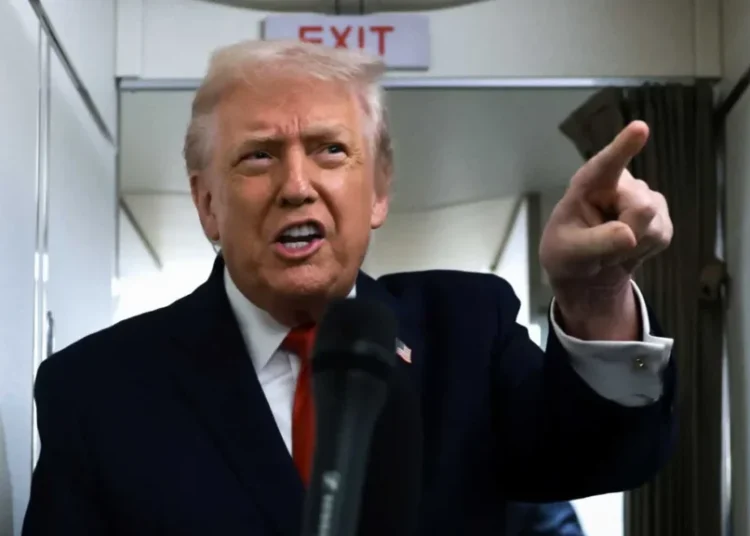
President Trump was eager on Tuesday morning to announce the latest concession that he says his negotiators extracted from Iran, writing on social media that the country had agreed to allow the “highest level Nuclear Inspections long into the future (Infinity!!!).”
But he omitted the fact that as a signatory to the Nuclear Nonproliferation Treaty, Iran is required to allow in international inspectors. And his statement came after the Iranians had insisted that there were no plans to allow inspectors into the three major nuclear sites the United States bombed a year ago — and where just about all the nation’s enriched uranium is stored.
The previous day, Vice President JD Vance, leaving the negotiating site at a Swiss resort, said Iran had agreed that if Iranian assets were unfrozen, the United States and Qatari officials would oversee the process and the money would be used to buy American farm products. The Iranians denied that, too, saying that the 14-point memorandum of understanding they had signed with the Americans did not require them to do so.
Negotiating with Iran has always been an extraordinary challenge. But until recently, one rule of diplomatic bargaining has usually held: “Nothing is agreed until everything is agreed.” That is how the United States and Iran traditionally have left themselves some trading space, and fine-tuned wording to satisfy the many critics at home who will have to be sold on any agreement. In 2015, when details of the inner-sanctum negotiations leaked, American officials complained bitterly, saying that the news reports were making it harder to get to a final deal.
But in this negotiation the leaks are replaced by official, if fragmentary, announcements — usually from the American side. Mr. Trump’s style is often to describe his preferred outcomes as fully negotiated side deals, in hopes of locking the Iranians into each element of any eventual agreement.
The Iranians seem to have caught on. And they have a spin strategy of their own: deny the American statements immediately and publicly to avoid getting cornered, even if there is an element of truth to Mr. Trump’s pronouncements. It is the kind of public dynamic that can easily undermine a high-stakes negotiation.
Suzanne Maloney, an expert on Iran and the vice president for foreign policy at the Brookings Institution, one of Washington’s leading think tanks, said that both “Washington and Tehran are engaged in a public battle to shape the narrative and advance their preferred outcome on specific elements of the negotiations.”
The public divergence, she added, “highlights how little has actually been agreed upon yet and what an enormous gap has to be addressed in a short period of time.”
In fact, there were elements of truth in both what Mr. Trump and Mr. Vance were arguing, and in the Iranian rebuttal. And dissecting the differences helps explain why this negotiation is likely to be painful — and long.
Despite Iranian denials, inspections were a topic of discussion at the negotiations in Switzerland over the weekend, two officials familiar with the talks said. The idea under consideration would grant the International Atomic Energy Agency, the U.N.’s nuclear inspection arm, broad powers to inspect just about any suspect site on short notice. It revives ideas that were being discussed in February, in Geneva, when the Iranians and the Americans were meeting Jared Kushner, the president’s son-in-law, and Steve Witkoff, his special envoy, before the negotiations broke off when Mr. Trump ordered the attack on Iran.
At the Swiss resort this past weekend, the secretary general of the I.A.E.A., Rafael Mariano Grossi, was in the hallways and negotiating rooms talking to each side, describing what kind of access his inspection teams would need to assure no nuclear fuel was being diverted to weapons projects, according to diplomats who were familiar with the discussions. The Iranians appeared to agree to the concept, but did not want to agree to dates or details until other parts of the accord — including when they would have access to billions of dollars in frozen funds — were worked out.
So when Mr. Vance declared on Monday that Tehran had agreed to allow I.A.E.A. inspectors into the sites, calling it “the first step” toward ensuring that Iran did not obtain a nuclear weapon, Iran’s Foreign Ministry spokesman, Esmail Baghaei, immediately pushed back, saying that there were no plans to allow inspectors access to facilities at Isfahan, Natanz and Fordo, all of which the United States bombed a year ago. And, in fact, there is no imminent plan.
That prompted Mr. Trump to say on Tuesday that if there were no inspections, there was no accord. Secretary of State Marco Rubio was a little more careful.
“I don’t know why they have to say the things they say,” Mr. Rubio told reporters in Abu Dhabi, where he was beginning a tour of the Gulf states, trying to drum up support for the deal with Iran. He noted the complexity of Iran’s internal politics and said: “I guess they’ll navigate it. But we know what they agreed to do, and now they’ll either do it or they won’t.” Mr. Trump, he said, “will have some decisions to make.”
Richard Nephew, who was the lead sanctions expert on the U.S. negotiating team that reached the 2015 nuclear accord, said of the current talks, “They’re trying to do this all very quickly and it still feels a bit slapdash.” That haste, he said, comes from the urgency to reopen shipping traffic through the Strait of Hormuz, as well as the risk of Mr. Trump growing impatient with his envoys if they do not deliver tangible progress fast enough.
The open contradictions are a sign that the two sides “fundamentally disagree with each other and they’re trying to paper over it,” said Mr. Nephew, now a senior research scholar at Columbia University and a former official in the Obama and Biden administrations.
Posturing is all part of the process, of course. But the question here is whether a succession of such public disputes will ultimately sink the whole venture — which would be fine with many in the United States and Tehran who have criticized the deal.
Iranian diplomats face a treacherous domestic terrain, with hard-line factions who oppose any engagement with the United States, and a supreme leader, Ayatollah Mojtaba Khamenei, who has stated that he did not agree with signing the initial deal with the United States. For that reason, they have an incentive to downplay or deny any concessions claimed by the American side.
But Mr. Vance has also made claims that are difficult to verify or that go beyond the text of the signed agreement.
For instance, the vice president said on Monday that if Iranian assets were to be unfrozen, American and Qatari officials would have approval over the process, and the money would be used to buy American farm products.
But Iranian officials have repeatedly batted down the idea that Iran is required to spend any of its unfrozen funds on American agricultural goods, or that there would be non-Iranian control over how the money is spent. Iran’s central bank governor, Abdolnaser Hemmati, said in an interview published on Monday in Tasnim, an outlet affiliated with Iran’s Islamic Revolutionary Guard Corps, that Iran had “no obligation” to buy American farm products under the signed memorandum.
His wording, however, left open the possibility of a verbal agreement between the U.S. and Iranian sides to that effect.
On Tuesday, Mr. Baghaei, the Foreign Ministry spokesman, did not rule out Iran’s purchasing American farm exports with its frozen funds. But he said the decision would be up to Iran.
“Regarding Iran’s released assets, we will make decisions in whatever way is most beneficial and appropriate for the country,” Mr. Baghaei said. “The important point is that Iran’s frozen assets are now accessible and can be used freely by Iran, in whatever manner it deems appropriate, to procure the goods and supplies needed by the country.”
The dueling narratives even extended to more minor details, like whether or not Iranian negotiators walked out of talks in response to a threat by Mr. Trump to resume bombing their country if it closed the Strait of Hormuz.
Mr. Vance said on Monday that diplomats continued negotiating well past 1 a.m. despite threats by the Iranians to walk out. But Mr. Baghaei said that after Mr. Trump’s threat, Iranian diplomats refused to meet directly with the Americans, and instead exchanged messages through mediators.
Shirin Hakim and Leily Nikounazar contributed reporting.
The post Trump Is Making Big Claims About the Iran Talks. Iran Keeps Contradicting Him. appeared first on New York Times.