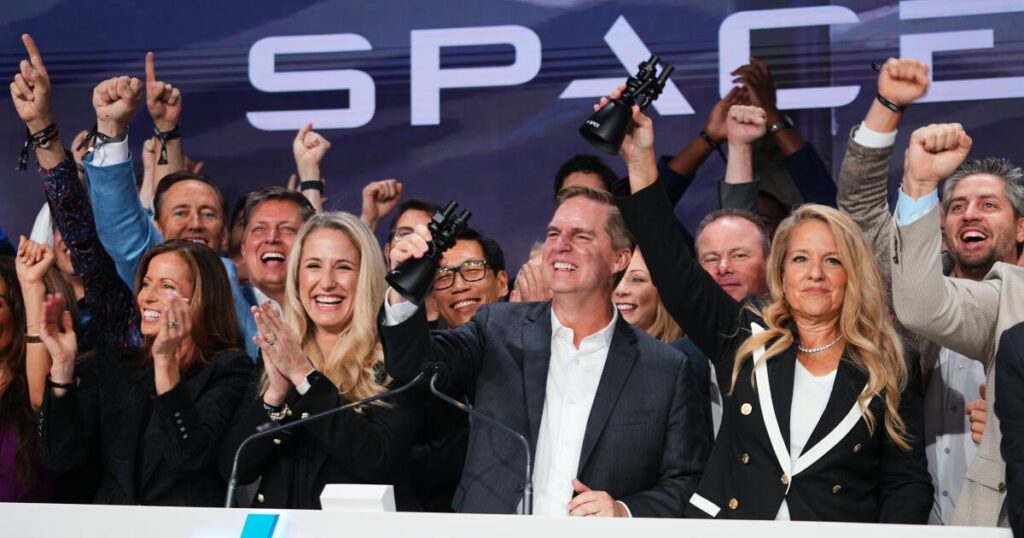
Shares in Elon Musk’s rocket company SpaceX halted their three-day slide that had erased roughly $600 billion off its market value.
SpaceX shares closed at $156.11 with a nearly 1% gain on Tuesday, a slight recovery from a 16% fall on Monday.
That loss dropped the stock below $160.95, where it ended the day June 12 after a 19% surge during its record initial public offering. The IPO gave it a market cap of $2.2 trillion, making SpaceX one of the world’s most valuable public companies.
It also turned Musk into the world’s first trillionaire, a status he retains despite the sell-off.
The downturn probably reflects investor unease over the company’s spending plans and potential debt load, analysts say.
SpaceX raised a total of $86 billion after underwriters exercised their right to sell additional shares, on top of the $75 billion initially raised. It was the largest IPO in history.
A little more than half a billion shares were distributed to institutional and retail investors at a price of $135, with the stock opening at $150 as some holders immediately flipped shares for a profit.
Shares rose as high as $176.52 during the IPO before settling at the $160.95 price. In the weeks since, shares reached a high of $225.64, meaning that some investors lost money or are underwater with paper losses.
Since the IPO, SpaceX has dropped some big bucks.
It announced last week that it was acquiring AI coding startup Cursor for $60 billion in a deal expected to close in the third quarter. The San Francisco company, founded in 2022, enables engineers to instruct software in English to run coding tasks autonomously.
It also is preparing a $20-billion bond issue, which is unusual for a company that just went public, much less for one that just raised a record sum.
The IPO surpassed the 2019 offering by Saudi Aramco, Saudi Arabia’s state-owned oil giant, which raised $29.4 billion, the prior record holder.
S&P Global issued a report last week that assigned SpaceX a “BBB” credit rating, the lowest possible rating to qualify as an investment grade credit risk. It noted the company will have “elevated capital expenditure” through 2029.
SpaceX rivals OpenAi and Anthropic filed this month for initial public offerings that, while not expected to be as large as Musk’s company, will be large in their own right.
Wedbush analyst Dan Ives, who has been bullish on SpaceX stock, said the market is digesting “massive debt and equity raises from Big Tech players” in the coming years.
“This is part of an industry wave of debt offerings on Wall Street, like Alphabet and SpaceX among others,” he wrote in an email.
With the stock already giving up gains since the IPO, it will be further tested when tranches of locked up shares held by current and former employees are released.
At least 20% of the shares will be released after second quarter results are disclosed some time in the coming months, with all the lockups expiring in December.
SpaceX, based in Texas, is the leading launch services company in the world, with its Falcon 9 rocket accounting last year for the vast majority of satellites sent into space.
It is also the leading satellite-based broadband provider with its Starlink service. But the extraordinary interest in the IPO was driven by Musk’s plans to make the company an AI leader — including plans to launch orbiting satellite data centers powered by the sun that crunch AI data .
He merged his xAI artificial intelligence companyinto SpaceX this year, with the combined entity recently announcing it was leasing computer power to rivals Anthropic and Google at two terrestrial data centers it has constructed.
Musk moved the company’s headquarters from Hawthorne to Texas in 2024, but it retains large operations in the South Bay city and blasts off regularly from Vandenberg Space Force Base in Santa Barbara County
Investment research firm Morningstar placed a $780 billion valuation on SpaceX, focusing on its core rocket and Starlink broadband satellite businesses. It suggested investors wait a few months for the stock to settle before buying in.
“I think the day-to-day stock price movements are usually based on market sentiment,” said report co-author Nicolas Owens, an equity analyst at Morningstar. “So I was not surprised when it went way up right after the IPO — and I’m not surprised it (came down). Not much has really changed in the fundamentals.”
Mike Alves, founder of Pasadena’s Vida Vision Fund, has a stake in SpaceX that accounts for 46% of his AI and robotics fund.
He said he was not perturbed by the stock drop, noting that Facebook fell under $18 a share just months after its May 2012 IPO closed at $38 a share. It has since risen more than 1,000% above its offering price.
“The volatility doesn’t really matter because you’re going to multiply your best investment many times, so I’m not so worried about it,” he said, adding that investors seeking shares could now go in “scoop them up at a good deal.”
The post SpaceX stock returns to Earth after record IPO appeared first on Los Angeles Times.