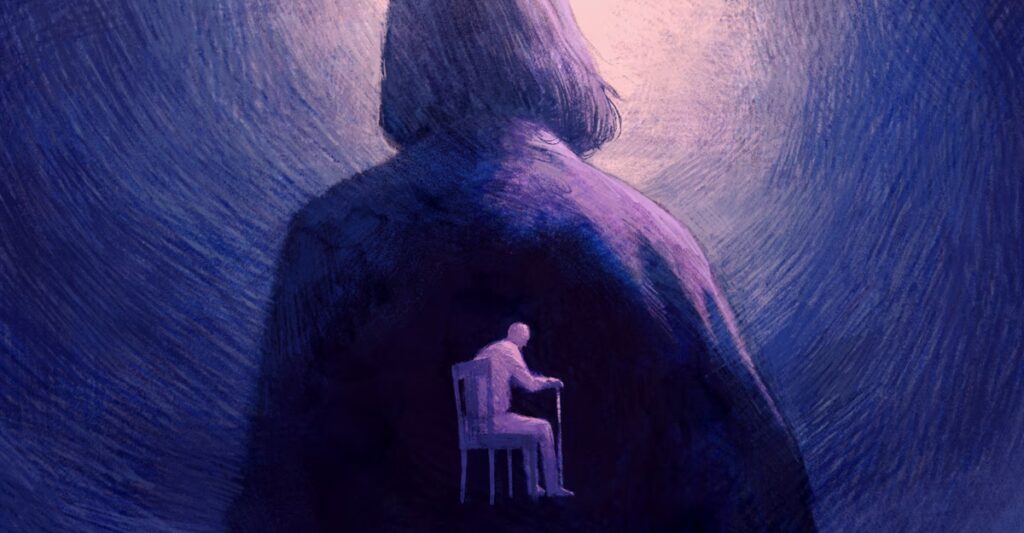
As far as growing old goes, the Dutch have it pretty good. The Netherlands offers arguably the world’s most generous long-term-care insurance, covering professional nursing or home care for all residents who can demonstrate need. The country spends a whopping 4.1 percent of its GDP on formal elder-care services, 94 percent of which is publicly funded. (The United States, by comparison, spends 1.3 percent, 71 percent of it publicly funded.) “No other country spends more per capita on publicly financed formal care,” a 2023 working paper published by the National Bureau of Economic Research concluded.
And yet, nearly half of elderly Dutch residents who need assistance with the basic functions of daily life—dressing, bathing, grocery shopping, paying bills—still partly or even entirely rely on informal care from family and friends. Herein lies a lesson for Americans: Chances are, your elder care will not be outsourced, at least not entirely.
It is no secret that in the United States, the accessibility and quality of long-term care leave a lot to be desired. But many Americans go through life carrying two big misconceptions about aging. One is that, in the postindustrial world, a ton of elder care is hired out to professionals. The other is that, with sufficient savings and adequate public services, it is possible to avoid relying on kin for help.
These notions are, quite simply, more myth than reality. The Boston University sociologist Deborah Carr told me that in classroom discussions on aging, she routinely hears her undergraduate students echo a “Grandpa Simpson” stereotype of American elder care: They assume that many older people spend their latter years in nursing homes, largely forgotten by their families. But “the proportion of older adults who actually live in a nursing home,” Carr said, “is very, very small.” And even when the elderly are in residential care, family members tend to be highly involved.
In my own conversations with family and friends, I find that many of them presume that relying on one’s grown children in old age is a thing of the past. But the truth is that, across the developed world, the majority of elder care is still done informally—usually by spouses or children, sometimes by other relatives or friends—and it is probably not possible for matters to be any other way.
More than 80 percent of Americans over 65 in need of care depend on kin; about two-thirds rely solely on informal care. And the share of American elder care done on an unpaid basis is, if anything, growing over time. For context, things don’t look all that different in our peer countries, including those that spend far more on elder care: In an analysis of 10 high-income nations with varying levels of public investment in long-term care, the Netherlands emerged as the only one in which less than half of the elderly population relied on kin. This suggests that if the United States were to suddenly and massively scale up its formal care services—a possibility that, in the current political climate, seems unlikely—Americans would still most likely rely on a significant amount of informal care.
Even when families can find and afford formal care, many older people are deeply resistant to the idea of moving into a nursing facility or having a stranger come into their home to help them, Emily Kenway, a social-policy doctoral researcher at the University of Edinburgh and the author of Who Cares: The Hidden Crisis of Caregiving, and How We Solve It, told me. Aging can be psychologically and emotionally difficult. Accepting that you need a home health aide means coming to terms with your own vulnerability, which is easier said than done, particularly for those who’ve been nondisabled their entire lives. And when you are struggling with a cognitive impairment, as many elderly people do, changing homes or having strangers care for you can be genuinely frightening. (In some cases, Kenway noted, racial biases can add to the discomfort—a difficult reality, but one that family members cannot simply hand-wave away, given that the majority of nursing and home-care workers are people of color.)
Of course, many spouses, daughters, sons, nieces, and nephews want to care for their aging loved ones. But considering recent demographic, economic, and social trends, the need to seriously reckon with the load-bearing role that kin play in elder care has become freshly urgent.
For one, a growing number of Americans don’t have children or spouses. This is partly why the proportion of older adults with daily care needs that will go unmet is expected to grow by more than 30 percent by 2050. At the same time, even people with spouses and children can’t assume that those family members will be willing or able to care for them, especially if they’re in the workforce. Many employers don’t make it easy to combine work and care.
Then there’s another complication: proximity, or the lack of it. For much of human history, people could rely on kin because family members lived close by. Nowadays, most Americans live within 30 miles of their nearest parent—which might seem quite close. But “every single mile matters if you are caring for parents who have a disability,” Hwajung Choi, an associate professor of internal medicine and of health management and policy at the University of Michigan, told me. Her research has shown that although older adults with disabilities rely heavily on care from their adult children, the amount of care they receive drops off steeply the farther away the child lives. Those living with their parent provide roughly twice as many hours of care as those living on the same block, who provide nearly three times the care that those living a couple of miles away do. Beyond five miles, adult children don’t provide much care at all, whether they live 10 miles away or 100.
[Read: How affluence pulls people away from their families]
Other troubling trends loom. American society seems to be going through a widescale retreat into isolation. People are spending less time with one another and opting out of community and religious institutions, where durable, supportive relationships have historically taken root. Meanwhile, AI seems poised to further wear down relational bonds at a time when the country desperately needs to be building them up. All of this points to a situation in which, over time, more and more Americans may find themselves heading toward precarity as they age—unless they start thinking creatively and pragmatically about how they want their future life to look.
Aging is unpredictable. When I asked Susan Fordham, who works in payroll for a school system in West Virginia, what a typical day of caring for her 84-year-old mother looks like, she struggled to answer the question. Her mother’s need for help arose last summer, when she had an operation that required a stint in a rehabilitation center and then several weeks of hands-on care. “She couldn’t fix her own lunch or drinks or even make it to the bathroom at certain points,” Fordham told me. By the time Fordham and I spoke, the sort of assistance her mother needed was less intensive but still crucial to her comfort. Her mom—who alternates between living with Fordham and Fordham’s sister—could pour her own coffee but couldn’t make it herself. So Fordham would prepare a pot before she headed into work. “Trying to lift a whole gallon of milk and hold on to it is more than she can do,” Fordham said. So every morning, Fordham put milk in a tiny pitcher that her mother could lift.
All the while, Fordham was prepared to drop everything in the event that something more serious might come up. The week we spoke, she had to call in sick to take her mother to urgent care—and then again for a follow-up later in the week.
Fordham’s experience is typical. Care needs can arise instantly—after a fall in the shower or an unexpected diagnosis—and can fluctuate wildly month to month, week to week, day to day. This volatility runs counter to the planned nature of most formal services. “You can set up paid care workers with certain shift patterns for a period of time, and then suddenly that need changes,” Kenway, the University of Edinburgh researcher, said. As people age, most will need someone well positioned to swoop in when problems first arise, and then to stick around to keep an eye on them even during spells when their care needs subside.
None of this is to say that there is no point in publicly funding formal care—only that such care is not enough. Formal care is “necessary but insufficient,” Kenway said: vital, but only one half of the “duet” required to meet elderly people’s needs. In fact, it’s perhaps best to think of formal and informal elder care as complements rather than as substitutes for each other. Even if an elderly person is receiving formal care at home or in a nursing home, someone has to coordinate those services, whether applying for programs and figuring out how to pay for them, scheduling appointments, or corresponding with government agencies, insurance providers, and care workers. “The family caregiver is like the boss of a team,” Kenway told me.
Fordham is the one who hired the home health aide who looked after her mother following her operation last summer. She paid for that service out of pocket because, although her mother has long-term-care insurance, the need for in-home assistance came up so quickly that she didn’t have time to explore what the policy covered. The local health-care system arranged for rehabilitation therapists to aid with her mother’s recovery—but it was Fordham with whom they communicated. “They quickly learned not to call Mom,” Fordham said. “I’d be on a call, and I’d have to go let them in because she can’t get to the door.”
Difficult as things are for Fordham’s mother, she is fortunate in one respect: She does have family to care for her. Many Americans, as they grow older, may not be able to say the same.
Parents and nonparents, the elderly and their aging family members—all have a tendency to avoid confronting their need for elder care. Jody Day, a psychotherapist and an author who has spent a good part of her career advocating for the needs of people aging without children, told me that parents she speaks with typically resist admitting that they are counting on their kids to care for them in old age. And many people, she added, begin to consider who might care for them only when they’ve been thrust into the position of caring for an elderly relative.
Such stalling is understandable. Planning for old age requires pondering death—our own, that of our loved ones—in a way that many people are not psychologically well equipped to do. Grown children may simply not comprehend the level of care they might need to provide for their parents. The elderly may resist acknowledging that they’re going to need help. Even younger, able-bodied people who imagine that, when they need it, they’ll be more easygoing about accepting help from paid caregivers may be deluding themselves. “People always assume they won’t be like that,” Kenway said, but “that does not seem to be what happens once you start aging.”
The problem with this kind of denial is that failure to think ahead can make life incredibly hard for both givers and receivers of care. This is true for everyone—but can be especially so for those without children or a partner.
One reason family members have historically taken on elder care is that they are driven by a strongly felt obligation, Sarah Patterson, a demographer and University of Michigan assistant professor who researches aging and caregiving, told me. Such cultural norms can be powerful, compelling people to care even for parents who have badly mistreated them. But this sense of duty isn’t as robust for other relationships. In a recent study exploring Americans’ beliefs about who ought to undertake the care of an older adult, a clear hierarchy emerged. Respondents assigned the greatest level of responsibility to partners, spouses, and “the family as a whole,” followed closely by adult children. The responsibility assigned to “lifelong friends” was much lower.
Essentially, modern elder care presents an enormous social and logistical quandary: Family members, who generally feel the greatest desire or sense of obligation to help, are not always well situated to do so. And the people well situated to do so, by virtue of their living in close proximity—that is, our neighbors—may barely know us, let alone feel responsible for our well-being. Combined, these facts add up to a sobering reality. As Carr, the Boston University sociologist, told me: Parent or not, married or not, “no one can assume anything” about who is going to care for them.
It strikes me as not at all coincidental that my quest to better understand the role that family members play in elder care led me to Kenway and Day, neither of whom have children. Both women are deeply familiar with the simultaneous strain and beauty of caring for aging relatives. Kenway wrote her book during and after the years she spent caring for her mother, who had cancer. Day lived with her mother-in-law during the final eight years of her life. The two also know that their own elder care will have to look different—and they are making preparations accordingly.
Now in her 60s, Day is in the early stages of building out what she refers to as “alterkin” (short for “alternative kinship circle”), which she describes as a “radical community-of-care model for people who are aging without children.” Membership in the circle requires people to do “inconvenient things for inconvenient people at inconvenient times” and to reject various elements of the frictionless culture of contemporary living, in which people cede tasks to technology and strangers rather than ask people they know for help. Her group, which meets monthly, has six core members, some partnered and others single. Some are middle-aged; others are nearing 80. All live in a rural Irish area, within fairly close proximity to one another.
On one hand, the sort of kin network that Day is attempting to build isn’t new. She has based her vision on a model long adopted by LGBTQ communities, which have historically had to rely on networks of “chosen family” after having been rejected by blood relations. “Many of them have had to really think about support systems for their lives outside their nuclear family,” Day said. On the other hand, she is clear-eyed about the fact that fostering such non-nuclear bonds is hardly a straightforward proposition.
The goal of Day’s group is, on its face, simple: to make a “shared commitment that we won’t let each other down,” she said. Its members spent several months formalizing their promises to one another, which are laid out in a document that they read at the beginning of their gatherings. The hope is that by repeating these vows aloud, they can internalize a spirit of shared obligation.
Both Day and Kenway told me that in some respects, they feel grateful: Their caregiving experience, along with the fact that they have no children, has forced them to confront the practical reality of what it means to age well before the challenges of doing so are upon them. Day said that people sometimes find her frankness about aging off-putting or overly bleak. But that’s not how it feels to her. At the moment, she doesn’t need much care from the community she is steadily building. She has a sense, though, that “there is some emotional and psychological scaffolding in my life that wasn’t there before,” she said. “That feels deeply reassuring.”
Certainly, American policy makers have avenues for better supporting informal elder care—whether by subsidizing care through cash payments or paid family leave (as some states do), streamlining access to public programs, or reforming zoning laws to make intergenerational or multifamily living broadly accessible. Massachusetts, for example, now allows homeowners to build accessory dwelling units—also known as “granny flats”—by right, which can help make it easier for older folks to live near family while maintaining some independence, Joshua McCabe, the director of social policy at Niskanen Center, told me.
But ultimately, it will fall to individuals to put the kin network they’ll eventually require in place—a task that may get only harder the more that people resort to tech-enabled life hacks in the present. A defining feature of modern existence is the ease with which able-bodied adults can survive without turning to family and friends, or encountering another human at all. But that style of living has a time limit. For most of us, truly preparing for old age will mean getting much more comfortable with asking for help and offering it to those around us, regardless of whether we’re bound by blood or law. It will require thinking strategically and long in advance about where we live—and whom we live near. It will mean resisting the temptations of digital convenience and instead opting for human interaction. More than anything, it will mean accepting that we still need one another in a world that makes it all too alluring to act like we don’t.
When you buy a book using a link on this page, we receive a commission. Thank you for supporting The Atlantic.
The post The Elder-Care Delusion appeared first on The Atlantic.