In the constellation of French honors, being laid to rest in the Panthéon is the ultimate gesture of respect by France’s president. But several of the roughly 80 people interred in the hallowed monument over two centuries — a list that includes Victor Hugo, Émile Zola and Simone Veil — have proven to be divisive choices.
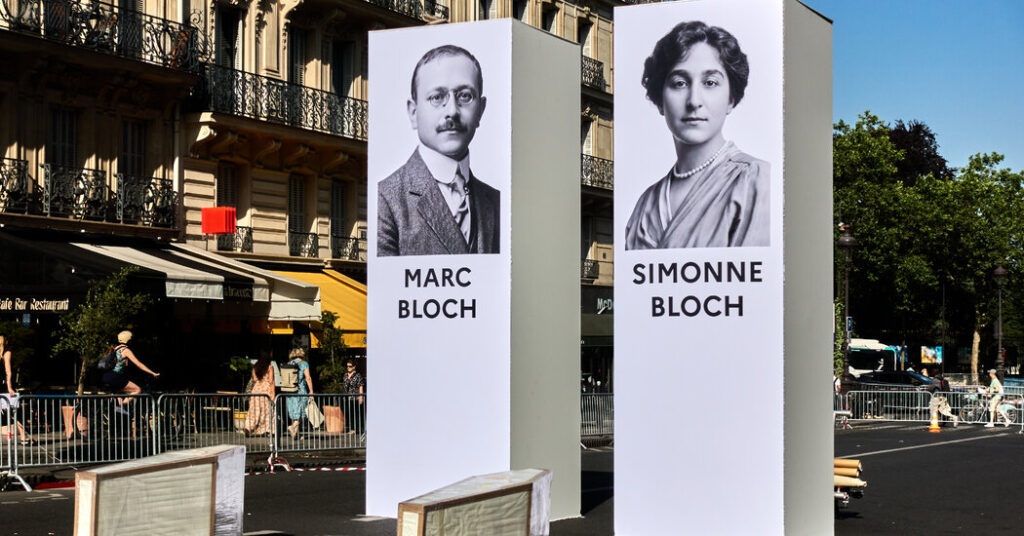
On Tuesday, President Emmanuel Macron is to elevate Marc Bloch, a pioneering French historian and Jewish World War II resistance fighter who was executed by the Gestapo in 1944, to that exalted company. In this case, it is Bloch’s remarkably unifying nature that has made his elevation contentious.
After looming large for decades on university campuses in Europe and the United States, his courageous personal story has been picked up by French politicians of all parties, including those on the far right, who embrace him as a patriot. That has put Bloch in the middle of a political tug of war.
Last October, Jordan Bardella, the president of France’s main far-right party, the National Rally, cited Bloch’s commitment to truth, in a letter demanding transparency in the release of statistics about illegal immigration from the interior minister. That offended members of Bloch’s family and scholars, who have called on the government to bar far-right leaders from attending Tuesday’s ceremony. (It did not agree.)
“It’s more than grotesque; it’s scandalous,” Peter Schöttler, a German historian and author of a new biography of Bloch, said of the far right’s co-option of him. “Marc Bloch is a victim of these people who contributed to the founding of the National Rally,” he said, referring to the party’s antisemitic past, which it has since disavowed.
Far from being a right-wing nationalist, Mr. Schöttler said, Bloch was more likely a “man of the left,” though he kept his politics discreet in a career marked by both prestige and pain. Stripped of his professorship when the Nazi-backed Vichy government took over southern France, Bloch joined the underground resistance movement in Lyon in 1943.
Earlier in the war, while serving as an army officer, Bloch wrote “Strange Defeat,” a searing analysis of why France fell so swiftly to the Nazis. “Our leaders, or those who acted in their names, were incapable of thinking in terms of a new war,’’ he wrote. “The German victory was, essentially, an intellectual victory.’’
The book drew little attention when it was published posthumously in 1946. But Bloch’s focus on France’s institutions and an out-of-touch elite resonated in 2020, during the coronavirus pandemic. It has remained unexpectedly popular in a country hobbled by political and economic crises.
“It’s a catalog of ills in France, and it’s brutal,” said Carole Fink, an American historian who wrote the first major biography of Bloch, published in 1989, and has traveled to Paris for the ceremony.
Yet Professor Fink said Bloch’s criticisms were leveled not with contempt but in the spirit of bettering the country. That may account for the book’s newfound popularity in France. Mr. Macron keeps a copy of “Strange Defeat” on his night stand, according to the president’s office.
Bloch is the first historian to be elevated to the Panthéon, a Greek-style monument in the Latin Quarter of Paris. He will join other major figures of the French Resistance, including one of its early leaders, Jean Moulin, and the American-born dancer Josephine Baker.
Bloch’s casket will be interred alongside that of his wife, Simonne Vidal, but at the request of his family, his ashes will remain in a village in central France where he lived for much of his life.
Born in 1886 in eastern France, Bloch was the son of a historian of the Roman Empire. His father championed the cause of Alfred Dreyfus, a Jewish army officer falsely charged with espionage in 1894. Though Bloch never rejected his Jewish identity, he was not religious and said he claimed that identity only when confronted with antisemitism.
A scholar of medieval history, Bloch rose to be a professor at Sorbonne University, where he pioneered the integration of other social sciences into traditional historical research. In 1929, he and Lucien Febvre, another historian, founded Annales, a journal that helped popularize this approach.
That work has made Bloch a heroic figure among academics, Professor Fink said, the first to show that history is “not just about wars and treaties and kings; it’s about how we live.” He was fluent in economics and fascinated by technology, she said, adding, “A.I. — I mean, he would be brilliant with this.”
But the war sidelined Bloch’s academic career. Offered an academic post in the United States, Bloch ended up not fleeing the country he loved so deeply. “Nourished by its spiritual heritage and its history,” he wrote of France, he was “incapable of conceiving another land whose air I could breathe with such ease.”
As a resistance fighter, Bloch organized supplies and wrote for underground publications. On June 16, 1944, 10 days after the D-Day landings, he was executed near Lyon by a firing squad, along with 29 fellow fighters.
The post Soldier, Scholar and Symbol: Marc Bloch Is Elevated to France’s Panthéon appeared first on New York Times.