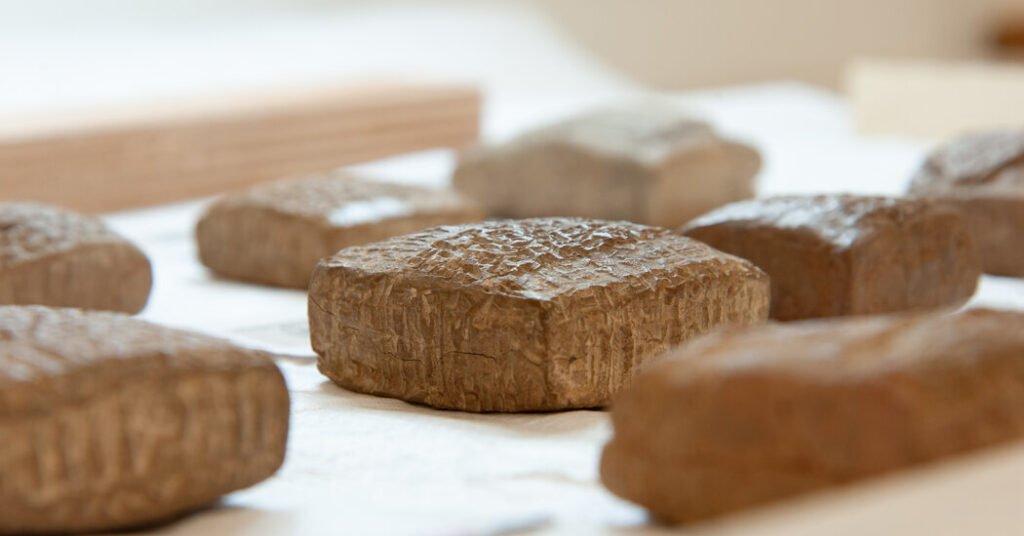
Out with the hammer, in with the X-rays: Researchers have traded brute force for technological finesse when it comes to reading ancient letters.
Cuneiform is the world’s oldest written script, and its characteristically wedge-shaped impressions have been found on clay artifacts unearthed in countries like Iraq, Syria and Turkey. More than half a million cuneiform artifacts have been discovered, but many of them remain tantalizingly unstudied for a very simple reason: They’re tightly wrapped in one or more layers of clay, the Mesopotamian version of an envelope.
Researchers used to smash the envelopes open, but a team has now developed a portable X-ray scanner that can digitally peel away the layers of clay to reveal the writing inside, with no destruction necessary.
The researchers have taken their scanner to several museums, and the 4,000-year-old letters they have analyzed have shed light on both trading practices and the role of women in Anatolian society. The results were recently published in the journalnpj Heritage Science.
Artifacts bearing cuneiform script tend to be small, rectangular clay tablets roughly the size of a smartphone. Made by pressing a stylus, often reed or wood, into damp clay, these tablets were used to record contracts, legal and administrative matters and personal correspondence.
Sealed tablets survive to this day, whether abandoned long ago by their recipients or misplaced in the ancient world’s version of undeliverable mail. And while the envelopes containing legal and administrative documents are often inscribed with summaries of their contents, a sealed letter is a decidedly more private matter.
“You have only the name of the sender and the name of the recipient,” said Cécile Michel, a researcher who studies ancient Mesopotamia at the National Centre for Scientific Research in France and the University of Hamburg in Germany. “I would love to see what’s inside.”
To build the device, Dr. Michel teamed up with Christian Schroer, an X-ray physicist at the Centre for X-ray and Nano Science at the Deutsches Elektronen-Synchrotron in Germany and the University of Hamburg, and they turned to the tried-and-true technology of X-rays.
A technique called X-ray computed tomography involves firing X-rays at an object and measuring how they’re absorbed. By repeating that process from many different angles, it’s possible to reconstruct an object’s three-dimensional interior structure.
The team spent four years designing and building a portable X-ray scanner. The completed device can capture over 1,400 images of an object in under 15 minutes, after which a program analyzes the images to create a three-dimensional view. The technology is good enough to resolve the cuneiform script, differentiate between the handwriting styles of different scribes and even pinpoint how many layers of clay went into forming each envelope.
The scanner can be disassembled into eight portable pieces, so it can travel from site to site and give more institutions access to the technology, Dr. Michel said. Off-the-shelf X-ray scanners do exist, but most weigh several tons and are generally immovable. Most museums don’t have one, Dr. Michel said.
It’s also rare for a museum to be willing to ship off its tablets for analysis elsewhere. “These objects are so precious that they never leave museums. We have to bring the technology to the objects,” Dr. Michel said.
Philip Jones, a collections manager at the University of Pennsylvania Museum of Archaeology and Anthropology, can attest to the care that cuneiform tablets receive. He was once asked to personally deliver a set of tablets to a different museum, and flew first class while the tablets were in his possession. There was no such luxury on the flight home. “The tablets were worth more than I was,” Dr. Jones said.
So far, Dr. Michel, Dr. Schroer and their colleagues have brought their scanner to museums in France, Germany and Turkey and have analyzed over 100 sealed tablets. The newly revealed texts record “hints about daily life and the relationships between men and women 4,000 years ago,” Dr. Michel said. They include details, for instance, about a merchant receiving a shipment of textiles and a woman attempting to settle a debt on her absent husband’s behalf.
It’s exciting to think about getting to analyze more of these objects without having to remove them from a controlled environment, Dr. Jones said: “The fact that they’re coming up with something that you can actually take out to museums is a real breakthrough.”
The post X-Ray Specs for the World’s Oldest, Sealed Letters appeared first on New York Times.