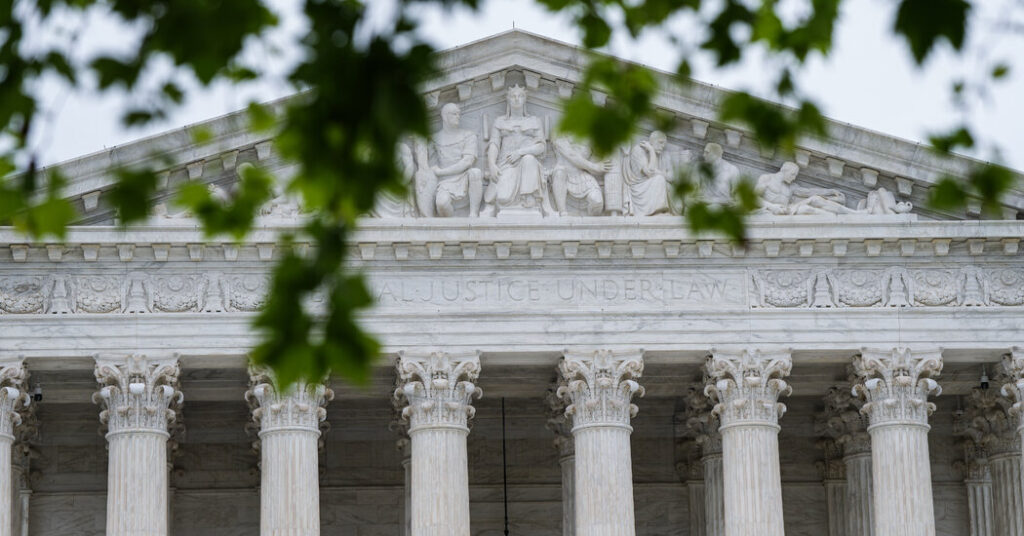
The Supreme Court is in the homestretch of its term and expected to announce more than a dozen remaining opinions over the next two weeks, starting Tuesday morning. They include major cases that will decide the fate of key aspects of President Trump’s agenda.
Before the justices take their annual summer break, they will resolve a series of high-profile cases testing the administration’s policies to expand presidential power and reshape the federal bureaucracy.
Significant decisions still to come will determine whether Mr. Trump can end the longstanding guarantee of birthright citizenship for the U.S.-born babies of undocumented immigrants and fire Lisa D. Cook, a leader at the influential and independent Federal Reserve.
Already in February, Chief Justice John G. Roberts Jr. and two justices who were nominated by Mr. Trump during his first term joined the court’s three Democratic nominees to invalidate the president’s sweeping tariffs on imports from nearly every major U.S. trading partner.
Mr. Trump was furious about that ruling. He has repeatedly criticized the opinion and the justices who ruled against him, calling them “fools and lap dogs.”
In recent weeks, he has appeared to be bracing for another setback in the birthright citizenship case. In April, Mr. Trump attended oral arguments in the matter, a first for a sitting president. He later bemoaned on social media what he called “nasty, one sided questions” from the justices “on the country destroying subject of Birthright Citizenship.”
On the flip side, Mr. Trump seems more likely to prevail in his efforts to oust independent government regulators. In a case that involves Mr. Trump’s attempt to fire a member of the Federal Trade Commission, the justices are being asked to overturn a 90-year-old precedent that has limited the ability of presidents to fire top agency officials without cause and solely over policy disagreements.
In the first year of Mr. Trump’s second term, the Supreme Court issued a series of quick-turn orders that overwhelmingly allowed the president to implement his policies while litigation continued in the lower courts. The court, for instance, permitted the administration to terminate deportation protections for hundreds of thousands of Venezuelans.
But that decision, like other wins in 2025 for Mr. Trump, came in an emergency order that the justices issued without providing detailed reasoning. It did not examine whether homeland security officials followed the procedures outlined in federal law for ending the program. Now the justices are deciding whether the administration can immediately end humanitarian protections for hundreds of thousands of Haitian and Syrian migrants who have been living and working legally in the United States. A resolution of that matter, too, is expected in coming days.
After Tuesday, the justices are expected to release additional decisions on Thursday morning and are likely to take to the bench at least once more before the July 4 holiday, until they release decisions in all of the cases they have heard since their term began in October.
Other high-profile cases that the justices will soon resolve include determining whether a gun control measure in Hawaii violates the Second Amendment and whether states can adopt laws barring the participation of transgender athletes from school sports.
Based on their questions during oral arguments in January, the justices appeared likely to allow laws in West Virginia and Idaho that bar transgender women from participating on girls’ and women’s sports teams. The court will also decide whether Mississippi and other states can permit mail-in ballots postmarked by Election Day to be counted if they are received within five business days after the election.
The ruling could have far-reaching consequences for voters in the midterm elections, potentially creating chaos among states that allow mail-in balloting.
The post Major Supreme Court Decisions Testing Trump’s Policies Remain appeared first on New York Times.