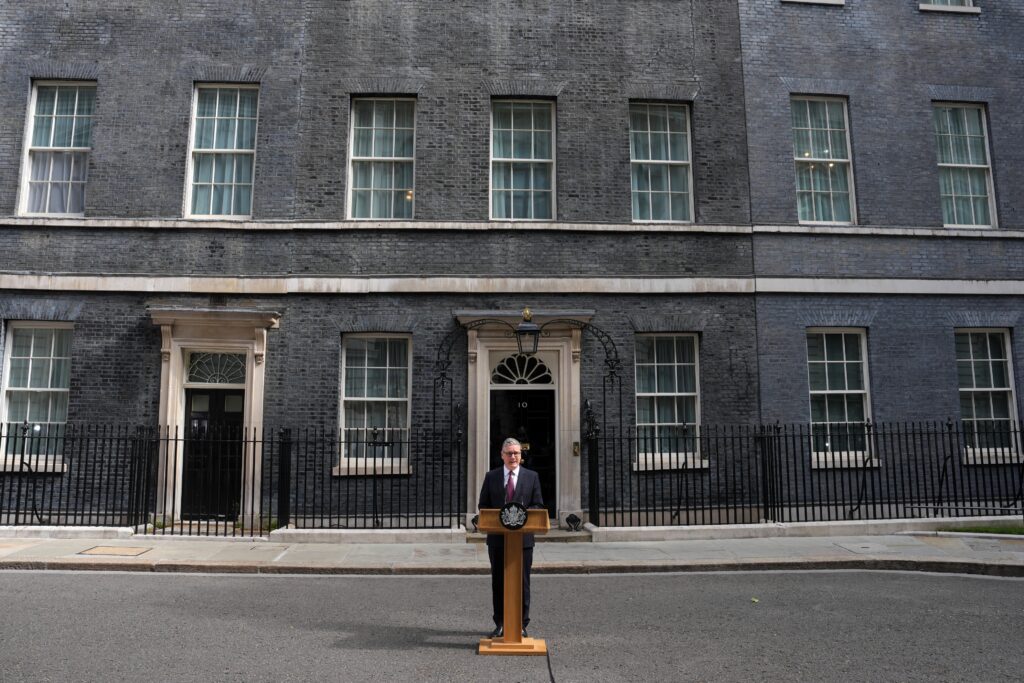
LONDON — Announcing his resignation on Monday, U.K. Prime Minister Keir Starmer appeared in a uniquely British tableau: the small lectern, the glossy black door, the brass “No. 10” gleaming over his shoulder. Starmer was the sixth occupant of Downing Street to quit under pressure in the last decade.
But while the setting was pure London, the forces that felled him were not particular to Britain — they were the latest gusts in a populist gale that is battering mainstay political parties from Washington to Paris to Berlin.
Across the West’s advanced democracies, conventional parties of the left and right are being gutted by the same dynamics: stagnant wages, a fraying social contract, an electorate that has concluded the people running things either can’t or won’t fix what’s broken.
In nearly every case, that fury has organized itself around an outsize figure or two — Donald Trump in the United States, Marine Le Pen in France, Alice Weidel in Germany, Nigel Farage in Britain — and around fiery rhetoric rather than a party platform or governing philosophy.
These figures differ in temperament and ideology, but they share a method: convert diffuse anger over immigration, the cost of living and a sense of national drift into a singular, durable political brand, then let the establishment’s own panic do the rest of the work.
Farage, an architect of Brexit — Britain’s departure from the European Union that is now viewed as an economic failure — and the leader of the surging Reform UK Party, didn’t need to win an election himself to topple Keir Starmer. He just needed to scare Labour lawmakers into doing it themselves.
“Starmer isn’t the first Prime Minister I’ve deposed,” Farage boasted on Monday, “and he won’t be the last.”
Starmer took office in July 2024 on Labour’s biggest electoral landslide in a generation, ending nearly 15 years of Conservative Party rule that had delivered Brexit, austerity and a revolving door of its own — five Tory prime ministers in eight years.
Within months Starmer’s approval ratings had collapsed, in part by missteps of his own — including a reduction of heating subsidies for the elderly — but largely by the impatience of voters increasingly willing to abandon the two parties that have run Britain for more than a century in favor of insurgents who promise simpler answers.
In France, Les Républicains on the right and the Socialist Party on the left never recovered from the defeat they suffered at the hands of Emmanuel Macron, who won the presidency campaigning as an outsider in 2017. Since then, France has had seven prime ministers and Macron has governed without a parliamentary majority since 2022. With Macron term-limited, Le Pen’s anti-immigrant National Rally is leading in the polls ahead of an election next year.
Germany’s traditional coalition politics have grown steadily more fragile as the nationalist Alternative for Germany (AfD) party, branded “far-right extremist” by the country’s domestic intelligence agency, has surged in popularity. Since March, multiple polls show AfD running ahead of Chancellor Friedrich Merz’s Christian Democratic Union.
And in the U.S., Trump’s MAGA movement has shown how thoroughly a populist insurgency can redefine a mainstream party from within rather than simply challenging it from outside.
Britain version of the story carries its own twist. In local elections in May, Labour and the Tories were trounced by Reform UK party. Labour MPs quickly called for Starmer’s head.
In his tearful resignation speech — delivered one day before the 10th anniversary of the Brexit vote — Starmer gamely listed his government’s achievements. They didn’t matter.
The moment recalled President Joe Biden’s many futile attempts to highlight an improving economy as his party pushed him aside. Biden and Starmer each had defeated rivals who alienated voters — Trump in the U.S. and the Tories in the U.K. And both Biden and Starmer quickly faced the same wrath.
“The trust in the leadership falls away almost immediately,” said Tony Travers, a political science professor at the London School of Economics.
While American presidents serve a fixed term, Britain’s parliamentary system makes it easier to force change. “With prime ministers, you can get rid of them any day of the week because you just need a majority of the members on their side of the House of Commons to decide they’ve had enough,” Travers said.
Starmer’s likely successor is Andy Burnham, the Liverpool-born mayor of Greater Manchester who has spent a decade styling himself as the unpretentious, plainspoken voice of Northern England.
Burnham, 56, could be prime minister within weeks. But whether he, or any politician, can calm the political churn that toppled Starmer — and the five prime ministers before him — is unclear.
Burnham arrives with advantages Starmer lacked. His assets include a personal brand built over three popular terms as mayor and a decisive win last week for a parliamentary seat in a working class district, where he soundly defeated an opponent from Reform UK. The result was better than many Labour strategists had dared hope.
Now, with his rivals in a potential leadership contest stepping aside, Burnham will claim a convincing mandate without the bruising public fight some in the party feared. And his supporters hope his everyman demeanor and soft Northern burr will break through to jaded voters in ways the more beige, technocratic Starmer never could.
But the problems that will confront him when he steps into No. 10 will be the same that have stymied Starmer and old-school leaders across other Western democracies.
“The challenges he faces aren’t that different from the ones that Keir Starmer faces,” said Tim Bale, a professor of politics at Queen Mary University of London. “He seems to be a better communicator than Starmer, seems to probably be better at building a team and bringing different interests together. But that doesn’t mean that the problems he’s facing are any easier.”
The same is true in France, where a high quality of life has become difficult for the country to sustain, forcing a fractious debate.
Britain ousted the Conservative Party in 2024 in part out of fury over where Brexit — which the Tories championed — had left the country: stalled growth, strained public services, immigration numbers that kept climbing despite promises they would fall.
Two years later, many of those voters are now repudiating Labour to embrace Reform UK, led by Farage, perhaps the politician most responsible for Brexit.
“It is an irony that Brexit fragmented support for the two long-term major parties in the way it did and that only 30 percent of people in Britain today still think Brexit was a good idea,” Travers said.
On both sides of the Atlantic, mainstream parties are looking for candidates who can defuse antiestablishment anger. American Democrats have spent two years searching for their own version of plainspoken populism — floating figures like Kentucky Gov. Andy Beshear and Texas state Rep. James Talarico, a Senate candidate whose folksy, Bible-quoting delivery has made him an unlikely liberal star.
Burnham’s backers think he could be an antidote to populist toxins, based on his success in governing a fast-growing region of 3 million diverse residents in northwest England.
He is no outsider. Burnham held a House of Commons seat for 16 years before giving it up in 2017 to become the first mayor of Greater Manchester, a political district encompassing Manchester — England’s second largest city — and surrounding towns and villages.
Burnham honed an interventionist style of local governance. His vocal campaign for payments to furloughed workers in his region during the pandemic earned him the nickname “King of the North.”
One his most visible initiatives was to cap bus fares at two pounds and used public control — not nationalization, his supporters are quick to point out — to force Manchester’s long-privatized transit companies to serve routes the private market had abandoned.
Throughout, he managed to push his agenda without sparking a backlash from businesses or more conservative voters, winning reelection in 2021 and 2024 during an era of anti-incumbent politics.
Longtime Labour pollster and consultant Marcus Roberts said Burnham’s “Manchesterism” could work on the national stage, and even globally.
“It’s not that Britain is ungovernable, it has to be governed in a different way,” said Roberts, the CEO of Mandate Research, a strategic data consultancy. “Andy Burnham’s approach is not the government does everything. It’s that the government can make smart moves where there are market failures to improve the situation for citizens.”
Replicating that on a national stage will be far harder, particularly on immigration, where Reform UK has built its entire political identity around keeping voter anger at a boil.
Starmer, a former human rights lawyer, tried to straddle the imperatives of enforcement and compassion, adopting policies that sought to stem, with only partial success, the flow of asylum seekers in small boats. He also adopted some of Reform’s more caustic rhetoric, alienating some in his own party.
Burnham will need to achieve a similar goal: making progress on controlling the border without offending his base. Some analysts say Burnham will need to tack even further to the left.
“The priority has to shift from trying to get voters back from Reform who are never going to come back, to at least trying to get back some of those voters who have deserted to the Greens and nonvoting,” Bale said.
Burnham won’t have much time to figure it out.
The party is likely to carry on with a leadership election, Bale said, if only to give Burnham a few extra weeks to select and brief his cabinet ministers.
Each of the last six British prime ministers arrived promising to be the exception to the merry-go-round of predecessors and unquenchable voter rage. Burnham may well prove a more skilled rider. But around the world, the leadership carousel is still turning.
The post Keir Starmer is out. Other establishment politicians are in trouble. appeared first on Washington Post.