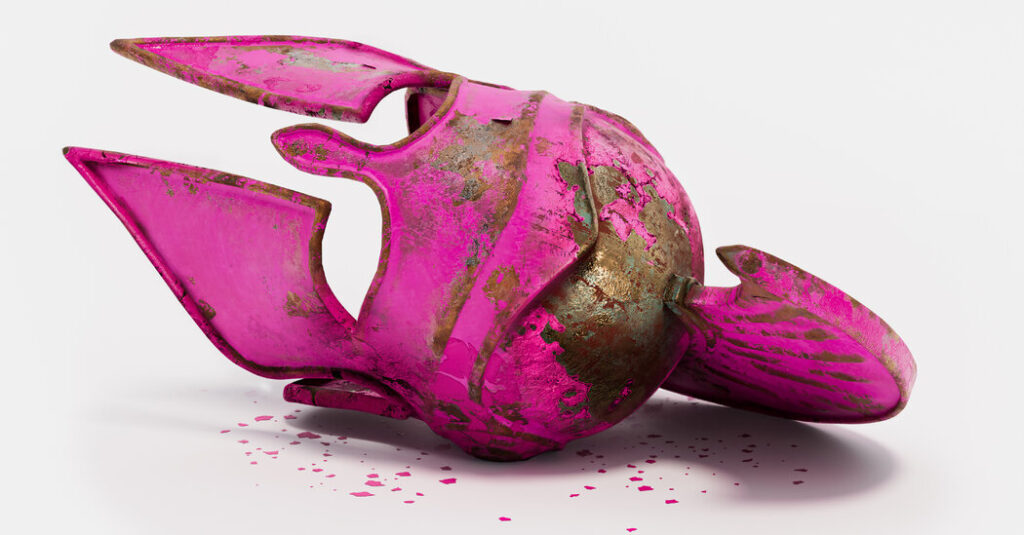
Among the many afflictions distorting our current politics, one has gone unrecognized: We’re in the midst of a zero-sum struggle over which gender gets to own the hero’s journey, that ancient story formulation in which the hero leaves home, faces monsters and temptations and returns to reclaim his kingdom and his woman from usurpers. In modern times, the question of whether the hero must be male has been contested and recontested.
The fight is about more than a story. We feud over certain foundational myths because whoever owns the myth owns the culture.
It’s hard to get more foundational than Homer. Sitting in my local wide-screen Cinemark, mid-slog through Christopher Nolan’s “The Odyssey,” a film that hardly veers from the high-testosterone, man-on-a-quest Homeric template, I was struck by an odd sensation. Hadn’t I already seen this movie, but in a different palette?
Indeed I had, in the same theater on another July day three years ago. That version featured a female protagonist who journeys by car, boat, spaceship, bicycle, snowmobile and Rollerblades to a foreign land fraught with perils. She eludes a horde of male suits who want to lock her in a box before returning to her pastel principality to find it besieged by boisterous bros. Both “Barbie” and “The Odyssey” feature a beach battle with flotillas of bowspritted landing ships and an equine theme, though the horse figure stranded on Ken’s beach is fashioned of pink plastic sand. But while the boys of “Barbie” are brawling, the girls regain the kingdom; matriarchy is restored.
To a topologist’s eye, Greta Gerwig’s “Barbie” and Mr. Nolan’s “Odyssey” are the same objects with different shapes. The difference being that hers is suffused in Crayola hues, has wit and grossed more on opening weekend. (Ms. Gerwig and Mr. Nolan seem star-crossed rivals — Barbenheimer, anyone?) The movies themselves are hardly serious enough to serve as philosophical antagonists. Yet as major cultural artifacts only three years apart, they illuminate a serious shift in our society, going far beyond Hollywood. The showdown over the hero’s narrative is corroding our political and public life, and disfiguring our government.
Our government — all the way to the top. President Trump seems to see himself embarked on a Homeric quest. Tossed from his rightful throne in 2021, he fought his way back and is now wreaking vengeance on the infidels who betrayed him. It’s a quest with a modern twist: His rival as he sought to recover the crown was a woman. The patriarch beat her in part by avowing on the campaign trail that he would “protect” women, before continuing his decimation of their welfare once he won. Since Inauguration Day, his administration has been hellbent on reversing women’s fortunes at every level.
For a short while — with the 2017 Women’s March, #MeToo and outrage over the Supreme Court’s Dobbs decision — it looked as though women had seized the hero’s mantle; they were going toe-to-toe with adversaries from a grab-’em-by-the-pussy prez to a priapic studio head to a Supreme Court injustice. In the heady moment of Brat Summer (before Kamala’s Fall), it seemed as if the heroine’s journey might even end in victory. Until the revanche. “The cavalry has arrived,” Elon Musk proclaimed on Election Day 2024. “Men are voting in record numbers.” (Well, actually not.) How did everything change so suddenly? Or, to quote Barbie: “This is Barbieland! The Barbies worked hard and dreamed hard to make it everything that it is. You can’t just undo it in a day.” Oh yeah?
The hero’s struggle resonates so universally because we’re all up against monsters of one sort or another. The monomyth promises to turn our mundane muddles into noble quests. That’s what’s at stake in the zeitgeist shift between “Barbie” in 2023 and Nolan’s 2026 he-man travelogue: Which sex gets to own that ennobling elixir? The battle is not to be found within the films themselves — which characters win or lose — but between competing claims to the archetypal story. The fight has been re-genderized. It’s no longer Menelaus fighting Paris for the possession of Helen — it’s Menelaus versus Helen. Or Odysseus versus Barbie.
Or Pete Hegseth versus Lisa Franchetti.
Nowhere is the administration’s war on women more evident than in the military itself. Admiral Franchetti, the Chief of Naval Operations, was one of the early high-profile female casualties of Mr. Trump’s new Department of (Trojanesque) War. Women in the military are being punished systematically: their promotions denied, combat capabilities impugned, achievements scrubbed from official websites, the longstanding committee to integrate women into the military shut down and the ceremony to honor their fallen canceled. The most dramatic purges have come at the top, to women who’ve already completed their hero’s journeys, who’ve left home, gone abroad, fought their battles and returned to claim their laurels and rightful posts. Only to be met by Secretary of Defense Hegseth’s Antinous.
Between 2000 and 2018, the number of female generals and admirals had doubled. Now, thanks largely to Mr. Hegseth, the modestly decorated (mostly with tattoos) Army National Guard major and former TV host turned warlord, there are no four-star female officers on active duty in any branch, and no female candidates on the roster of likely four- or three-star appointments. (He’s also turned his sights on troops who are Black or transgender.) A New York Times analysis this month found that women’s nominations to high-ranking posts in the military are at their lowest level in a quarter century. This year, for the first time in a decade, there will be no women nominated to be admirals. (Evidently, women can still aspire to humbler posts like captain or major — women’s nominations to lower-level ranks rose in the past year.) Who are these veteran female officers relieved of their commands by the “central casting” (Trump’s words) matinee idol with the gelled hair and pocket hankie, the face that launched a thousand missiles?
Well, for starters, just in the Navy —
Admiral Franchetti: rose from surface warfare officer to command the Sixth Fleet; first woman to lead the Navy and the first permanent female member of the Joint Chiefs of Staff; 40 years of service. Fired from her post, no explanation. Replaced by a man.
Vice Adm. Shoshana Chatfield: commanded the Helicopter Sea Combat units; first female president of the Naval War College and the only woman on NATO’s Military Committee; 37 years of service. Fired from her post, no explanation. Replaced (in an acting capacity) by a man.
Vice Adm. Yvette M. Davids: veteran of Desert Shield, Desert Storm and the Iraq war; commanded a carrier strike group; first woman and first Hispanic officer to head the U.S. Naval Academy; 36 years of service. Relieved of her post, no explanation. Replaced by a man.
Adm. Linda Fagan, Coast Guard; Vice Adm. Nancy Lacore, Navy; Col. Julie Sposito-Salceies, Air Force; Lt. Gen. Telita Crosland, Army; and on and on. These women didn’t claim heroic status; they embodied what the military has traditionally valued: service, teamwork, courage, dedication. But in terms of their mythic warrior life journeys, they are among our Odysseuses. And their elevation has enraged some Odyssean wannabes eager to enshrine what Mr. Hegseth calls “the highest male standard.”
In his book “The War on Warriors,” Mr. Hegseth maintained that so-called D.E.I. hires have made the military weak and “effeminate.” The “standard,” though, has nothing to do with military effectiveness. Were Admirals Franchetti and Chatfield, General Crosland and company fired for not being good enough? Or for being too good, with skills and experience that threatened the restoration of a masculinist culture? Small wonder the photos of Mr. Trump’s cabinet meetings — especially after the departures of Pam Bondi, Kristi Noem, Lori Chavez-DeRemer and Tulsi Gabbard — have begun to resemble the shipboard scenes in “The Odyssey”: men seated around the edge of a long wooden ellipse, with a board table standing in for a galley deck. Pull, boys, pull!
Mr. Trump’s return to power resembled a sack of Troy — with women getting the sack. A National Women’s Law Center report found that DOGE’s mass layoffs targeted departments with a “substantial majority” of female employees, though the civil service overall leans male. Hardest hit were Black women, especially with college and advanced degrees, whose overall employment rate last year suffered one of the sharpest one-year declines in a quarter century. After Mr. Trump fired the two Democratic female commissioners and the female general counsel of the Equal Employment Opportunity Commission, its new leadership urged white men to file discrimination suits, and the agency sued a Coca-Cola distributor for excluding men from a women’s forum. Information on reproductive health, maternal mortality, employment equity and sexual violence began disappearing from government websites, along with women’s historical contributions and the words “women,” “female” and, of course, “feminism.” NASA employees reportedly received a “drop everything and reprioritize your day” advisory instructing them to delete by 5 p.m. “anything specifically targeting women (women in leadership, etc.).” The administration that insists “there are only two genders” seems determined to make it only one.
Also gone: data collection on women’s advancement, or the lack thereof. The E.E.O.C. voted to toss out the agency’s 60-year-old requirement that companies file annual work force demographic reports, claiming it burdened corporations. Is it any mystery that women have lost ground in corporate leadership two years running and their representation on corporate boards declined in the first quarter of 2026? Or that women constituted 100 percent of the decline in the labor force in December 2025, then again last month, bringing the total net job loss for women this year to 845,000? None of these women got their jobs, or lost them, because they were seen as heroes. Nevertheless, they were collateral damage in the custody fight over the hero’s journey.
That fight has filtered down to saturate workaday lives. Starting in the post-9/11 hero frenzy and accelerating in the “peak woke” era of the early 2020s, more and more ordinary struggles have been deemed heroic. For a while, thanks to feminism, women enjoyed an advantage in garnering those commendations. They didn’t just become firefighters or telephone linemen. They’d slain the Cyclops of sexism. Not to gainsay their grit, but their lionization came with a cost. The kudos over every valiant ascent excited the anger and envy of some men who, if they became telephone linemen, became … telephone linemen. In “Barbie” terms: just Ken. The backlash isn’t simply about who gets to do the job — it’s about who gets glorified for doing the job. Witness Mr. Hegseth’s book with its repeated fulminations about servicewomen showcased as heroes by a “military P.R. machine, looking for a ‘first.’”
Diversity measures were created to open up pragmatic, incremental opportunities for people long deprived. But there is nothing pragmatic or incremental about being a hero. The right sees D.E.I. as a plot to dethrone the men who once stood on Mount Olympus. For its part, the left employs the hero mythology to validate its causes, and uses journeys out of persecution, abuse, every misfortune from A.D.H.D. to PTSD, to place its contentions beyond debate and stamp even well-meaning dissenters as intolerant. The right has its own hero-martyrs. It’s a strategy to be wary of. When Purple Hearts become Medals of Honor, when suffering is conflated with valor, critique is relabeled as heresy. Surely not every victimhood drama has engendered a fascism, but every fascism has used a core myth of injustice and injury to justify its absolutism and brutality.
The purpose of civic society and government — in the democratic world, anyway — is to serve the unheroic needs of ordinary people. Not to make a mess of their lives on the way to staging a cage fight on the White House lawn. Or to assert personal virtue through a megaphone. One raised fist begets another.
Mr. Nolan’s “Odyssey” comes to an awareness, banal though it may be, of the hero’s moral peril. Matt Damon’s Odysseus is guilt-ridden over his leading role in the destruction of Troy, a violation of xenia, Zeus’s law of hospitality. In Homer’s original epic, the reckoning is more existential. Odysseus tries to console the despondent ghost of Achilles, now in Hades, telling him the Greeks “honored you as a god” immortalized by brave deeds. Achilles retorts, “By god, I’d rather slave on earth for another man — some dirt-poor tenant farmer who scrapes to keep alive — than rule down here over all the breathless dead.” It’s a desire that Odysseus shares. When Calypso offers him eternal life if he will remain on her island, he refuses. He’d rather go home to his wife and family — and lead a mortal’s existence.
That immortality offer disappeared from Mr. Nolan’s script but was present in Ms. Gerwig’s. In the finale, Barbie can opt to remain a timeless toy in Barbieland, waking up forever in her Dreamhouse to her “best day ever.” But she is determined to return to the real world, to become an ordinary adult woman with all the difficulty, messiness and mortality that implies. However convenient or trite such movie sentiments may be, they are instructive. They suggest there’s another way to end the story. Can we free our civic life from heroic imperatives, return our governance to the humble and the human? The object of any healthy politics is not to win but to prosper. We are all soldiers in that quest, and none of us heroes.
Susan Faludi is a journalist and the author of “Backlash: The Undeclared War Against American Women” and, most recently, “In the Darkroom.”
The Times is committed to publishing a diversity of letters to the editor. We’d like to hear what you think about this or any of our articles. Here are some tips. And here’s our email: [email protected].
Follow the New York Times Opinion section on Facebook, Instagram, TikTok, Bluesky, WhatsApp and Threads.
The post The Barbie Backlash appeared first on New York Times.