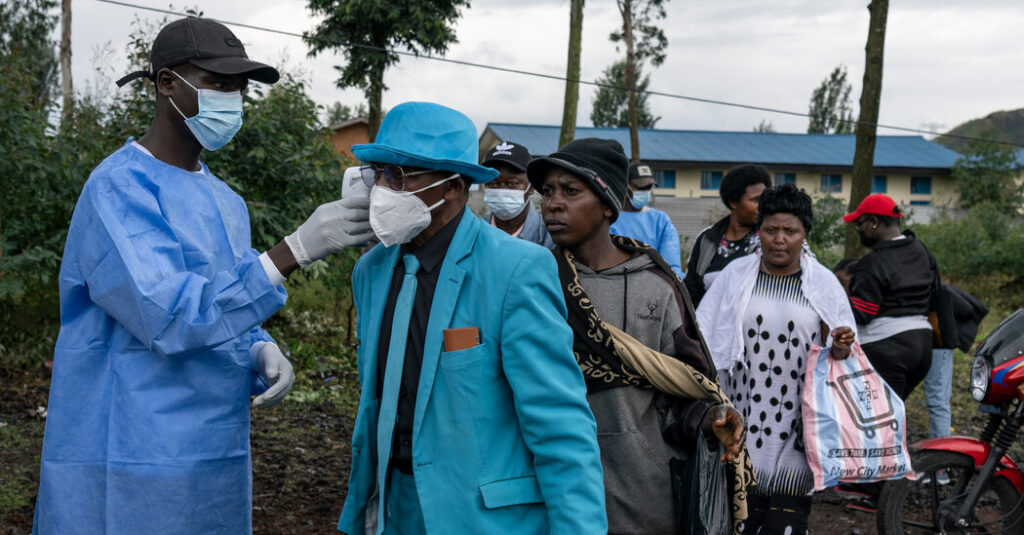
Doctors treating Ebola patients in the Democratic Republic of Congo say the symptoms may be milder than in previous outbreaks of the disease.
There is too little data yet to be certain, but an assessment by the ministry of health in Congo suggests that about 90 percent of patients do not seem to develop the extensive internal and external bleeding that can arise in the disease’s horrific end stages, according to Dr. Marie-Roseline Belizaire, who leads the World Health Organization’s response to the outbreak. Some early data also suggests that fewer people may be dying this time compared with previous outbreaks.
Milder symptoms, and perhaps a lower chance of death, are undoubtedly good news for the patients. But they could paradoxically make it harder to control spread and end the outbreak.
“That’s really what I’m a bit anxious about, that this might be an indicator for an outbreak that lasts a lot longer,” said Dr. Chikwe Ihekweazu, the executive director of the W.H.O. Health Emergencies Program.
The current outbreak, which was detected in mid-May, has already sickened more than 1,000 people and killed more than 250, according to Congo’s health ministry. The true numbers are likely much higher. Public health experts believe the outbreak simmered undetected for months; the milder symptoms may partly explain why.
The virus causing the outbreak, Bundibugyo, is distinct from the virus, often known as Zaire, that caused most previous epidemics of the disease. But all Ebola patients generally progress from what doctors call “dry” symptoms — fever, body ache, fatigue — to “wet” symptoms of diarrhea and vomiting.
Both of those stages can mimic myriad other illnesses that affect people in Congo, including malaria, typhoid and dysentery. With Ebola, however, eventually people’s blood vessels and organs start to break down, and the failure of multiple organs may precipitate gruesome deaths.
In the case of Zaire Ebola, which killed more than 11,000 people in a 2014 outbreak in West Africa, about half of people developed the dramatic bleeding symptoms. If only about 10 percent of patients with Bundibugyo reach that stage, many who become ill might continue to interact with others and spread the virus without seeking care.
“It makes total sense to me now how this was missed for months,” said Dr. Nahid Bhadelia, the director of Boston University’s Center on Emerging Infectious Diseases.
Dr. Bhadelia and her colleagues have found four unresolved clusters — including one in Burundi and one in South Sudan — of viral hemorrhagic fever that they suggest may be part of the outbreak. If they are, the virus may have spread far more widely and for longer than previously thought.
It is extremely challenging to find mildly ill patients and trace their contacts who may have been exposed. So far, patients have named five to eight contacts on average, compared with the expected range of 15 to 40 contacts per case, said Dr. Craig Spencer, a public health expert at Brown University who has treated Ebola patients. And only about half of those named contacts have been found.
Those unfollowed contacts “are out there continuing to spread smaller fires, each one of which can blow up into something much bigger,” Dr. Spencer said.
The mortality rate of the Zaire virus can top 80 percent when no vaccines or treatments are available. The rate in this Bundibugyo outbreak has varied widely depending on the resources available in a community, but overall it seems to be less than 30 percent, according to the W.H.O.
That jibes with the death rate observed in previous outbreaks of Bundibugyo, noted Dr. Babou Rukengeza, the Ebola response lead in Congo for the advocacy group Save the Children.
“From the literature, when we compare the mortality rate, you’ll see very clearly that Bundibugyo has less mortality rate compared to other types of Ebola,” he said.
As in previous outbreaks, health workers have been most at risk of exposure, and at least 18 have died so far. Some health workers who became sick earlier in the outbreak may have gone undiagnosed.
Dr. Patrick LaRochelle, an American physician who was flown to the Czech Republic to quarantine after a possible exposure, said dozens of his colleagues at the hospital in Bunia, Congo, had become sick starting in mid-April. Many had severe itching, but without the rash that sometimes accompanies Ebola, and most recovered without becoming severely ill.
“I was convinced it was some sort of other virus,” he said. Many of the tests from that time went missing, so it is still unclear whether they had Ebola, he added.
Many patients are arriving at hospitals only when they are close to death. Some refrain from seeking care because they mistakenly attribute the symptoms to malaria, witchcraft or poisons. Others fear that their organs will be harvested when they are isolated.
“It’s quite severe and quite difficult to control once they reach that stage,” said Dr. Abdou Sebushishe, who is helping to lead the outbreak response for the International Medical Corps.
Some patients may also lose precious time by seeking care from traditional healers or from small health centers. Larger Ebola treatment centers in Ituri Province, the epicenter of the outbreak, are now well equipped, but Dr. Sebushishe said he was increasingly concerned about the towns of Beni and Butembo in the neighboring province of North Kivu, where resources, including testing, are extremely limited.
“That is something that needs to be addressed quickly to control this outbreak fast,” he said.
Even in Ituri, most small health centers lack basic gear like gloves and are struggling to keep up.
“It was and is an extremely fragile health system that already had many issues in terms of trying to provide support to the population,” said Kate White, the emergency medical coordinator for Doctors Without Borders in Congo.
Declan Walsh contributed reporting.
The post Ebola Symptoms in Current Outbreak May Be Milder Than in Previous Ones appeared first on New York Times.