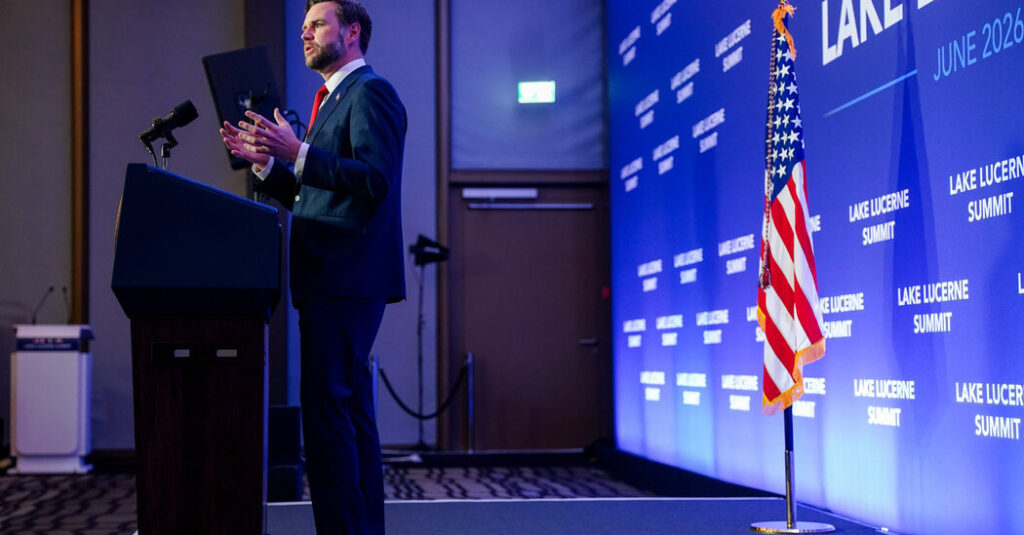
Vice President JD Vance on Monday declared the first round of U.S.-Iran talks “a successful foundation” for a lasting peace agreement.
He said Iran had agreed to invite United Nations nuclear inspectors back into the country. The Treasury Department granted a 60-day exemption to U.S. sanctions on Iranian oil while talks are underway.
If confirmed, those provisions would echo key parts of the 2015 nuclear accord. President Trump withdrew the United States from that agreement three years later and derided it as “one of the Worst Deals ever.”
Neither the war nor the cease-fire struck by Tehran and Washington has eliminated what U.S. and Israeli officials regard as the main threats from Iran: the country’s nuclear program, authoritarian regime, ballistic missiles and the armed groups that it backs in the region.
In the near term, there are two major issues clouding the peace process: how to enforce a cease-fire between Israel and Hezbollah in Lebanon and how to ensure oil tankers and other shipping flow freely again through the Strait of Hormuz.
Here’s a guide to understanding the talks.
What just happened?
In the first installment of talks, U.S. and Iranian negotiators agreed to a road map for reaching a final deal within 60 days, mediators said on Monday.
Mr. Vance said negotiators had created a direct line of communication to avoid incidents in the Strait of Hormuz and a “de-confliction cell” to keep the peace in Lebanon.
“This is a work in progress,” Mr. Vance said, adding that the new process would help “ensure it doesn’t spiral out of control in the future.”
He also said Iran had agreed to invite inspectors from the U.N. nuclear watchdog, the International Atomic Energy Agency, back into the country. There was no immediate response from the agency or Iran.
Qatar and Pakistan, which are mediating the talks, said technical discussions would continue in Switzerland over the next week.
How did we get here?
Here are some of the key events since the latest round of fighting between the United States, Israel and Iran began:
Feb. 28: The United States and Israel launch airstrikes on Iran, which Mr. Trump said would transform the Middle East and terminate the threat from what he called a “wicked, radical dictatorship.”
March 1: Hezbollah drags Lebanon into the conflict, firing rockets toward Israel in retaliation for the killing of Iran’s supreme leader.
Early March: Iran’s missile and drone strikes on oil facilities and tankers effectively close the Strait of Hormuz, the route for a fifth of the world’s oil and much of its gas, fertilizer and other crucial commodities.
April 7: The United States and Iran announce a two-week cease-fire.
April 12: U.S.-Iran talks end with no agreement as the two sides fail to compromise on major points, including Iran’s uranium stockpile and reopening the Strait of Hormuz.
April 13: The United States initiates a blockade of Iranian ports.
April 16: Israel and Hezbollah agree to a 10-day cease-fire in Lebanon.
June 7: Israel strikes the outskirts of Beirut targeting Hezbollah. Iran retaliates with its first airstrikes since the cease-fire.
June 15: The United States and Iran sign a memorandum of understanding that halts fighting for 60 days.
Who’s at the table?
The United States: Mr. Vance led the delegation in the round of talks that ended on Monday. Treasury Secretary Scott Bessent announced the oil-sanctions reprieve. The negotiating team also included Steve Witkoff, Mr. Trump’s special envoy, and the president’s son-in-law Jared Kushner.
Iran: Tehran’s delegation for the talks that ended on Monday was led by the speaker of Iran’s Parliament, Mohammad Bagher Ghalibaf. Foreign Minister Abbas Araghchi also spoke for Tehran. As Iran’s senior delegation departs, technical discussions will be led by Iran’s deputy foreign minister, Kazem Gharibabadi.
Qatar, Pakistan and Switzerland: Qatar and Pakistan, which helped to bring the United States and Iran to the negotiating table, are mediating the talks. Switzerland is hosting them at the luxury Bürgenstock Resort on Lake Lucerne.
And who’s not?
Israel, which launched the war against Iran alongside the United States, was not a party to last week’s initial deal. Nor was Hezbollah, the Iran-backed militant group. Both militaries appeared to be maintaining a tense cease-fire in Lebanon for a second day on Monday.
Israel’s top diplomat warned that the country would not withdraw its forces from the self-declared “security zone” it has established in Lebanon, up to about six miles north of the border.
Cease-fires in Lebanon have been declared, broken and reinstated numerous times in recent weeks. Over the weekend, several Israeli soldiers in Lebanon were killed by Hezbollah, according to Israel, setting off waves of Israeli retaliatory strikes.
The key sticking points
Could Iran still build a nuclear weapon?
The most difficult issue in the U.S.-Iran talks — what to do about Iran’s nuclear program and its stockpile of enriched uranium — has been left for later. So far, Iran has only reiterated its longstanding promise not to develop nuclear weapons, saying its program is purely for civilian purposes. The country’s president said on Sunday that Iran would “never back down” from its right to enrich uranium.
If Mr. Vance’s claim about Iran’s agreeing to U.N. inspections is confirmed, it would be a significant shift. Inspections were a key part of the nuclear accord that the Obama administration and five of the world’s most powerful countries struck with Iran in 2015. After Mr. Trump withdrew the United States from that accord in 2018, Iran began limiting inspections of its nuclear facilities, and it all but ended them last year, after some of the sites were hit by U.S. and Israeli attacks.
Who will control the Strait of Hormuz?
The status of the strait was thrown into confusion on Saturday, after Iran claimed it was closing the waterway over the fighting in Lebanon, its most powerful form of immediate leverage over the global economy. Mr. Vance insisted on Monday that the strait was open to shipping traffic.
Oil prices have swung with every twist and turn in the conflict, falling more than 2 percent on Monday’s signs of progress.
Iran’s financial interests
Iran stands to reap significant financial rewards from the U.S. sanctions exemption, which represents a sharp reversal of American policy.
Mr. Vance also outlined a U.S. proposal to potentially unfreeze seized Iranian assets, a core demand of Tehran’s in the negotiations. Under the proposed deal, any unfrozen Iranian assets would have to be spent buying U.S. goods, such as soy and wheat.
The preliminary deal also commits to developing a $300 billion reconstruction fund for Iran. Mr. Trump has said the U.S. government would not contribute, leaving open the possibility that Persian Gulf states could provide the money.
Reporting was contributed by Neil MacFarquhar, Jim Tankersley, Lara Jakes, David M. Halbfinger and Natan Odenheimer.
The post The U.S. and Iran are in talks to end the war. Here’s where things stand. appeared first on New York Times.