Ten years ago this week, I woke up in southeast London to learn that Britain had voted for Brexit. I remember my oldest daughter, who was then 7, asking what Brexit was. I said Britain would be leaving Europe. She was baffled. “Where do they want to go?” she asked. “Africa?”
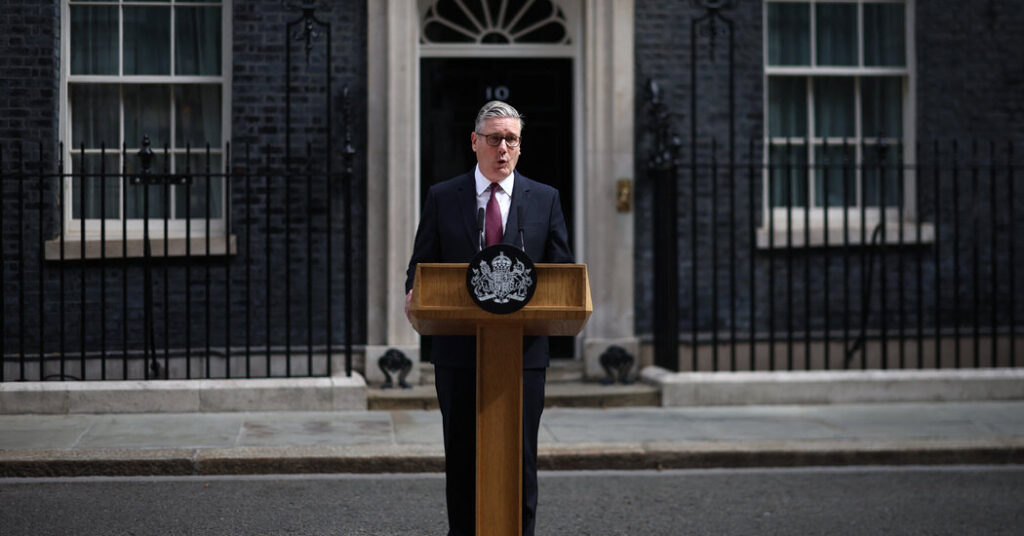
Thus began a period of political tumult that hasn’t let up since. Yesterday, the sixth post-Brexit prime minister resigned. Keir Starmer, who won a landslide election less than two years ago, lost the trust of voters and many officials in his own party.
The man poised to take over is charismatic, popular and, crucially, from a modest background in the north of England. But is that enough? Today, I write about how Britain’s economic problems, made worse by leaving the E.U., are so serious that it will take more than a change in leadership to solve them.
Ten years, six prime ministers
The writing was on the wall.
First, the right-wing populist Reform U.K. party led by Nigel Farage, the mastermind of Brexit, overtook the governing Labour Party in opinion polls more than a year ago. Then it actually beat Labour in a set of local elections across England. The calls for Starmer to resign have not stopped.
It’s a remarkable downfall for a politician whose party won one of the biggest postwar parliamentary majorities only two years ago.
But it also says something bigger about the challenges Britain is facing. Growth is stagnating, the government is deeply indebted and the health care system is underfunded. Reform is pushing a muscular anti-immigrant populism that has captured the support of about a quarter of Britons.
In the 10 years since it voted to leave the E.U., Britain has cycled through six prime ministers, who have all failed to address the country’s deep malaise. It’s about to get a seventh.
Will it make a difference? The man expected to take over is Andy Burnham, a popular former mayor of Greater Manchester. Many in his party want to believe that he can somehow shake Labour, and the country, out of its funk.
But, as my colleague Michael D. Shear writes, if Burnham does make it to Downing Street, all of the challenges that brought down Starmer will still be there. And so far at least, there’s little to suggest that a Burnham government would differ drastically in policy terms.
‘King of the North’
Andy Burnham is the most popular Labour politician in the country and maybe the only one routinely referred to by his first name.
At 56, he is seven years younger than Starmer. He was born and raised in the northwest, with the accent to prove it. His father was a phone engineer and his mother was a doctor’s receptionist. He is seen as someone who understands the grievances of people who live outside of London and the wealthy southeast.
And he has earned a reputation for standing up for them. As mayor, he reversed the privatization of Manchester’s bus system, introducing free and low-cost travel on bright yellow “bee buses” in the city center. During Covid, his protests against harsh lockdown measures earned him the nickname the King of the North.
Starmer, by contrast, never got a cool nickname — he’s not, at least in public, a cool nickname kind of guy. His lack of charisma has compounded his government’s lack of tangible results. Voters seriously dislike him now.
“Men don’t want to be his mate and women don’t want to give him a hug” the left-leaning magazine The New Statesman wrote in an article titled “Why you hate Keir Starmer.”
In Burnham, Labour will have a better storyteller with arguably a better story to tell. But Britain at this moment needs more than good stories.
Ten years after Brexit
The British economy is in a bad way. Brexit hasn’t helped.
Years of underinvestment mean that health care, energy, transport and defense need more money. But the government doesn’t have it. Public debt as a share of gross domestic product is at 94 percent, primarily because of the financial crisis and the pandemic. Interest payments now amount to more than the annual budget of the entire public education system.
It’s not clear that Burnham can do all that much about it. Last September, he lamented that Britain shouldn’t be “in hock to the bond markets.” Most took this as a sign that Burnham, whose politics lean left, would borrow more to spend more if he were prime minister.
But when bond traders — the ones who’d be lending the government that money — pushed interest rates up, Burnham backtracked. There needs to be a plan to shrink Britain’s debt, he said. And yes, he would keep to strict fiscal rules.
What this reveals is that he’s facing the same bad choices as his predecessors.
Can Burnham fix Britain? It’s a tall order indeed. But his background may help take the sting out of Reform’s story about Westminster elites who don’t care about left-behind voters. And his charisma might help in a contest against Farage, the Reform leader.
In a special election last week, Burnham trounced his Reform rival in a northwestern constituency that 10 years ago overwhelmingly voted for Brexit.
His fans hope that he might at least have what it takes to beat Reform, which for now is the No. 1 priority of the Labour Party. But that, too, might take more than charisma and a northern accent. If Burnham becomes prime minister, he’ll have a little over three years until the next election to deliver results — if he can survive that long.
Keep the conversation going: Click here to share your comments.
MORE TOP NEWS
The U.S. eases sanctions on Iran
The Trump administration said it had temporarily lifted oil sanctions against Iran, as Vice President JD Vance said that Tehran had agreed to invite U.N. inspectors back to Iran’s nuclear sites. But the two sides framed the matter in starkly different terms, leaving the details unclear.
As the first round of talks concluded in Switzerland, Vance also described new lines of communication to de-escalate tensions in the Strait of Hormuz and in Lebanon, where Israel and Hezbollah appear to have eased their attacks on each other. Those two issues have complicated the delicate cease-fire between the U.S. and Iran, which is still holding, but with many of the most challenging questions unresolved.
OTHER NEWS
-
China barred 10 U.S. manufacturers from purchasing rare-earth magnets, including two that are trying to revive the American rare-earth industry.
-
Qatar blamed a technical malfunction for an explosion at a liquefied natural gas site that killed at least 13 people.
-
Ukraine escalated attacks on Crimea, which Russia annexed in 2014, leading to fuel shortages and rolling blackouts.
-
A high-pressure “heat dome” over Europe will be felt most intensely in parts of France, Spain, England and Wales, where temperatures are expected to reach or exceed 40 degrees Celsius.
-
Pakistan plans to abolish a sales tax on pads and tampons, but health activists say it is not enough to combat the stigma around menstruation.
-
Clive Davis, a music industry impresario who guided the careers of Whitney Houston and Aretha Franklin, died at the age of 94. Alan Greenspan, the former chairman of the Federal Reserve, died at the age of 100.
TOP OF THE WORLD
The most clicked link in your newsletter yesterday was about a Los Angeles architect’s “optimistic modernism.”
WORLD CUP
Messi’s record-breaking goal
Lionel Messi became the top scorer in men’s World Cup history with his first goal on Monday in a match against Austria. His second goal, which came in stoppage time, capped a resounding 2-0 victory for Argentina, the reigning World Cup champions.
Plus: France, another tournament favorite, plays Iraq. Follow live updates.
An unconventional star: With no team to root for, China’s fans are cheering a referee.
CLASSICAL DROP OF THE DAY
Mozart’s compositions for flute and harp
The National Library of France has unveiled seven previously unknown works by Mozart, found in the notebook of one of his students.
When that student was stumped by the task of writing a new melody, the composer gave her a head-start. “Look what an ass I am,” he told her, as he recounted in a letter to his father. “I started a minuet, and I can’t even complete the first part — would you be kind enough to finish it?” (He complained in the same letter that his student “had no ideas at all.”)
The pieces — described by the scholar who found them as “worthy of living” — were performed publicly for the first time this weekend. Have a listen.
MORNING READ
For decades, roads were steadily getting safer for U.S. pedestrians. Then, around 2009, the trend reversed. The number of pedestrians killed each year has risen by about 75 percent since then. Most other wealthy countries haven’t seen similar increases.
A New York Times investigation found the biggest culprit: the rise of large S.U.V.s and pickup trucks, which have larger blind spots and hoods so tall they are higher than the average American’s center of gravity, resulting in much deadlier accidents.
Take an interactive look at why those factors make a deadly difference.
AROUND THE WORLD
A boozy shipwreck celebration
In 1851, 29 survivors from a capsized French whaling ship waded ashore on an island off Korea, then known as the Hermit Kingdom, which had recently beheaded French Catholic missionaries. But the sailors had nothing to fear: The islanders welcomed them with makgeolli, a milky, lightly sweet rice wine. And the French provided Champagne.
Fast-forward 175 years to a recent Saturday, when the island of Bigeum hosted a Champagne-Makgeolli Festival. Hundreds of locals and mostly European expatriates gathered on a lawn as singers belted out “La Vie en Rose,” and children from a French school in Seoul sang “Les Champs-Élysées.” Under a blazing afternoon sun, the crowd joined hands for Ganggangsullae, a traditional Korean circle dance. Check it out.
RECOMMENDATIONS
Bond: Want to know your dad better? Ask him these questions.
Read: From multigenerational epics to offbeat space operas, these are the year’s buzzy novels.
Travel: These new London hotels offer large spas, hidden gardens and superior chicken pies.
Crack it: Wordle turned 5. Here’s the data on how best to play it.
RECIPE
Uova in purgatorio, or eggs in purgatory, is a speedy southern Italian dish whipped up from pantry staples. It’s unclear whether “purgatory” refers to the bubbling red tomato sauce used to poach the eggs or the fire of the red-pepper flakes that the sauce is spiked with. Either way, it’s a crowd pleaser.
WHERE IS THIS?
Where is this coast?
TIME TO PLAY
Here are today’s Spelling Bee, Mini Crossword, Wordle and Sudoku. Find all our games here.
That’s it for today. See you tomorrow! — Katrin
We welcome your feedback. Send us your suggestions at [email protected].
The post Charisma Alone Can’t Fix Britain appeared first on New York Times.