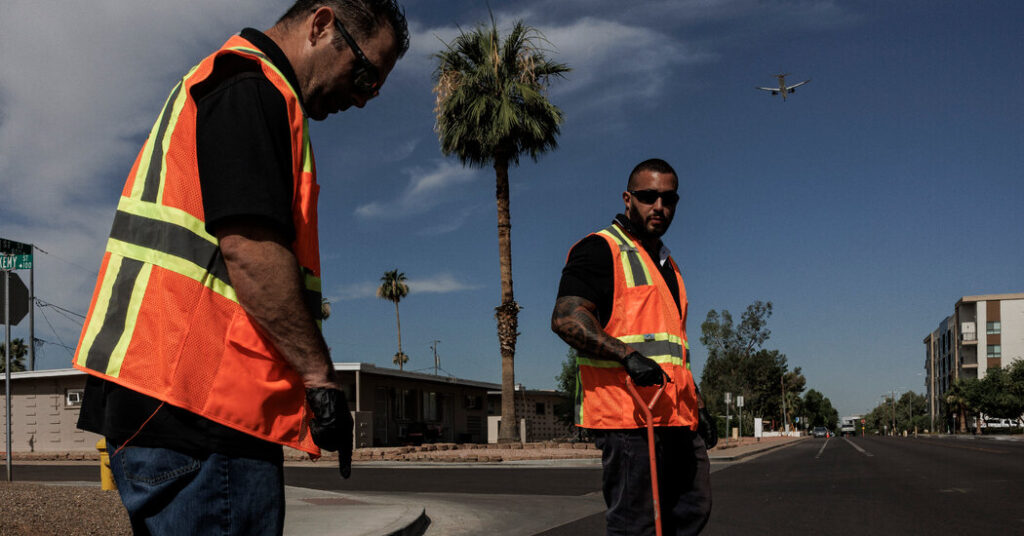
A foul odor permeated the early morning heat as city workers in Tempe, Ariz., unlocked a sewage monitoring shed and opened the tap of a collection jug that had been siphoning from the city’s wastewater over the previous day. They filled a jar, packed it in a blue cooler and hurried to the next shed, or “doghouse,” retrieving from 11 in all.
Rushing to prevent the samples from degrading under the glowering sun, they delivered the coolers to a new municipal lab, where chemists test sewage for traces of dangerous drugs.
The aim of this citywide effort is to detect drugs as soon as they start infiltrating neighborhoods and to reduce overdoses by alerting citizens and emergency medical responders. A colorful, interactive dashboard broadcasts the latest results: On April 27, xylazine, which can necrotize human flesh, was popping in Collection Area 4; on May 11, fentanyl jumped in Collection Area 6.
“The poop don’t lie,” said Wydale Holmes, director of strategic management and innovation for the city, invoking her office’s mantra.
Tempe is among a growing number of local governments that are experimenting with monitoring wastewater for drug use, using methods similar to those widely employed to track the coronavirus during the Covid pandemic.
Sewage samples have been collected from high schools in Missouri and New Mexico, truck stops in Kentucky and at Super Bowl and Mardi Gras festivities in New Orleans. Legislators in at least five states have proposed bills to fund the practice.
Last month, the strategy got a boost from the Trump administration, when the White House’s Office of National Drug Control Policy praised its potential to show illegal drug use and trafficking across the country in real time. The administration has contracted with Biobot Analytics to help support the lab’s yearlong project testing sewage for 20 different substances at about 100 sites around the country.
In its biennial drug strategy report last month, the White House called for federal wastewater reporting standards, similar to the national surveillance system for tracking infectious diseases like Covid-19 and influenza.
But though deadly viruses and illicit drugs are both serious public health issues, drug surveillance is also a law enforcement matter. That overlap introduces new questions about wastewater drug monitoring, including debates over how to balance privacy rights with the goal of saving lives.
“Law enforcement and public health are both government modes of responding to a problem. But one seeks you out in order to punish you while the other is trying to identify people who are sick so they can be helped,” said Natalie Ram, a professor at the University of Maryland Carey School of Law, who has written about the ethics of wastewater surveillance.
At hearings and town halls, community groups and some experts in law and public health have expressed worries that the testing is taking place without consent and that neighborhoods targeted for such testing could be stigmatized. Some parents object to schools being singled out for scrutiny because most students are minors. Secrecy is also a concern. Some data collectors, including police, do not disclose results or how they use them.
“This is scary Big Brother stuff, but we’ll see where it goes,” Don Bosch, a criminal defense lawyer in Knoxville, Tenn., told local TV station WBIR after the Tennessee Bureau of Investigation, the state’s lead law enforcement agency, sought funding in 2024 for wastewater drug testing.
He added: “I’m just afraid that in government’s zeal to deal with this, that they could tread on personal liberties if they take subsequent steps after a positive test from wastewater.”
Sewage testing cannot isolate a drug’s source to an individual, a bathroom or a home. It can, however, reveal emerging drug trends. Missouri’s pilot testing of 37 high schools this year, for instance, detected a potent new class of synthetic opioids called nitazenes in 26 schools.
One was in the tiny rural district of Craig R-III in Missouri. Superintendent Matt Copeland alerted other area superintendents; made overdose reversal medication available in the one-building, 90-student, K-12 school; and brought in a state trooper for a townwide assembly.
Though he faced criticism for allowing his school to be tested, Dr. Copeland said he believed the education that followed was well worth it. “I would argue that my community can probably talk nitazenes better now than most people in the country,” he said.
Other communities, armed with fast results, have taken swift action to try to blunt the threat. When xylazine, a veterinary sedative that is not an opioid, started showing up in Tempe wastewater, emergency medical responders got training in how to treat those overdoses. When the public health department in Laredo, Texas, received results showing opioids and stimulants, it set up a “knock and talk” program, with workers canvassing high-risk neighborhoods to hand out leaflets about emergency and support services. In response to opioid findings, Lincoln, Neb., stocked vending machines around the city with free doses of overdose reversal nasal sprays.
Testing wastewater for viruses dates to efforts to contain cholera in 19th-century London. Monitoring sewage for illicit drugs is far more recent, with technology now capable of exposing that which would seem all but undetectable.
With fentanyl, for example, people inject or smoke the equivalent of a few sand grains, which the body then breaks down further into metabolites. The excreted drug may continue decomposing in the sewer, awash in millions of gallons of water dense with chemical compounds from showers, dishwashers, laundromats, carwashes, hospitals and industrial facilities. Yet labs can still not only identify the original drug, but also distinguish the excreted metabolites from fentanyl that was flushed whole down a toilet to evade seizure.
Some communities even test for medications that treat drug addiction or reverse overdoses to gauge how widely they are being used.
In 2018, Tempe became the first municipality in the United States to try the strategy. Desperate to stem opioid fatalities, the city partnered with researchers from Arizona State University on wastewater drug-checking, which had already been gaining traction among law enforcement agencies and researchers in Europe.
Anxious residents peppered officials with questions: “‘Why does the government feel a need to test my poop? And what else are you looking at while you’re there?’” recalled Rosa Inchausti, who oversaw the launch of the program and is now Tempe city manager.
Legal experts say wastewater searches are almost certainly constitutional. In 1988 the Supreme Court ruled that when people voluntarily put out their trash on the curb, they abandon privacy claims to it. By extension, the purpose of flushing a toilet is to get rid of one’s waste. The government doesn’t need a warrant to poke around in it.
But Tempe residents feared that certain neighborhoods would be singled out. The city, determined to build trust, committed to sampling across its entire 40 square miles and only from catchment areas with populations of no fewer than 3,000.
Its agencies have since learned that testing provides an important data point in mapping the full reach of drug use. “It was not just in alleys where the homeless were,” Ms. Inchausti said. “It was in affluent neighborhoods where people would probably be hesitant to call 911 because they don’t want the fire engine showing up on their street.”
In another measure to establish trust, officials committed to posting results immediately. “It’s not my data. It’s the people’s data,” said Ms. Holmes, who now oversees the program.
That public health view of data is almost antithetical to that of law enforcement, which typically needs to hide its ongoing investigations from open scrutiny.
David Rausch, director of the Tennessee Bureau of Investigation, told state legislators in 2024 that if law enforcement officers received complaints about drug use, they could take sewage samples from a tightly focused area.
Results, he said, “wouldn’t be able to tell me the exact house, but they could tell me from a selection of four houses. “
Then, with their own intelligence resources, he added, “We would be able to tell where the house is.”
The Tennessee investigators who, according to an agency spokesman, have been testing wastewater at 16 locations around the state for drugs for nearly a year, have yet to make findings public.
Some communities have discovered that drug-testing wastewater can have unintended consequences. At Dr. Copeland’s school in Missouri, results were occasionally positive for hydrocodone, a prescription opioid that is often combined in pills with acetaminophen or ibuprofen. He said teachers approached him privately, confessing, “‘I just wanted you to know I’ve got a prescribed pain medication and I’m so sorry I’ve hurt your testing.’”
Dr. Copeland said he felt awful; he had not been seeking private medical information.
In 2023, a New Mexico pilot project of 24 schools revealed that 92 percent tested positive for methamphetamine. Then officials acknowledged that chemists could not distinguish between the illegal drug and prescription A.D.H.D. medications, which include amphetamine.
In contrast, a cutting-edge test can give early warning about the latest drugs invading the supply. Bikram Subedi, an environmental chemist at Louisiana State University who has analyzed wastewater for drugs for more than a decade, has detected cychlorphine, the newest, deadly opioid from China, in samples from a small community in East Tennessee. He has shared the results with local law enforcement and health agencies.
Now Dr. Subedi’s team is investigating using artificial intelligence and wastewater drug results so “we can predict overdose mortality in the next month, the next year. And then predict what’s coming next in the drug supply.”
Many local governments now routinely test for pathogens, but adding drug monitoring is expensive. To reduce costs from an outside lab and shrink turnaround times, Tempe, cash-strapped by state and federal budget cuts, has just invested in its own lab.
The new city lab may even one day contribute to its own upkeep. Ms. Inchausti has been talking with private businesses about contracting with the city to sample their office wastewater, as a less invasive way to drug-check employees randomly.
Some legislators and local administrators are urging that sewage drug monitoring be aggressively expanded. Ms. Inchausti pointed out that Tempe and Phoenix huddle in the basin of the Valley of the Sun, which is overwhelmed with ready, cheap supplies of Mexican opioids, meth and cocaine. Yet in the combined metro-area population, which is greater than 5 million, only Tempe tests its sewage for drugs.
“If Tempe is doing this,” Ms. Inchausti said, “why aren’t we doing it regionally?”
The post Cities and Schools Are Testing Wastewater for Illicit Drugs appeared first on New York Times.