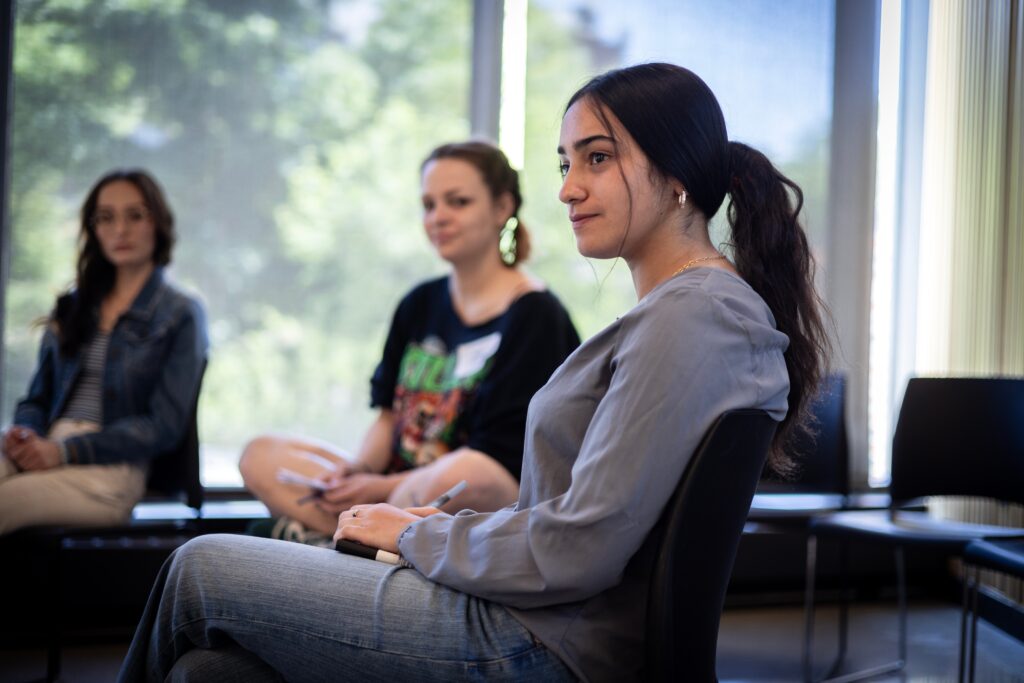
AURORA, Colo. — In the morning, Wissal Chichou hoped, she would answer the question she asked herself most days: How compassionate should she be in a country where many lacked empathy for her?
She was a Muslim teenager, 18 and a freshman in college, not quite the adult she hoped to be, but she had endured enough to know she would have to decide soon. Should she forgive everyone who discriminated against her? Or should she stand up for herself?
The world felt increasingly hostile and short on kindness. Most Americans believe their fellow citizens are morally bad. Trust is on the decline. Political violence is rising. And the Trump administration felt especially hostile to immigrants. With all that brewing around her, Chichou had signed up for a college conference on compassion to help her decide how to be.
For now, it was dinner time. She looked across the kitchen table as her parents opened take-out containers of halal chicken and lamb, and Chichou knew that her mom and dad had offered her two opposing ways to approach the world.
“Do you remember the campus monitor?” she asked them.
A few years earlier, when Chichou and her older sister Ikram were in high school, a campus security guard had mocked them on camera for having to take a citizenship test then posted the video online. Later, after it went locally viral, he’d waited outside the girls’ classrooms and asked other students to fight them.
“I told the principal I want a restraining order,” Chichou’s dad, Abdelilah, said as he dug into a plate of rice. “That’s dangerous. He doesn’t have the right to do that.”
“But he’s young,” her mother, Amina, said. “He was just 20 something. I told the principal, ‘Don’t fire.’”
This was the way Chichou’s parents approached every indignity they’d faced since moving to America from Morocco in 2014. Her mother opened her arms. Her father crossed his.
That night, at the table, as Chichou prepared to find her own strategy, the family recounted a dozen or so examples. There was the girl who wouldn’t hold Chichou’s hand in gym class because she said Chichou was a “dirty African monkey.” There were the patients on Ikram’s nursing assistant shift who mocked her hijab. The kids who called Chichou a bomber. The man who almost ran them over in a grocery store parking lot before shouting that the family should go back to the Middle East.
“You can read it in their eyes,” Abdelilah said. “They look at you like, ‘Yeah, you’re a terrorist.’”
“But mom would always tell us, ‘You can’t blame these people,’” Chichou said. “‘This is what’s been taught to them.’”
If everyone were as empathetic as her mom, Chichou thought, life would be peaceful, calm. But Chichou also worried her mother’s compassion left her vulnerable. Some nights, Amina came home crying, and Chichou wondered if all the hatred didn’t hurt her mother more than she let on.
“So tomorrow I’m going to this Compassion Lab,” Chichou told her family as they finished dinner and retreated to the couch for mint tea and pistachios. “And I want to ask the professors, ‘How do I be a compassionate person without creating these environments of hatred?’”
Her mom raised her eyebrows. Her dad leaned back with a smile.
“I want to find an answer,” Chichou said. “It needs to have an answer. Right?”
Chichou woke up extra early the next morning and rode the train from the suburbs to the University of Denver. By 8 a.m., a hundred sleepy students had settled in with coffee cake and complimentary journals to record any thoughts they had that day.
Compassion was a relatively new subject for the school. A few years ago, university leaders decided that to produce thriving graduates, they had to do more than teach them how to learn. They had to show them — more holistically — how to be. .
One of the lead facilitators that day was Cris Tietsort, an assistant professor whose work had evolved from the communications department into research on happiness and empathy. When Tietsort taught his first compassion lesson in 2023, he thought he’d help students relate to people who were different from them. He discovered that today’s teenagers struggle to connect even with like-minded people.
In the years since, Tietsort and other professors had taught courses on compassion, as well as roving, hour-long lessons in departments from music to political science. The day-long conference was new, a chance to go deep quickly.
That morning, while the students polished off breakfast, Tietsort told them compassion felt more important than ever. People both young and old were increasingly lonely. The rates of depression had shot up. The country felt divided and disconnected, he said, and many people no longer knew how to sit and have a conversation.
“The broad question that we’re asking today is, given the pain and suffering, how do we want to be treated?” Tietsort said. “How do we treat others? And how is this going to look in our lives?”
Chichou had been doodling flowers on one of the conference handouts, but as Tietsort spoke, she stopped. His words struck her as profound. He wasn’t just saying that suffering is happening. He was inviting the students to think about their own reactions. How did she want to respond? How did she hope to be treated?
She took a long drink from a water bottle she’d decorated with stickers from Colorado nonprofits. Compassion for others, Tietsort told the group, cannot exist without self-compassion.
“Studies have shown that people who take care of themselves can better show up for others,” he said.
Chichou thought of her mom. Amina did a great job of caring for other people, but she deserved compassion, too, Chichou believed. Both of Chichou’s parents had worked a variety of blue-collar jobs since they immigrated, but her mom had recently found a position working with special-education students. A life of service suited her, and Chichou hoped to spend her adulthood helping people, too. After college, she planned to go to law school, then eventually run for public office.
Neither of those careers felt particularly safe from bigotry. Chichou didn’t even wear a hijab yet — though she longed to — because she worried a law school would reject her if she did. Maybe they’d think of ISIS, or maybe they’d wonder if she was too oppressed to think for herself. She’d seen plenty of TikTok videos where seemingly educated people suggested that the only reason a woman would cover her head is because a man made her.
That couldn’t have been further from the truth. Chichou’s faith was one of the most important parts of her identity, and that belief was her own, not one her parents ever pushed. But she’d seen the way people reacted to her mom and her sister’s head scarves, and she was scared.
She’d already experienced harassment in the political world. She’d spent the last few months interning for Senator Michael Bennet (D-Colorado). A few weeks before the conference, an Iraq War veteran had called for help navigating his benefits. As Chichou tried to find answers, the man said several hateful things about Muslims.
It had hurt to listen to him, but Chichou had thought of her mother and she told herself the man had probably experienced horrific things at war. She said nothing.
The conference broke for a mid-morning break, and as the students lingered in the hallway, several admitted they were “neutral” on the idea of compassion. Mostly they had signed up for the lab because their teachers had agreed to give them extra credit or a week without homework.
As far as Chichou could tell, no one who considered themselves hateful had signed up. Those were probably the people who needed a compassion conference most, but Chichou knew from her own friend group that sometimes even people who consider themselves open-minded balk at crossing a divide. She and most of her friends were liberal, but they hadn’t understood when she’d befriended a conservative earlier that year.
“Why are you engaging with that person?” they’d asked her. “What do you see in her?”
Teens today wanted to preserve their peace, Chichou understood. That often meant building a fortress of safety away from any comments or opposing beliefs that might hurt them. Chichou desired peace, too, but was that all that mattered? She didn’t want to spend the rest of her life being called a terrorist, but she was too curious to wall herself up. She wanted to reach the people who hated her. If she never took the time to understand them, how could she ever change their minds?
The break ended, and the students headed off to sessions on relationships and the media. Outside, the temperature had topped 80 degrees, and young people sunbathed on the lawn. Chichou joined a dozen other students for an indoor meditative walk through a labyrinth.
Psychology of religion professor Danny McIntosh had designed the room-sized fabric labyrinth with a colleague. He told the students that labyrinth-walking is an ancient tradition practiced by people all over the world. Recent research shows that if a group of people walk together with a shared intention, labyrinths can promote compassion.
“One way of thinking about the labyrinth is as a mini pilgrimage,” McIntosh said. “There’s been research of pilgrims who go on the Hajj, the Islamic pilgrimage.
“One of the effects of going on the Hajj is an openness to all traditions. … Despite all the differences, all the variety, heterogeneity, they say, ‘We’re all on this journey together.’”
Chichou couldn’t believe it. In all her years in America, she’d never heard anyone mention Hajj in a classroom setting. But he was right: She’d always heard the pilgrimage united people.
Before they walked the labyrinth, McIntosh explained, they’d chant a shared meditation. Chichou slid off her white New Balances and pulled her waist-length hair into a ponytail. She joined the other students in a circle.
“We recognize that suffering is part of being human for us and for others,” McIntosh read. “We allow ourselves to see it without turning away.”
One by one, the students stepped into the purple labyrinth. Chichou was last, and when she set her foot inside, she felt a kind of jolt — something close to static electricity, but sharper. It made her dizzy.
She rounded the outside, and she tried to channel her mother. She meditated on other people’s suffering. She thought about the genocide in Congo, the war in Iran, and she considered the veteran who’d called the Senate office asking for help.
Chichou knew that man deserved compassion, but as she made her way around, she thought of her father. He always let people have their say, then he stood up for himself. He corrected them if they were wrong. He fought for his right to exist as a Muslim immigrant in America.
She hadn’t felt on the phone as if she could respond the way her dad might. She was at work. Her job was to help all constituents, not interrupt them to explain her own religion. But what if the things Tietsort had said about self-compassion were true? Didn’t her own suffering matter? Maybe she could have handed off the call to a coworker. Maybe she could have taken a moment to herself.
Chichou felt lost as she searched for the labyrinth’s center, but by the time she reached it, she knew the right path for her wasn’t her mom’s or her father’s, but something in between. She wanted to be someone who listens and fights for all people — including herself.
By the end of the day, Chichou was back with her family in the living room. Her mom brewed another pot of mint tea while their cat Minu slinked around trying to decide which family member he loved most that hour. Chichou pulled out the journal she’d kept during the conference, and she told her parents she’d had a great day.
“I would say I felt enlightened,” she said. “I need to be easier on myself, extend the same compassion to myself that I am giving to other people.”
“Not like me,” her mom said quietly. “You don’t want to be like me.”
Chichou laughed and leaned over to hug her.
“No, no, no,” she said. “You’re a great person, a great role model.”
They hugged until Minu settled and the tea was ready. Chichou took her first sip, then collapsed into the couch.
“I also learned that I can’t wake up at 7,” she said. “That’s just too much.”
The post Fight or forgive? An unusual class helped a Muslim student decide. appeared first on Washington Post.