SACRAMENTO — Gov. Gavin Newsom vetoed legislation to require proposed data centers to provide estimates of their water usage last year, saying he was “reluctant to impose rigid reporting requirements” without understanding the impact on businesses and consumers.
Opposition to the mammoth tech hubs and their massive thirst of water, power and land has only escalated throughout the state and nation ever since. In just a matter of months, Newsom again could find himself in the political crosshairs.
Several bills to regulate the facilities and increase public transparency on their impacts are progressing in the California Legislature, which could create a conundrum for a governor who has long aligned with the tech industry but also paints himself as an environmental and social justice advocate.
“I think the governor is in a fragile position,” said Megan Mullin, a public policy professor at UCLA. “Tech has been a long backer of his, but at the same time there is this growing national outcry against data centers.”
Data centers have existed for decades but are rapidly expanding due to the worldwide boom in artificial intelligence. The newer centers built to power AI are far larger than their original counterparts and require immense amounts of water and energy.
The facilities also contribute to fossil fuel emissions, with Cornell University researchers estimating last year that AI growth could add 24 to 44 million metric tons of carbon dioxide to the atmosphere annually by 2030. Fossil fuel emissions are drivers of climate change and linked to a range of health conditions, including asthma, various cancers and birth defects.
Environmental Protection Agency Administrator Lee Zeldin announced last week that the Trump administration will not set national environmental requirements or recommendations for the data center industry, leaving it to state lawmakers to determine best policies.
Thad Kousser, a political science professor at UC San Diego, said the nation will likely look to the Golden State for guidance.
“California’s laws will create a national model,” he said. “We’re the home of Silicon Valley and we’re just a massive state — the way we regulate data centers will set the tone.”
The political landscape around data centers has since changed since Newsom’s veto in October, said Dan Schnur, a political science professor who teaches at UC Berkeley and USC.
“No one should assume he will automatically act in the same way,” Schnur said. “Newsom is an incredibly savvy politician so he is clearly aware that voters are a lot more upset or concerned about data centers than they were a year ago.”
A Gallup poll released last month found 7 out of 10 Americans oppose data centers being built in their area.
The facilities can create thousands of jobs for construction workers and generate significant revenue for local governments due to sales and property taxes. The artificial intelligence they power is also — at least temporarily — boosting the stock market, leading to more tax dollars for California.
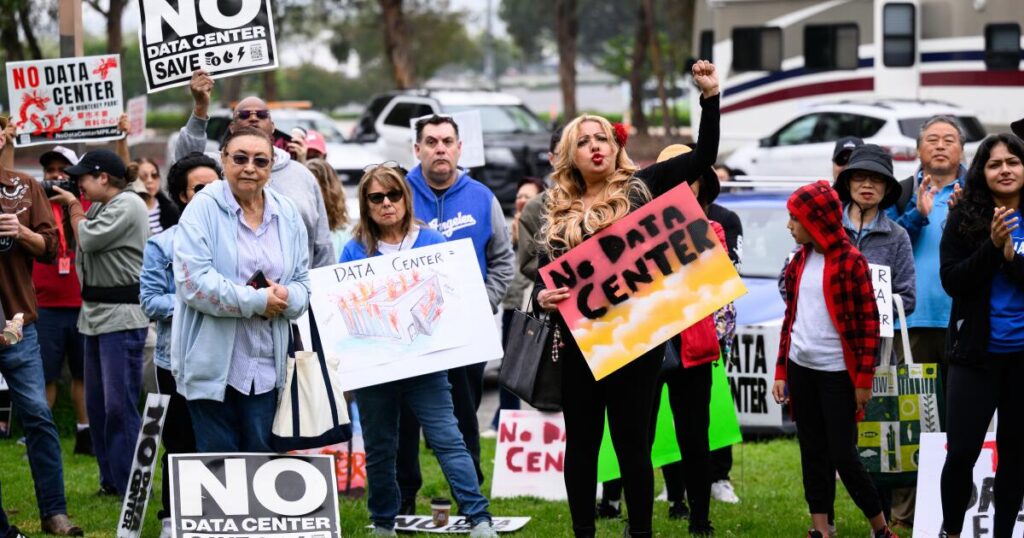
But residents who live near hyperscale centers have expressed outrage over a range of issues, including health impacts, spiking utility bills, constant noise, dropping water pressure and concerns about potentially losing their land through eminent domain. Meanwhile, community meetings about data centers are growing contentious, with police arresting a farmer in Oklahoma, three women in Wisconsin and a man in California.
Earlier this month, residents of Monterey Park voted overwhelmingly to ban data centers,making the San Gabriel Valley city the first in the nation to do so by public vote.
“Six months ago, politicians of both parties were falling all over each other to bring data centers into their states,” Schnur said. “Now that the public backlash has erupted, they are working just as hard to distance themselves from these projects.”
With Newsom eyeing a presidential bid in 2028, he might be reluctant to brand himself as a defender of an increasingly unpopular industry.
But Schnur said the governor likely also has concerns about angering one of his biggest backers.
“The tech community is a critical part of Newsom’s donor base, so he has to keep fundraising in mind when he makes these decisions,” Schnur said.
A spokesperson for the governor’s office declined to comment on data centers or pending legislation.
Newsom, during an interview at a Center for American Progress conference in May, said the concern that data centers may drive up electricity costs for Californians is a “legit issue,” but not the main one.
“The tech genie is not going to go back in the bottle,” Newsom said. “Just saying that you should not or cannot build a data center is not going to slow this technology down. What can be, will be. Nature of technology. And so we just have to steer it and not make the mistakes we made with social media.”
Among the measures in the Legislature are two bills from Sen. Steve Padilla (D-San Diego). SB 886 would create a corporate tariff to cover the cost of data center-related grid upgrades. SB 887 would ban data centers from receiving ministerial exemptions from the California Environmental Quality Act, known as CEQA.
Neither bill picked up support from Republicans, but both cleared the Senate and were recently referred to the Assembly Utilities and Energy Committee.
Padilla represents Imperial County, a farming community near the border of Mexico where plans for a 950,000-square–foot data center face fierce opposition from residents. The county exempted the proposal from CEQA, which requires projects to undergo an extensive state environmental review before breaking ground.
The city of Imperial sued the county earlier this year, arguing the project should not have received an exemption. The San Diego Chapter of the Sierra Club joined the lawsuit last month. The county board of supervisors last week approved a 45-day moratorium on all new data centers to allow the county to evaluate proposed data center development.
Two other data center-related bills recently passed the Assembly, each picking up support from a few Republicans. They now await action from the Senate.
AB 2619 from Assemblymember Diane Papan (D-San Mateo) would require data center owners to provide an estimate under penalty of perjury about expected water usage and sources before applying for a business license. AB 1577 from Assemblymember Rebecca Bauer-Kahan (D-Orinda) would require data center owners to submit monthly information to a state commission about water and fuel consumption.
Ben Green, an assistant public policy professor at the University of Michigan who is researching how data centers impact communities, said reporting requirements are a “bare minimum” type of regulation, making it especially noteworthy that Newsom vetoed a similar measure last year.
For comparison, several states are weighing more restrictive bills — New York recently sent legislation to the governor’s desk that would enact a one-year moratorium.
“It seems that there was a ton of lobbying pressure that he was getting,” Green said. “The tech industry doesn’t want to have any restrictions.”
Green said data centers could be a hot topic in upcoming elections, as Americans on both sides of the aisle are expressing valid concerns.
“There’s not an easy fix for getting the public on board with data centers because their critiques are grounded in reality,” he said. “This is not just some sort of reactionary NIMBY-ism or pearl clutching.”
The post Newsom’s stance on controversial data centers about to be tested. Again. appeared first on Los Angeles Times.