On July 4, 2012, scientists packed a large hall at the European Organization for Nuclear Research, also known as CERN, to hear the results of two experiments to find the Higgs boson, a particle so important in the realm of physics that it had been nicknamed “the God particle.” The detection of that elusive fundamental particle would confirm the existence of a field that gives mass to all other particles, such as electrons and quarks.
“I think we have it,” Rolf-Dieter Heuer, then the director general of CERN, announced to thunderous applause.
Peter Higgs, the English scientist for whom the particle was named, was in the audience, wiping away tears. Sitting next to him was François Englert, a Belgian physicist who, along with Higgs, helped develop the theory behind what became known as the Higgs field. It proved an essential ingredient in the Standard Model of particle physics, the 1970s framework that classifies all known fundamental particles and forces — widely considered one of science’s crowning achievements.
A year later, in 2013, Dr. Higgs and Dr. Englert shared the Nobel Prize in Physics for “the theoretical discovery of a mechanism that contributes to our understanding of the origin of the mass of subatomic particles.”
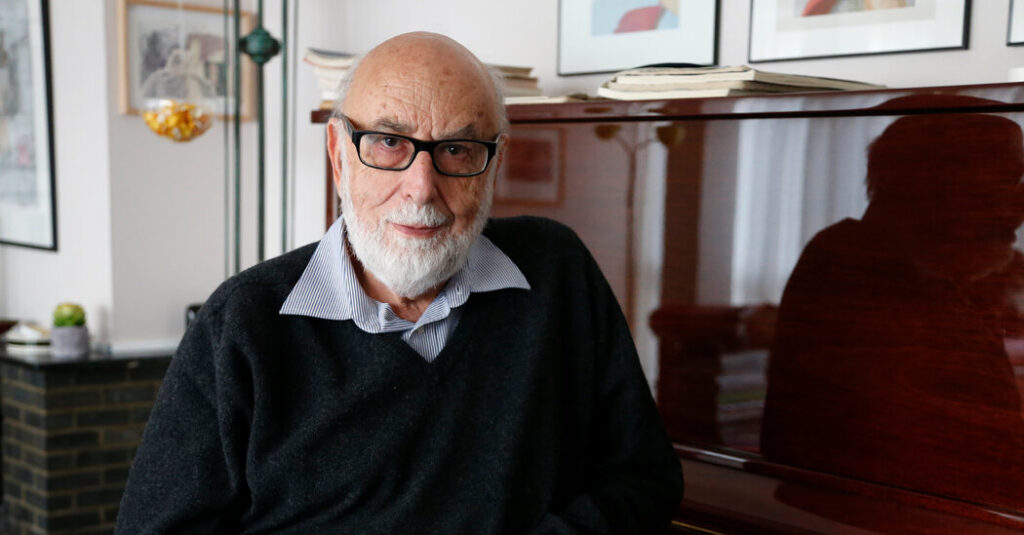
Dr. Englert died on Thursday in Uccle, Belgium, a suburb of Brussels. He was 93.
His death was announced by CERN on its website.
In the late 1950s, Dr. Englert was working at Cornell University as a research associate for Robert Brout, a theoretical physicist, when the two became interested in the work of Yoichiro Nambu, a Japanese American physicist. Dr. Nambu had figured out how to address a problem that was bedeviling physicists: the breaking of symmetry in some subatomic reactions.
Symmetry is an important idea in physics. It describes how a system can undergo a transformation while remaining unchanged, like when a sphere is rotated around its center. Symmetry also appears in quantum physics, the study of subatomic particles, as electrons interact by exchanging photons — massless gauge bosons that carry the electromagnetic force. Because this interaction is governed by an underlying gauge symmetry, certain quantities such as energy and momentum are conserved in the collision.
Symmetry can be preserved in theories that explain electromagnetism — the interaction of particles with electric charges, like electrons — and the strong force, which binds protons to neutrons in the nuclei of atoms. But when physicists tried to explain the weak force, which is responsible for radioactive decay in nuclei, they ran into a problem.
The weak force acts at very small distances; less than the diameter of a proton. To balance the equation in collisions involving that force, the mass of the gauge bosons that are exchanged, which physicists call W and Z bosons, has to be very large. The creation of massive W and Z bosons, seemingly out of thin air, breaks the symmetry of the interactions.
Dr. Nambu’s theory showed mathematically how symmetry breaking is possible. For example, if a pencil is standing perfectly upright on its point, the pencil is in equilibrium and symmetrical. But the pencil will not stay on its point; it will fall because of the quantum mechanical forces acting on it. After it does, the system that it is a part of is no longer symmetrical; it has been spontaneously broken, even though the physical laws of the symmetry of the system are unchanged.
Though Dr. Nambu received the Nobel Prize in 2008, his proof did not answer the question of where the gauge bosons involved in a weak interaction could get their mass.
In 1961, Dr. Englert returned to Belgium, and Dr. Brout, who would become his lifelong friend, joined him. They came up with a hypothesis: There must be some sort of field responsible, a field that is everywhere, like a sort of cosmic molasses, and gives mass to all elementary particles passing through it.
Dr. Englert and Dr. Brout published a paper in August 1964 in the Physical Review Letters. Less than two months later, Dr. Higgs published his own paper in the same journal proposing a similar solution. A month after that, Gerald Guralnik, C. Richard Hagen and Tom Kibble published a third paper, also in the Physical Review, that took a similar approach. Collectively, the papers are recognized as a landmark in the development of quantum physics.
Though the process by which the Higgs field gives mass to other particles is usually referred to as the Higgs mechanism, its fuller name is the Brout-Englert-Higgs mechanism, and sometimes even the Englert-Brout-Higgs-Guralnik-Hagen-Kibble mechanism.
The scientists’ theory predicted that the Higgs field, which is normally invisible, would produce a quantum particle if it is hit hard enough with the right amount of energy. The particle is extremely fragile and falls apart in a trillionth of a second, but it was that particle, the Higgs boson, that was detected at CERN in 2012, thus proving the existence of the Higgs field, or something very much like it.
Dr. Brout died in 2011, before the Nobel Prize was awarded, but he received the prestigious Wolf Prize in Physics in 2004, along with Dr. Englert and Dr. Higgs. And all six scientists (including Dr. Guralnik, Dr. Hagen and Dr. Kibble) were awarded the J.J. Sakurai Prize for Theoretical Particle Physics in 2010. And Dr. Englert and Dr. Higgs, along with CERN, received the Princess of Asturias Award for Technical and Scientific Research in 2013. (Dr. Higgs died in 2024.)
François Englert was born on Nov. 6, 1932, in Etterbeek, Belgium, the second son of Szmul Joseph Josek Englert and Bajla (Cymberknopf) Englert, Polish Jews who emigrated in 1924 and owned a small textile shop.
The German invasion of Belgium in May 1940 turned the family’s life upside down. According to Dr. Englert’s autobiography on the Nobel website, they gradually became subject to persecution, forced to wear yellow Stars of David identifying them as Jewish.
In August 1942, when the Nazis began deporting Jews from Belgium to concentration and extermination camps, the family split up, thinking they would have a better chance at survival. They placed François with a couple who owned a cafe. He did not know his parents’ whereabouts for about a year, when the family was denounced, Dr. Englert recounted in a 2017 interview with Paris Match.
The family reunited and fled in the night to Annevoie-Rouillon, a small village in the Ardennes region of Belgium. There, a priest took the family under his protection, introducing them to the village’s residents as Christians and even baptizing François so that he could attend Notre-Dame de Bellevue, a school in Dinant.
The immediate family survived, but their relatives in Poland were killed during the Holocaust.
Dr. Englert said in the 2017 interview that he was only beginning to speak about that part of his life. “After the war, to protect myself, I tended to erase from my memory this period of my existence,” he said.
Dr. Englert went on to study electromechanical engineering, graduating from the Free University of Brussels in 1955. While there, he became interested in physics and decided to focus on that, obtaining his master’s degree in 1958 and a Ph.D. in 1959. Shortly after that, he was offered a two-year research position at Cornell, where he met Dr. Brout.
On his return to Belgium in 1961, Dr. Englert was hired by the Free University of Brussels. Dr. Brout joined him on the faculty and together they founded a theoretical physics group that studied many areas of physics, including general relativity, string theory, fractal structures and cosmology.
In addition to his science awards, in July 2013, King Albert II of Belgium made Dr. Englert a baron.
Dr. Englert had three children, Michele, Anne and Georges, with his first wife, Esther Dujardin, and two children, Sarah and Hélène, with his second wife, Danielle Vindal. He is survived by his children and his third wife, Mira Nikomarow.
In the Paris Match interview, Dr. Englert was asked what he would do if he could see the people who saved him from the Nazis again. “I would kiss them,” he replied. “And then, if I could manage to formulate the words, I would tell them that I managed to do something with my life and that I owe it to them and to my parents.”
The post François Englert, Nobelist Who Helped Predict the ‘God Particle,’ Dies at 93 appeared first on New York Times.