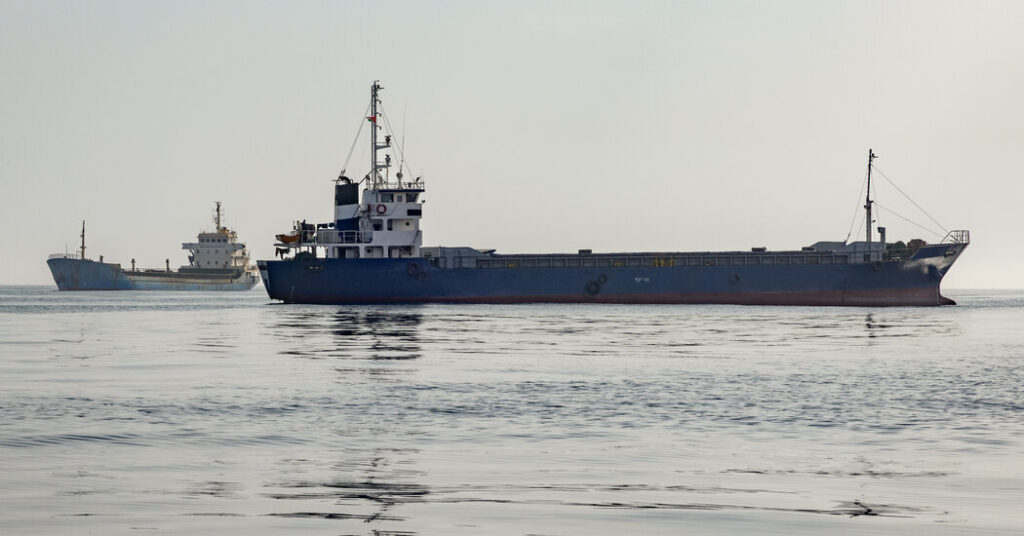
Shipping numbers in the Strait of Hormuz have been on a slow climb since the United States and Iran agreed to a preliminary deal this week to end the war and reopen the vital waterway. But traffic was suddenly jeopardized on Saturday, when Iran’s military said it was shutting the strait once again.
The closure came as U.S. Central Command announced a milestone, saying 55 commercial ships transited the strait on Saturday. That would be the largest number of ships to cross in a day since Iran effectively closed the strait early in the war — though it’s still far below the 130 daily prewar average.
It was not clear whether traffic had changed after Iran announced the new closure.
The confusion compounded as the United States and Iran offered conflicting assessments. The naval arm of Iran’s Islamic Revolutionary Guards Corps said if ships approached the strait, their security would be at risk.
But Capt. Tim Hawkins, a spokesman for U.S. Central Command, denied in a text message on Saturday that Iran had closed the waterway, saying, “The strait is open and the U.S. blockade against Iran has ceased.” He wrote that traffic was “continuing to flow” and U.S. forces were monitoring the situation to ensure that continues.
Throughout the war, Iran has used the strait — a critical route for the world’s oil and gas supplies — as one of its largest sources of leverage, and even the threat of renewed fighting has been enough to throttle shipping. Reflecting that volatility, traffic in recent days has been erratic and well below prewar levels.
Though the preliminary deal reached by Iran and the United States included provisions to reopen the waterway, shipping companies remain cautious about moving through it. They also face logistical hurdles after their ships have been sitting in the Persian Gulf for months.
On Thursday, 25 ships moved through the strait, including 14 oil tankers, according to Kpler, a maritime data company. The number was higher than the average in recent weeks. On Friday, 11 ships transited the strait: seven oil tankers and four dry bulk vessels, according to Kpler.
Windward, a maritime analysis firm, said 22 ships went through the Strait of Hormuz on Saturday, offering a lower number than the U.S. military’s. Michelle Wiese Bockmann, a senior maritime intelligence analyst at the firm, said the number could be higher after ships turned their tracking devices back on and became detectable.
In announcing the closure of the waterway on Saturday, Iran’s central military command cited the killing and the displacement of Lebanese residents from southern Lebanon, along with Israel’s refusal to withdraw from the region, as factors. The deal between the United States and Iran stipulated an end to hostilities on all fronts, including Lebanon.
The preliminary agreement between the United States and Iran introduced a 60-day period of negotiations to reach a fuller peace, outlined steps to reopen the strait, and removed a U.S. naval blockade on Iranian ships that had been imposed in April.
Under the deal, Iran agreed to reopen the strait and, for 60 days, return to the prewar status of allowing vessels to pass free of charge. The agreement, however, seems to leave open the possibility that Iran could charge fees after the 60-day negotiation period.
While the agreement calls for traffic to be reinstated “within 30 days,” it is not clear when it might return to prewar levels. The agreement called for reopening the strait to commercial vessels “immediately” but noted that there could be delays because of “technical and military obstacles,” as well as the need for Iran to remove mines from the waterway.
Ms. Wiese Bockmann said that her bellwether for the situation in the coming days would be whether container ships affiliated with the European Union, which have been stranded since the war began, would make the trek across the strait. “And they haven’t moved yet,” she said.
“We can conclude that Western-affiliated tonnage stranded is still stepping back and assessing the security situation,” she said.
Jenny Gross and Peter Eavis contributed reporting.
The post New Strait of Hormuz Closure Announcement Threatens the Slow Uptick in Traffic appeared first on New York Times.