At Camp Breastie, women who wanted to scream had to wake up early.
The lakeside venting session was the first activity of the day, so the sun was still low in the sky as dozens of breast cancer survivors scrambled down from their cabin bunks to the shore.
But first they wrote the names of their troubles on small stones and cast them into the water.
“Anger,” wrote Shelby Jones, 33, who is from New York City.
“Fear,” said Emily Tout, 30, from Buffalo, a single mother with metastatic disease.
Then Nancy Antoine, a cancer survivor from Davie, Fla., who said she’d been practicing scream therapy for years — albeit usually alone in the house — urged them to let it all out with a scream.
“Just release what you’re carrying with you, and let the lake receive it,” said Ms. Antoine, 51.
The screamers were among 500 women — breast cancer survivors, women living with advanced disease and women at high risk who had taken measures to prevent the disease — who had converged on a campsite near Honesdale, Pa., in early June for an annual, four-day retreat that has become so popular that organizers plan to add a West Coast location next year, doubling the event’s capacity.
More than 350,000 women in the United States are diagnosed with breast cancer every year, and there’s been a sharp rise in cases among younger adults, for whom the camp holds particular appeal. That means demand for spots regularly outstrips supply: Tickets for the camp sold out in two weeks in 2025, organizers said, and in less than two hours this year.
“It’s like Coachella,” said Trish Michelle, one of the organizers, referring to the popular music and arts festival held each year in Indio, Calif. The minute sales start on the website, people who are driving “pull off the side of the road and buy tickets.”
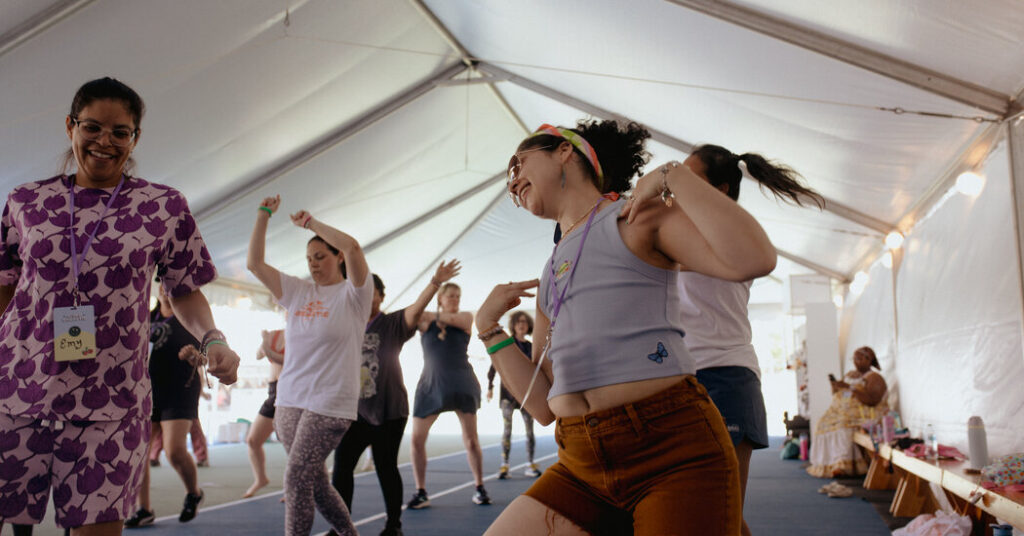
The retreat has all the trappings of a summer camp. Most of the campers, who call themselves Breasties, are brought in by bus. They are welcomed with cheers and whoops and assigned to cabins with names like “Guava” and “Mango.” There is a campfire the first evening, with s’mores (and mosquitoes).
The difference is that some campers are bald, having lost their hair during chemotherapy. Some use walking aids to navigate the campgrounds. Many have flat chests after mastectomies. And almost every group activity starts with a relaxation exercise and deep breathing.
There are 200 activities, including archery, aerobics, yoga and Zumba; cafeteria meals; and lots of snacks. But there are also talks by experts — doctors, nutritionists and psychologists — and one-on-one sessions with geneticists and breast surgeons. Mental health counselors are on standby.
Advances in breast cancer treatment in recent years have improved survival rates, even as the incidence of the disease has inched up, but many women here said what comes after the grueling treatments are finally over — going on with life as a cancer survivor — is, in many ways, just as daunting. The road map that has directed them from surgery to chemotherapy and radiation comes to an end, and the frequent contact with caregivers stops.
“Being in treatment is hard, but you know what to expect,” said Tracy Lane, 45, of Fort Worth, Texas, who was diagnosed with breast cancer last year. “You’re watched all the time and you feel very taken care of.”
When she completed treatment in October, she expected to feel relief, but instead was besieged by anxiety: “Who’s going to watch me now? Is it still there? Is it going to come back?”
“There’s an expectation that you’re done with chemo, you’ll get back to your life,” she said. “But that old me? She’s gone. She doesn’t exist anymore. She worried about dumb stuff. She bee-bopped through life.
“You always knew you could be hit by a bus tomorrow, but you have an illusion you’re in control,” she said. “Cancer hits you in the face, and that illusion is gone.”
How It All Started
The women who founded the Breasties were in their 20s and 30s when they had their encounters with breast cancer. They looked for kindred spirits, but found that traditional cancer support groups drew older patients who were in different phases of their lives.
Allie Brumel was 28 and had just gotten married when she found a cancerous lump in her left breast. “I didn’t know you could get breast cancer in your 20s,” said Ms. Brumel, now 37, who was living in the New York area at the time but has since moved to Bluffton, S.C.
She started Googling, she said, looking for other 20-somethings with cancer. She found Paige More’s Instagram, where Ms. More described having a preventive double mastectomy in 2017 after learning that she carried the BRCA1 gene mutation, which significantly increases the lifetime risk of both breast and ovarian cancer. Ms. Brumel was impressed that Ms. More was talking openly and publicly about her mastectomy, and she reached out to her.
Ms. More introduced her to her friend Bri Majsiak, now 32, from East Rutherford, N.J. Ms. Majsiak was 5 when her 31-year-old mother died of breast cancer. Her genetic tests were inconclusive, but she also elected to have prophylactic surgery in 2020.
Eventually, the three women met Ms. Michelle, a mother of two, who now lives in Rosedale, Queens. Ms. Michelle was 35 when she discovered a lump “that felt like a boulder” in her breast. She had to fight with her doctor to have a mammogram because she was not yet 40.
The scan indicated a small tumor, but she opted for a double mastectomy, which mystified her friends and family. During the procedure, surgeons discovered another cancerous tumor behind her chest wall that would have been missed with less invasive surgery
Eager to talk to other women who were going through similar experiences, Ms. Michelle went online and found Ms. More, who invited her to a Friendsgiving dinner.
The bond was immediate, though it surprised her. “Paige was a decade younger,” said Ms. Michelle, who was living on Long Island at the time. “On paper we didn’t have anything in common. I was a Black mother with kids in the suburbs, and she was a white single woman in the city. I was in health care, and she was in television. But she was open, and openly discussing her mastectomy on Instagram.”
The meet-ups continued, leading to weekend trips together. When they posted photos on social media, they were bombarded by requests from women who wanted to attend the next event. The group’s membership snowballed, and the leaders formed a nonprofit in 2018 named the Breasties. In addition to the retreat, the group organizes virtual meet-ups year-round, does advocacy work, raises money for research into advanced Stage 4 breast cancer and produces The Peak, an online guide to navigating breast and other gynecologic cancers.
During the opening assembly at Camp Breastie, Ms. Michelle told the crowd she was just about to mark her 10th anniversary in remission. They gave her a standing ovation.
No Going Back
One afternoon during the retreat, several women sat around a table sorting through trays of beads to make bracelets that spelled out “Survivor” or “Stay Strong.”
Brooklyn Olumba, 34, a pharmacist from Houston, said she found it therapeutic.
“Not for me — it’s stressful!” said Ardisa Smith, 51, of Snellville, Ga., who was frantically searching through the pile for letters she was missing. “I need another R.”
Like the other campers, Ms. Smith and Ms. Olumba said the real draw of the retreat was not the activities or the opportunity to ask an expert; it was the chance to spend time with other women who knew exactly what they were going through, before they even said a word. Even the most supportive friends and family could not understand how profoundly cancer had changed them, and often expected them to bounce back to their previous selves, which they could not do.
Ms. Olumba compared the experience to being in a car accident.
“Everyone is concerned about you right after it,” she said. “Then, once you’re healed, nobody else is thinking about it anymore. But you’re still scared to drive. You’re wondering if you’ll get into another accident.”
She switched tactics on her bracelet, giving up on “Stay strong” in favor of “[Expletive] cancer!”
“You come to camp, and everyone’s been in a car accident,” she said.
The post At This Camp, Everyone Knows What It Means to Have Breast Cancer appeared first on New York Times.