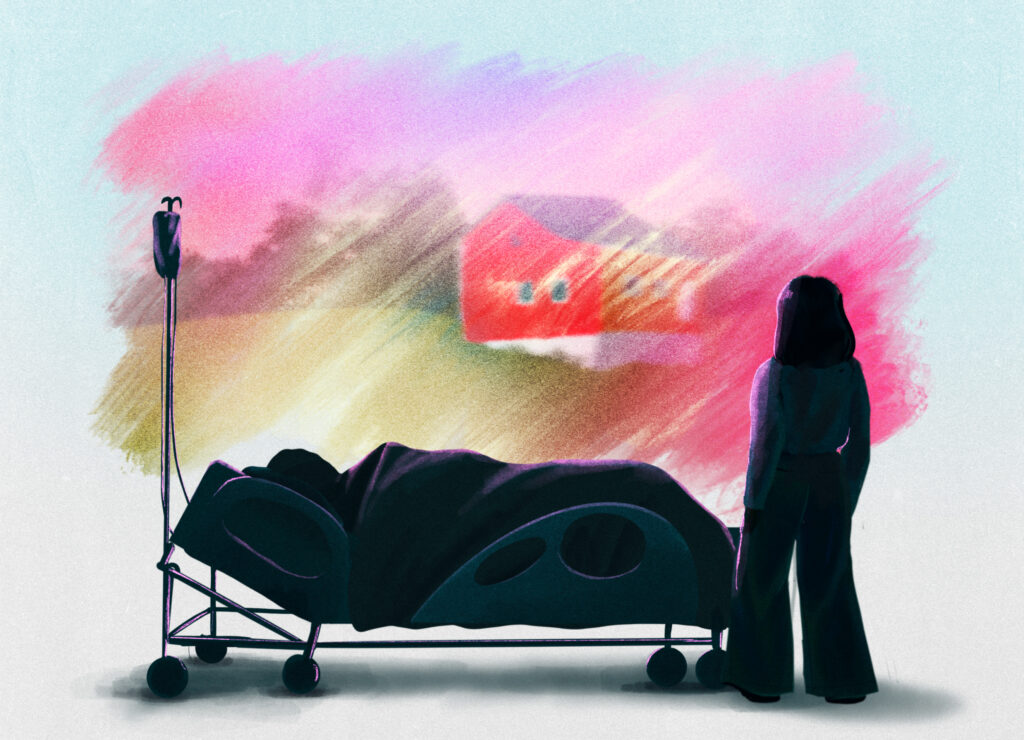
For as long as she can remember, Debbie Eichensehr has feared losing her mother. Throughout her early childhood and well into her teen years, she tried to quell her anxiety with a bedtime ritual. Before going to sleep, she would kiss her mother’s cheek and recite the same words:
Good night, I love you, I’ll see you in the morning.
Good night, her mother always answered. I love you, too.
And? Debbie would press her. Tell me you’ll see me in the morning.
“I had to hear her say it,” Debbie recalled recently. “I don’t know why.”
So when it seemed like her mother actually was going away — when 83-year-old Shirley Brydalski, confined to a hospital bed in her living room in western New York, began to speak and behave as though she were somewhere else entirely — Debbie’s immediate response was dread.
The departures were brief but strange. Once, Debbie awoke in the predawn darkness to the sound of her mother singing a folk song in a foreign language Debbie didn’t recognize. Other times — late at night or in the quiet afternoon hours as Shirley dozed — Debbie would hear her mother suddenly engaged in conversation. In the diminished voice of an elderly woman, she spoke the words of a long-ago little girl:
I’ll get the water, Grandma.
Yes, Grandma, I did my chores.
Your flowers smell so good.
Where had her mother gone? Seventy-five years and 200 miles away, it seemed, to a farm in Sagamore, Pennsylvania, where Shirley had lived with her maternal grandmother until she was 10. These episodes sometimes occurred when Shirley was half-awake, and most often when she was sleeping — but “dreams” felt like the wrong word to convey what she was experiencing. The visions came to her with such astonishing clarity that she narrated them aloud and sometimes awoke convinced that she’d just returned from an actual trip.
“I was at the farm,” she would say to Debbie. “Don’t you remember?”
Debbie found her mother’s reveries distressing, even frightening. Shirley was riddled with metastatic bladder cancer. She had incurable pulmonary disease, osteoporosis and a stent in her heart. Now Debbie wondered: Was her mother’s sanity eroding? Were her medications out of balance? Was she nearing a final descent? Debbie’s first instinct was to disrupt whatever was happening. Wake up, she would say. Come back.
She didn’t know yet that there was a name for what her mother was experiencing: end-of-life dreams and visions, or ELDVs. Debbie didn’t know that the foremost research into this deathbed phenomenon was conducted at a hospice facility only a few miles from her home.
As Shirley’s body bore her toward its end, her mind was carrying her elsewhere, back to her beginning. The visions were idyllic and comforting — but they were also bound to long-hidden traumas in Shirley’s past, and revelations that would transform the way Debbie understood her mother’s life.
As a physician and the chief medical officer of Hospice Buffalo, Chris Kerr has seen his patients experience end-of-life dreams and visions for nearly 30 years. Since 2010, he has led a research team that studies the phenomenon and chronicles how the visions can provide solace, meaning and healing to both the dying and their loved ones.
But his own first encounter came when he was 12 years old, standing at the bedside of his dying father.
William Kerr was a 42-year-old surgeon with end-stage cancer, and on that day in 1975, he reached out and ran his fingers over the buttons of his son’s jacket. The two of them had to hurry, he said; it was time to catch a plane to head up north for their fishing trip together.
Even as a boy, Kerr sensed that his father believed he was in a different place or time, far from the hospital room — and that wherever he was, he seemed peaceful there. But Kerr was quickly ushered away by a priest who said his father was “delusional.”
What he means by this — somewhere else — is that these patients were engaged with a different reality around them, interacting with people and places only they could see.
At first, he found it unsettling. But then he observed the veteran nurses.
“Watching the nurses work in that space was unbelievable,” he said. They were familiar with what they were seeing, accepting and affirming their patients’ experiences. “I’ll never forget the drive home, just thinking, ‘What’s happening here?’”
Kerr felt called to answer that question. During his residency, he grew disillusioned with the economically driven, “death-avoidance model of care,” as he says — the way doctors would sign off from following a terminal patient when it was determined that there was nothing more to diagnose or treat. Kerr decided to leave his cardiology fellowship — “when I went and told my chairman, he actually thought I was having a breakdown,” Kerr said — and join Hospice Buffalo as the medical director of the inpatient unit, where he could devote himself entirely to serving dying patients.
Many told him of people and places they saw in dreams and visions, which might occur in different states of consciousness — wide awake, half awake or completely asleep — but conveyed the same striking intensity, an undeniable sense of realness. They were nothing like “normal” dreams, these patients insisted; their experiences felt wholly immersive, coherent and meaningful.
Kerr noted that these descriptions stood in sharp contrast to the more discordant, often distressing experiences of delirium or medication-induced hallucinations, which also commonly occur in dying patients.
Often, deathbed visions were an apparent source of comfort — as with Mary, a 70-year-old artist and mother of four, who was one of Kerr’s first hospice patients.
One afternoon, with her children and Kerr together in her room, Mary suddenly started to cradle and caress a baby only she could see. She cooed the name “Danny” as she kissed an invisible, tiny body. Her children were bewildered and asked Kerr if their mother was hallucinating. But no one felt any need to intervene; Mary seemed utterly serene and blissful.
Kerr was doing his rounds the next day when Mary’s sister arrived to visit, and Mary’s children told their aunt what had happened. She momentarily froze — “You could literally see the color come out of her face,” Kerr remembered — and then she shared something that no one else in the family had known.
“That was her son,” she said. Years before Mary’s four children were born, she had delivered a stillborn baby named Danny.
Yet the trauma and grief of that loss were markedly absent from the moment Kerr had witnessed, he said; when Mary was absorbed in her vision, “there was only love.” Mary died soon after, Kerr told me, having completely altered his understanding of what it means to die peacefully, and to heal in ways beyond the reach of medicine.
Debbie knew her mother’s life hadn’t been easy, and that she had shielded her kids from the worst of it.
“She didn’t tell us about half the things that happened,” Debbie said. But she never imagined just how much her mother had left out.
The children knew Shirley became a widow at 24, when Debbie’s father died in a car accident. Debbie was 19 months old, the third of four children. In the immediate aftermath, Shirley suffered a breakdown, Debbie said, and was briefly hospitalized. The state threatened to take the children away, but Shirley was determined to keep her family together, and her father and stepmother took all of them in.
About a year and a half later, Shirley married her second husband, who became the father of her fifth child. They lived as a blended household with eight children — including three sons from Shirley’s husband’s first marriage — until the couple split when Debbie was 11 years old and Shirley and her five children moved out.
Their divorce was a time of painful upheaval, Debbie said, as they separated from her stepbrothers and the man she’d called “Dad,” but what she remembers most is the feeling of safety and stability her mother gave her kids.
“I don’t recall ever being afraid,” Debbie said. “My mom was always right there for all of us.” It must have been difficult for her, Debbie said — to be a single mother again, to have to support five kids on her own. But if Shirley was ever scared or overwhelmed, Debbie said, “she didn’t let us know.
“I always thought my mom should be put up for sainthood.”
When Debbie was 12, Shirley started dating the man who would become her third and final husband, Bob. They were together for more than 47 years. Bob cared for Shirley after she was diagnosed with thyroid cancer 15 years ago and had to retire from the assembly line job she loved at a local automotive parts company. In their later years, the two traveled around the country together.
When Bob died of lung cancer in January 2025, Shirley’s own health began to unravel. Debbie, then a 59-year-old widow, became Shirley’s caregiver. Debbie scaled back her shifts as a bar manager at a restaurant, left her day job at an Amazon warehouse and moved in with her mother, so they could spend as much time as possible together.
As the months passed, Debbie began to notice that her mother sometimes behaved as if she were elsewhere. Debbie worried this might indicate cognitive decline — but Shirley’s short-term memory was still sharp, and she did not seem distressed in these moments; she appeared calm and certain of where she was, or where she’d been.
In January, as Debbie lightly dozed in an armchair near her mother’s hospital bed, she heard Shirley speaking to someone: The flowers smell so pretty, she was saying. Debbie looked at Shirley and saw that her eyes were open, but she seemed to gaze straight through her daughter.
It took several moments for Shirley to return to the room. “I’m here now,” she said, finally. “I was on the farm.”
Kerr has made a mission of educating the public about the value of deathbed dreams and visions, and he has become a frequently sought-after speaker, with a 2015 TEDx talk on the topic and a 2020 book, “Death Is But a Dream: Finding Hope and Meaning at Life’s End.” This year, the hospice released a tool kit of guidelines and strategies for families and caregivers to help them navigate conversations about these events.
He has come to understand how this work is received: Members of the public are generally awed, and eager to share their own stories about deathbed visions. Nurses, hospice workers, death doulas and caregivers nod along: “I’m not telling them anything they don’t already know,” he said. Doctors often glaze over and lose interest, unmoved by anecdotal accounts of dying patients.
Kerr first encountered that skepticism early in his tenure at Hospice Buffalo, when he tried to convey the clinical impact of ELDVs to medical residents there. But doctors are taught to focus on evidence-based medicine, Kerr said, “and that allows for zero measure of the subjective, let alone the spiritual.” To shift perception at a meaningful scale, Kerr knew he would need data.
In 2010, he designed a research study to document the frequency and content of ELDVs among hospice patients in the 22-bed inpatient unit. “We screened for delirium, we looked at drugs they were taking, we did labs to make sure they weren’t affected,” he said.
The research team members conducted and recorded interviews with patients “to refute the medical community who was saying they were feebleminded,” Kerr said. They determined that video footage of lucid, articulate patients was often the most effective means to convince skeptical physicians that ELDVs were an experience of both intrinsic value and clinical significance.
The study, published in 2014 in the Journal of Palliative Medicine, found that end-of-life dreams and visions were strikingly common: 88 percent of patients reported experiencing at least one.
Further study has identified common threads among these dreams and visions, which have been documented in people of all ages, from very young children to the elderly. Patients often report seeing beloved people, places or pets from their past; deceased loved ones are especially common. The vast majority of ELDVs are comforting, but some can be unsettling or disturbing. Some patients find themselves revisiting pivotal episodes of their lives, while others experience more mundane, familiar moments. Travel is a frequently recurring theme: Many people describe packing suitcases, preparing for a trip or seeing loved ones in train or bus stations. ELDVs might occur very soon before a death — within hours or days — but can sometimes take place weeks or even a few months beforehand, often corresponding to a patient’s fluctuating health and typically increasing in frequency as death grows nearer.
Kerr emphasizes that these fully enveloping, interactive experiences seem beyond the reach of our existing nomenclature. “We don’t have the language for this,” he said. “I think there’s something wonderful about that.”
Kerr has always resisted mystical or religious explanations for deathbed visions — he is not inclined toward the “woo-woo,” he told me. He maintains that the findings of his research team are extraordinary enough; the impact of the phenomenon is real, no matter its origin: “I actually love the idea that we don’t know.”
About four years ago, Kerr found himself contemplating his own mortality as he underwent successful treatment for head and neck cancer. He was comforted by all he’d witnessed as a physician. “I felt less fearful of the process,” he said. “It’s a human experience. It’s life’s closure.”
He welcomes every opportunity to hear patients describe what this feels like — and so, one weekday afternoon this spring, Kerr and I drove to visit Fred Netzel, an 85-year-old former Cheektowaga, New York, police captain with heart failure, one of the hundreds of patients receiving care from Hospice Buffalo at home. His daughter, Kelly, greeted us at the door of his duplex and led us to the living room, where Fred sat in a plush armchair, a calico cat dozing at his feet.
Fred was facing his own death, and he was grieving for another: his next-door neighbor, a man named Tommy, whom Fred had known since they were high school classmates in Buffalo. They both became law enforcement officers and lived in their adjoined homes here for nearly 20 years, until Tommy died earlier this year after a short illness.
“We’d sit out on his deck or my deck,” Fred said, and then he abruptly stopped and touched his face. “He was like a brother, is actually what he was,” he continued, his voice breaking. “I miss him so goddamn much. I’m gonna cry just thinking about it.”
But Fred had been hearing from Tommy lately, he told Kerr. When Fred and Tommy used to go back and forth between their homes, he explained, they had a particular way of ringing each other’s doorbell — dingdingding, dingding, he said, miming the rhythm with his finger — “and that was our code.”
Now Fred often found himself hearing Tommy’s distinctive ring, clear as day, he said. “I’m usually just sitting here. I do a ton of reading. And sometimes I hear the bell,” he said. “It’s our signal.” One recent day, he heard it several times over the course of the afternoon, as he drifted in and out of light sleep in his armchair. Once, he heard Tommy’s voice call, “Hey, Fred!” and it was so real that “I got up, and I went to the door,” Fred said. “His wife was outside moving some snow, and I said, ‘Did you ring the bell?’ She says, ‘No.’”
Fred had encountered other loved ones recently, too. Wide awake, he once watched his late mother walk from the kitchen into the living room, beside his chair. In a recurring dream, he sometimes saw other detectives he served with, gathered together in their friend’s garden, where they often picked tomatoes. His friends didn’t say anything to him in these dreams; they just knelt in the sunlight, plucking fruit from the vines. It felt comforting to see them, he said.
“Are they living or dead?” Kerr asked.
“Dead,” Fred said. “All these guys are dead.”
“And does that feel real, when you see them?”
“Oh, absolutely,” Fred said, nodding. “Yes.”
Fred was grateful to Kerr for asking about this, he said. It made him feel like all of it — what he was hearing, who he was seeing — meant something. “Like there is a reason,” he said. “You know, I have no fear of dying.” He smiled. “It’s serious, but it isn’t the end of the world. On occasion, when I say my prayers at night, I’ll say, ‘If you’re ready for me, I’m ready to go. You need a joker up there.’”
“Not yet, Dad,” his daughter said.
“Fred, it sounds like you’ve had some real wonderful friends,” Kerr said. He had one more question. He wanted to know if Fred’s visions had affected his thoughts about where his friends had gone, and where he was going.
“Do you think you’ll see them?” Kerr asked.
Fred smiled. “I hope so.”
Shirley had never shared much about her early childhood. “I knew she lived on a farm in Pennsylvania as a child,” Debbie said. “That was it.” Nor had Debbie ever really asked her mother about that time; their family wasn’t inclined toward introspection, and there was always more than enough to manage in the present without delving into the past.
Debbie’s understanding was that Shirley’s mother died when Shirley was a newborn and her father did not seek custody, and that is how she came to be raised by her maternal grandparents on the farm. Shirley lived there until she was about 10 years old, when her grandmother died — Debbie wasn’t sure how; she assumed an illness.
Shirley had made the nearly four-hour journey south from Buffalo to Sagamore a few times in her adulthood, stopping to visit her grandmother’s headstone at the local cemetery before driving to see the farm where they’d lived together. Shirley had never said much about those trips; she’d mentioned only that she was pained by the way the place had changed.
Now, though, it seemed her mind was allowing her to revisit the childhood version of her home, and Debbie finally wanted to know more about it.
“What?” Debbie said. “What are you talking about?”
A man who lived nearby killed her, Shirley explained; she learned later that he had a romantic interest in her grandmother, which was not reciprocated. He shot her in her kitchen, and then he ran to a shed — one that Shirley had often used as a playhouse — locked the door and shot himself. It was Shirley who found her grandmother collapsed on the floor in the kitchen doorway. Shirley’s grandfather was out of earshot, working with the livestock.
Debbie was astonished and heartbroken by these revelations: that her mother had been abandoned as an infant by an alcoholic mother. That the grandmother who adored Shirley and raised her to the age of 10 was murdered. The crime was on the front pages of newspapers throughout Pennsylvania that January of 1953, but Shirley had kept the story from her children all her life, until now.
Debbie remembers that she turned her face away, trying to hide her tears.
“Oh, don’t cry,” Shirley said.
“But Mom,” Debbie said, “it’s so sad.”
“No, it’s not,” Shirley insisted. She meant that the tragedy and the trauma wasn’t what she was feeling anymore. It wasn’t present in her visions, and it wasn’t what defined that time in her life.
Shirley smiled at her daughter. “My grandma loves me,” she said.
In late February, Shirley was transported to Hospice Buffalo’s inpatient unit after her health sharply declined at home. Completely immobile, she had started refusing to eat; when she began struggling to breathe, Debbie knew she needed help keeping her comfortable.
At the hospice, in her room overlooking the landscaped grounds outside, Shirley kept seeing her grandmother and the farm.
Kerr visited Shirley the morning after her arrival. He wanted to get a sense of her — who she was, how she felt, what she was experiencing.
“Have you been dreaming?” he asked her.
When Kerr explained to Debbie that Shirley’s dreams and visions were a well-documented part of the dying process, Debbie said, her anxiety gave way to gratitude.
“It made it a lot easier for me to understand,” she told me. She was both startled and moved by the extent to which her mother had confided in her doctor: “She never talked to anyone about her farm life,” Debbie said, but “she just opened up to him.”
Kerr views it as an essential part of his work to help family members interpret what the dying are experiencing — to bring caregivers closer to what he calls “the view from the bed.” Without that alignment, he said, many might feel inclined to reject a loved one’s visions or try to “correct” their version of reality, which can feel deeply destabilizing to the patient.
But when end-of-life visions are understood, caregivers commonly start asking questions about them and learning things they’d never known about their dying relative, Kerr said. In the final days or weeks, there can be an extraordinary deepening of connection, an emotional growth that intensifies and accelerates.
Even so close to death, Kerr said, “there is profound living happening.”
Shirley had started sleeping for longer stretches and was still not eating much, but she was awake and alert on a weekday morning in March when Debbie arrived for her daily visit.
Shirley was sitting up in bed, her pale face framed by short silver hair, her eyes bright when her daughter introduced me as a visiting journalist. She seemed eager to talk about her grandmother, the woman she was seeing in her dreams — though not last night, she noted regretfully; she hadn’t slept particularly well.
“I see her just like she was, loving and caring and helping,” Shirley told me. In her visions, she was a young girl again, returning to the farm after school. She would find her grandmother in the kitchen, or sometimes tending to her garden outside, the flower beds filled with fragrant blooms. “I’m wondering what she’ll be teaching me,” Shirley said, explaining that she learned to crochet and cook from her grandmother.
They had no plumbing on the farm, Shirley said, and she sometimes dreamed that she was fetching water from the well for her grandmother. Other times, she could hear her grandmother singing, the way she often would when Shirley arrived home in the afternoons. “When she sang, it was in Lithuanian,” Shirley said — the language Debbie had not recognized when she first heard her mother singing late at night.
The farm of Shirley’s visions was exactly as she once knew it, down to the most minute details: the floral wallpaper in her bedroom, the rope swing that her grandfather hung from her favorite tree in the yard. Her grandmother, too, was frozen in time in her late 50s, wearing a handsewn apron she’d made from the burlap of old cattle feed bags, her long hair swept up in a bun. She rarely spoke, but sometimes, just before a vision faded away, she said Goodbye or I love you, Shirley said.
“Why do you think you’re seeing the farm so often now?” I asked her.
“Because I’d love to go back to it,” she said. She paused to breathe deeply; it took effort to speak so much. Her hand trembled as she reached to sip from a cup of water. “I’d still be with her, if things hadn’t happened the way they did.”
She spoke, then, about the way her time on the farm ended, the flashes of memory that had never left her: She was playing in the barn after school when she heard a gunshot and saw, through the gaping slats of the walls, the shape of a man running. She raced to the farmhouse, where she found her grandmother’s body slumped on the floor in the kitchen doorway. Then Shirley bolted after the killer, who had already locked himself in the shed before pulling the trigger one last time. “I couldn’t get in,” she said, “and it’s a good thing I couldn’t.”
This horror is nowhere in her visions. But seeing the farm again made her want to finally tell her family about what happened. Before she leaves, she said, “I want the kids to know all about me.”
She looked at Debbie. “We’re going to go back,” Shirley said, speaking of the farm. “I think we’re going to take a ride down there.” I thought of Kerr’s father, telling his son to prepare for a flight they wouldn’t actually be taking.
I asked Shirley: When she saw the farm in her dreams and visions, did it feel like she was really there?
Her blue eyes widened slightly. “Oh,” she said, “I know I was there.”
On a cold Friday morning in March, Debbie sat near her mother’s bed as she slept, the lights turned down, the room quiet. She was willing herself to accept what was coming, the separation she had resisted all her life.
Tell me you’ll see me in the morning.
There were moments from their family’s past that Debbie saw differently now. She had found herself thinking more about how authorities threatened to take Shirley’s children away after her first husband died, and what it must have meant to Shirley to keep them together.
“She could have given up, just like her mother did,” Debbie said. “She could have said, ‘No, forget it,’ and let us go. But she didn’t.”
Debbie thought about how she was 11 years old when she moved with her mother and siblings to a new home — about the same age Shirley was when she left the farm.
“She knew what that must feel like,” Debbie said. Shirley never minimized what her children were going through, even as she emphasized a longer view: I know it hurts, but you’re going to be okay, she’d tell them. There was a depth of empathy to Shirley that had always felt distinctive.
“She was just so different from other moms,” Debbie said. “I knew it, all my life.” Now, with a fuller portrait of Shirley’s formative years, and the traumas she’d learned to endure, “I think I know why,” Debbie said.
There are smaller things, too. When Shirley spoke about her visions of the farm, she noted a favorite glider swing in the yard, with two benches positioned face-to-face; she and her grandmother loved to sit there and talk. Debbie understood then why her mother always brightened whenever she saw that same style of swing in a park; sit here with me, she’d say to her kids.
“I know so much more now about how really, really happy she was,” Debbie said, “and that’s already helping me.”
Kerr stopped by to check in on them and took a seat on the couch alongside the big windows. Rain fell in the garden outside, where deer meandered beneath the trees and nuzzled at bird feeders. In the bed, Shirley’s breath was slow and heavy.
“It will continue like this,” Kerr said softly, nodding toward her. “There won’t be any new pain.”
Debbie exhaled, watching her mother sleep. “That’s good,” she said.
In her lap, Debbie held a page she had removed from one of Shirley’s photo albums and brought with her, in case her mother wanted to see it: four images of the farm, from a visit Shirley and Bob made to the property in 1983. It was so different, then, from the place Shirley remembered. These pictures were once all that Debbie knew of the farm, beyond the mere fact of its existence.
But now she understood where her mother had been, and where she wanted to go. In those final weeks, Shirley described it all so vividly that Debbie could almost see it, too: the long driveway winding through fields, past the rope swing strung from a towering maple. Lush beds of gladiolas and lilies by the door to the red farmhouse. The kitchen just inside, and the voice of a woman singing there, waiting for her granddaughter to come home.
About this story:
Editing by Ann Gerhart and Steve Kolowich. Copy editing by Emily Morman. Design editing by Christine Ashack. Photo editing by Toni L. Sandys. Video editing by Mariana Trujillo Valdes. Additional editing support by Christine Loman, Ellen McCarthy and Amanda Finnegan.
The post The profound meaning and mystery of deathbed visions appeared first on Washington Post.