This article is part of Overlooked, a series of obituaries about remarkable people whose deaths, beginning in 1851, went unreported in The Times.
For the visionary steel-string guitarist, pianist, composer and singer Robbie Basho, making music was more than a vocation; it was a way to assuage a lifetime of psychological and physical distress — pain that only ended with his death, at age 45.
Beginning in the early 1960s, Basho expanded the steel-string guitar’s vocabulary using alternative tunings and experimental forms to create trance-like compositions.
He forged a distinctive style that drew an array of traditional world music from India, Japan, France, Germany, Persia, China and Native America. An early example is “Harakiri, Kali Style,” which incorporates the flavor of North Indian classical raga, using an open harmonic structure, droning strings and improvisation to enter into a deeply personal state — an immovable, hypnotic track that bends time.
“Basho’s music is not made for casual listening,” Steven Rings, an author and music theorist at the University of Chicago, said in an interview.
“It requires patience and attention, like a meditation, where you have to sit through a lot of discomfort to get there,” he added.
Basho began exploring music from other cultures after he discovered the recordings of the renowned Indian composer and sitar player Ravi Shankar in 1962. He later included more vocals to his music. In songs like “Blue Crystal Fire” and “The Song of Leila,” his keening, dramatic voice booms over tense instrumental landscapes — cantorial in flavor and devoid of irony.
“It’s the most unstylish singing you can think of,” Rings said.
Basho earned a cult following as one of the great mystics of the American guitar. Yet in music, as in life, he existed outside the mainstream. He lived in isolation and, as a student of the California-based ascetic spiritual movement Sufism Reoriented, made a commitment to celibacy outside of marriage. He remained single all his life, though he longed for a partner — a feeling expressed in songs like “Tears of Teresa,” with the lyrics:
The crown of love is circled with thorns From this day on, from the day I was born And still I reach for you, Oh my crown of love, I reach for you But the thorns of thought are in the way.
He also struggled with mental illness and flashbacks that he attributed to his experimentations with LSD before joining Sufism Reoriented. He held conversations with unseen presences in private as well as onstage, and friends and colleagues said he rarely seemed at ease.
The chronic back pain that Basho suffered resulted from either a car or climbing accident (or both; stories vary). He treated it with acupuncture, massage, herbs, Chinese medicine and spinal adjustments. During a routine chiropractic appointment, an artery in his neck ruptured, causing a stroke that left him in a coma.
He died two days later, on Feb. 18, 1986.
Basho was born on Aug. 31, 1940, and was adopted; his birth certificate and adoption papers are sealed until 2040, leaving details of his early life unknown. His parents, Daniel Robert Robinson, a surgeon from Baltimore, and Eilene Webb, a clinical pathologist, named him Daniel Robert Robinson Jr.
Basho’s mother was “standoffish, cold, not a loving person,” Basho’s niece, Valerie Cantrell, said in an interview. He and his stepsister, Penelope Hurley, were primarily raised by a housekeeper, and Basho grew up introverted and socially awkward. He was sent to a psychiatrist, which was rare for children at the time.
Basho attended Mount Washington School and Loyola High School in Baltimore. He studied trumpet and then euphonium, a relative of the tuba, but it wasn’t until he was 20 and enrolled as a pre-med student at the University of Maryland that he took up the acoustic guitar — an interest he shared with his roommate, the musician Max Ochs.
Even in college, Basho was awkward, Ochs said in an interview: “Robbie was always reading, always sweating, anxious, and always trying, unsuccessfully, to get a girl.” Basho was also a large man and a weight lifter; he once worked as a bouncer at a bar in Ocean City, Md.
Basho never graduated from college. He and Ochs fell in with a Washington, D.C., crowd that included John Fahey, a fellow pioneer of what is now referred to as the American Primitive movement, and the producer Ed Denson. Basho moved there for a time to study flamenco guitar, then followed Fahey to explore the thriving music scene in Berkeley, Calif. It was there, Fahey said, that he adopted the name Basho, after a 17th-century Japanese haiku poet whom he claimed to have been in a past life.
Exposure to Shankar’s recordings soon followed and proved transformative. “After that,” Basho said in a 1974 radio interview, “nothing was the same.” He began studying with the renowned sarod player Ali Akbar Khan, whose teachings informed Basho’s creation of new guitar techniques, as heard on his first records for Takoma, the label founded by Fahey and Denson.
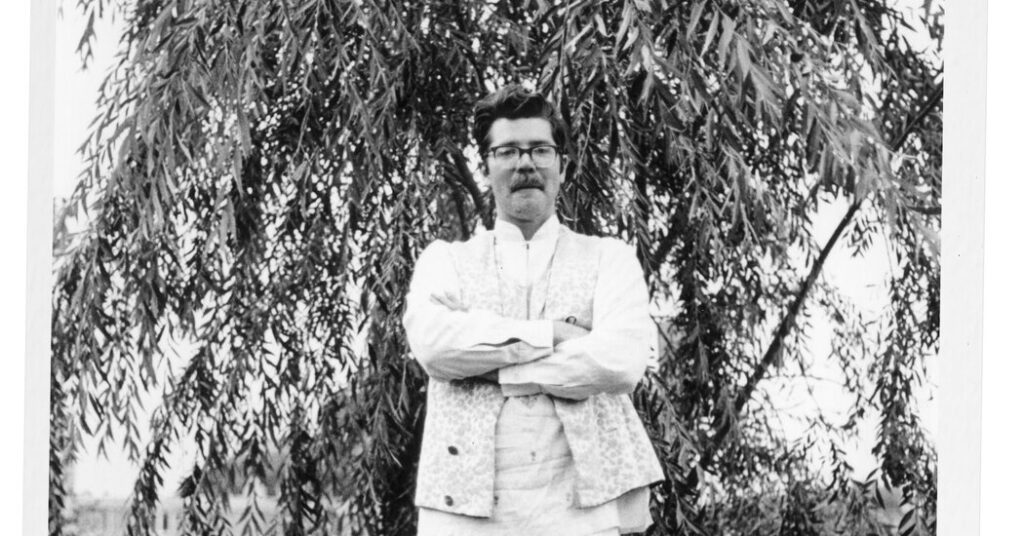
Basho was admired for his intricate guitar work, but the international sounds he pursued, combined with his emotionally volatile, naked aesthetic, proved to be kryptonite to mainstream success. He would wail and chant, as he did on tracks like “Orphan’s Lament,” and he cried openly during performances. On album covers, he dressed in brightly colored robes; onstage he wore more conventional clothes, looking decidedly out of place in what was mostly a hippie club scene.
The guitarist Leo Kottke sneaked into clubs when he was a teenager to see Basho perform. “I was astounded by this guy,” Kottke said in an interview. “There wasn’t much in the way of instrumentalism on the scene in those days, so what he was doing was really unusual.”
Basho had synesthesia, a condition that combines the senses, allowing a person to see images in sound, and it led him to create a chart titled “The Esoteric Doctrine of Color and Mood” to articulate the colors associated with his compositions. Describing his music in a 1981 interview with Frets magazine, Basho said, “My gift is texture.”
He insisted his work wasn’t “far out” but “far in,” his lyrics evoking the natural world and drawing on legends and archetypes to populate the private universe his music inhabited. “Ride the Buffalo,” for instance, uses a forceful, idiosyncratic strumming style and unexpected chord changes to evoke the wide, open spaces of the American West.
In the liner notes for his 1971 album “Song of the Stallion,” Basho wrote: “My philosophy is quite simple: soul first, technique later, or ‘Better to drink wine from the hands than water from a pretty cup.’”
Basho relied on financial support from his father for basic necessities. He was on the road for long stretches between the West Coast, Canada and the Northeast, performing in small venues and getting rides when he could (he did not have a driver’s license). Sometimes, he slept in public parks.
He began performing on larger stages after signing with Vanguard in 1972, opening for acts like Mahavishnu Orchestra. The success was short-lived. Two albums he recorded for Windham Hill — a label created by William Ackerman, in part, in response to Basho’s music — failed to generate widespread attention and, by the mid-1980s, all 14 of his LPs were out of print.
He started producing and distributing his music himself, on cassette; his final recording was “Twilight Peaks” (1984). Maurizio Angeletti, who toured with him in Italy in 1982, wrote in a remembrance, “It was clear that he lived in a dimension of near-poverty, struggling to stay alive financially and physically, but also struggling to get understood.”
There has been renewed interest in Basho’s music in recent years, thanks largely to the 2015 documentary “Voice of the Eagle: The Enigma of Robbie Basho” and to two box sets of unearthed recordings from his personal archive released by Tompkins Square Records in 2020 and 2024.
“He was not of this world and was not equipped to be part of this world,” Ackerman said in “Voice of the Eagle.” “I’m not surprised he left this world early. It must have been very tiring for him to try to be in it.”
Howard Fishman is a musician and composer and the author of “To Anyone Who Ever Asks: The Life, Music, and Mystery of Connie Converse.”
The post Overlooked No More: Robbie Basho, Guitar Mystic Who Sought Enlightenment in Sound appeared first on New York Times.