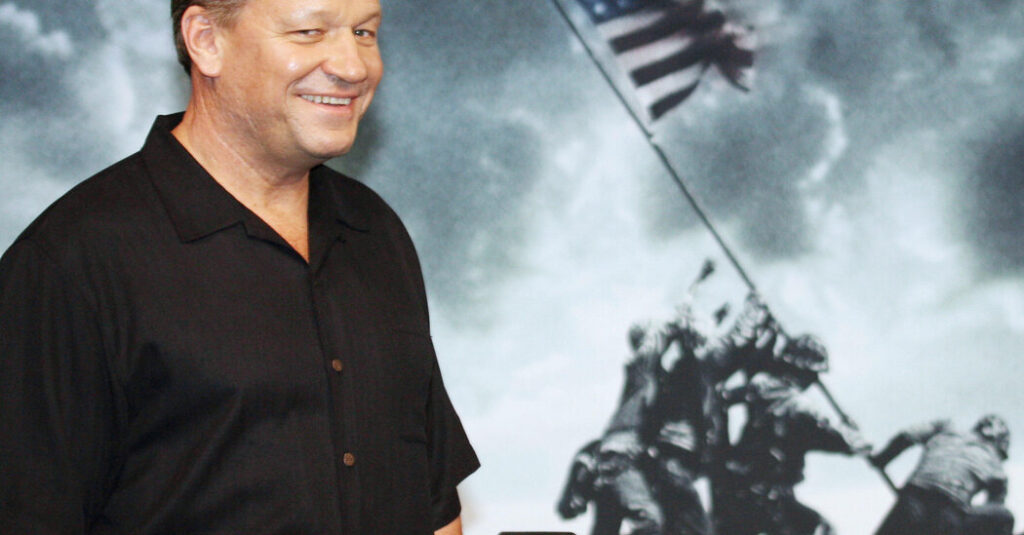
James Bradley, who turned his curiosity about his father’s time in the Navy during the Battle of Iwo Jima — and the long-held but ultimately mistaken belief that he was in the iconic photograph of six servicemen raising the American flag on Mount Suribachi — into the best-selling book “Flags of Our Fathers” (2000), died on June 5. He was 72.
His daughter Alison Cinnamond confirmed the death but declined to provide further details.
“Flags of Our Fathers,” which Mr. Bradley wrote with Ron Powers, a Pulitzer Prize-winning journalist, spent 46 weeks on the New York Times best-seller list, climbing to No. 1, and was adapted into a 2006 film directed by Clint Eastwood. Ryan Phillippe played his father in the movie.
“Flags” tells the stories of the six flag-raisers — John (Doc) Bradley and five Marines — through the brutal, five-week-long battle against Japanese forces on Iwo Jima, a tiny volcanic island.
The battle claimed the lives of some 6,800 American servicemen, including three of the flag raisers. Mr. Bradley’s narrative followed the survivors — his father, Rene Gagnon and Ira Hayes — on the national war bonds tour that they starred in upon their return to the United States and their sometimes difficult postwar lives.
Doc Bradley, who became a funeral director in Antigo, Wis., told his family little about his time in combat, or the fact that he had received the Navy Cross, the branch’s second highest award for valor, for treating and rescuing a wounded Marine while under mortar and machine gun fire on Iwo Jima.
But after his death in 1994, his family rummaged through boxes he had left behind. One of the items was a letter to his parents, postmarked Feb. 26, 1945, three days after the flag-raising photo was taken by Joe Rosenthal of The Associated Press. An image of the Pulitzer-winning photo appeared on the 3-cent stamp and on millions of war-bond drive posters. The picture also inspired the design of the Marine Corps War Memorial in Arlington, Va.
In his letter, Doc Bradley wrote, “I had a little thing to do with the raising of the American flag and it was the happiest moment of my life.”
The letter stunned his family.
“If that was the happiest moment of his life,” James Bradley told The Times in 2000, “why had he never talked about it?”
For nearly 70 years, there was little, if any, dispute that Doc Bradley was in Mr. Rosenthal’s brilliantly composed picture. The Marine Corps, had after all, named the six participants. James Bradley had no doubt of his father’s role, describing in “Flags” how he had dropped a handful of bandages before joining the other five men at the flagpole where he “gripped the pole in the cluster’s center.”
But in 2014, an article in The Omaha World Herald described serious doubts raised by amateur historians that Doc Bradley was in the photograph. Mr. Bradley was, at first, dubious.
“Listen, I wrote a book based on facts, told to me by guys who had actually been there,” he told the newspaper. “That’s my research. That’s what I trust. At the end of the day, the truth is the truth. Everything is possible. But really?”
He eventually took a deeper look at the paper’s findings and became convinced that his father had not been in Mr. Rosenthal’s picture but had been in a less dramatic one, with a smaller flag, taken earlier in the day on Feb. 23 by a Marine photographer which the service branch confirmed.
In 2016, a Marine Corps investigation — prompted by findings in a documentary, “The Unknown Flag Raiser of Iwo Jima” — concluded that Harold Schultz, a private first class, was the man in the image long identified as Doc Bradley.
Ms. Cinnamond, James Bradley’s daughter, said in an interview that her father didn’t feel that the book was diminished by the finding, but that he wanted the Marine Corps to get its facts straight about who was actually in the photo.
Indeed, it was not the only misidentification in the photo. In 1947, the Marine Corps said it had credited Henry Hansen for being in the photo when it had actually been Harlon Block. In 2019, the Marines determined that Mr. Gagnon, one of the Marines featured in Mr. Bradley’s book, had “contributed to the flag-raising,” but that Harold Keller was actually in the photo.
James Joseph Bradley was born on Feb. 18, 1954, in Antigo. He was one of eight children of John and Elizabeth (Van Gorp) Bradley. James received a bachelor’s degree in East Asian history from the University of Wisconsin-Madison in 1977.
Mr. Bradley was, at first, a traveling cookware salesman, then built a career as a corporate events and video producer. Without training as a writer or researcher, he began writing “Flags” on his own, but his proposal was rejected by 27 publishers, one of whom told Mr. Bradley that “no one wants to read a book about old men weeping into the telephone.”
One of his agents then brought Mr. Powers on as a collaborator; he had won the 1973 Pulitzer for criticism while writing for The Chicago Sun-Times. Bantam Books soon acquired the book.
The book was one of several successful works during a decade that detailed the bravery of American soldiers during World War II, among them Stephen Ambrose’s “D-Day: June 6, 1944” (1994); Tom Brokaw’s “The Greatest Generation” (1998); Steven Spielberg’s film “Saving Private Ryan” (1998); and the HBO mini-series “Band of Brothers.”
In his review of “Flags of Our Fathers” in The Times, the journalist Richard Bernstein called it “most affecting not because of its graphic portrayal of men at war, although its portrayal rivals ‘Saving Private Ryan’ in its shocking, unvarnished immediacy.”
Mr. Bradley continued to write about Asia in three subsequent nonfiction books. In “Flyboys: A True Story of Courage” (2003), he told the stories of nine American pilots, including the future President George H.W. Bush, who were shot down by the Japanese near the island of Chichijima during World War II. While Mr. Bush was rescued by an American submarine, the other eight were captured and executed by the Japanese.
In “The Imperial Cruise: A Secret History of Empire and War” (2009), Mr. Bradley wrote critically about what he saw as President Theodore Roosevelt’s diplomatic mistakes in Asia.
“Bradley explores the racist underpinnings of Roosevelt’s policies and paradoxical embrace of the Japanese as ‘honorary Aryans,’” Publishers Weekly wrote in its review, but added, “Bradley’s critique of Rooseveltian imperialism is compelling but unbalanced.”
And in “The China Mirage: The Hidden History of American Disaster in Asia” (2015), Mr. Bradley described what he viewed as America’s long-running misunderstanding of China, dating to the early 1800s.
He also wrote a novel, “Precious Freedom” (2025), set during the Vietnam War.
Mr. Bradley’s three marriages ended in divorce. He is survived by two daughters, Ms. Cinnamond and Michelle Bradley, from his marriage to Eileen Heywood; two more children, Jack Bradley and Ava Bradley, from his marriage to Laura Shuler; two sisters, Kathleen and Barbara Bradley; five brothers, Steven, Mark, Patrick, Joseph and Thomas; and two grandchildren. He was also married to Shelley Tupper.
In 1998, Mr. Bradley, his mother and three of his brothers traveled to Iwo Jima at the invitation of Gen. Charles C. Krulak, the Marine Corps commandant. After climbing to the spot on Mount Suribachi where the celebrated Rosenthal photo was taken, Mr. Bradley asked that everyone, including the Marines in attendance, sing the only songs that Doc Bradley said he knew: “Home on the Range” and “I’ve Been Working on the Railroad.”
“I knew, without looking up, that everyone standing on the mountaintop — Marines young and old, women and men; my family — was weeping,” Mr. Bradley wrote in “Flags.” “Tears were streaming down my own face. Behind me, I could hear the hoarse sobs coming from my brother Joe.”
The post James Bradley, Co-Author of ‘Flags of Our Fathers,’ Dies at 72 appeared first on New York Times.