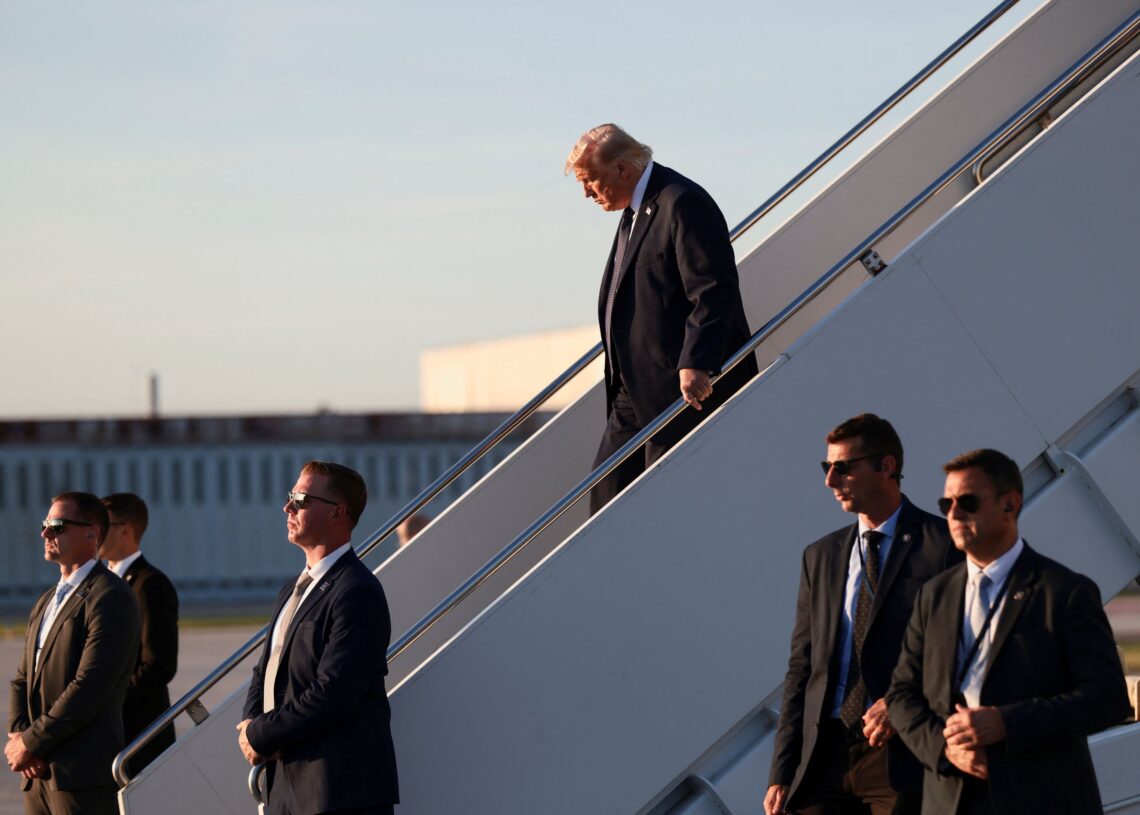
President Donald Trump deserves the scorn he’s receiving from the left and right for pretending that his exit ramp from the Iran war is some kind of victory. But schadenfreude is not a strategy. For reasonable people, the question remains: How can the frail “memorandum of understanding” signed this week produce a verifiable framework for preventing Iran from getting a nuclear weapon and further destabilizing the Middle East?
Let’s start with some obvious points. Trump unwisely started this war, but he did the right thing in ending it now, before it did any more damage. He was right to prioritize reopening the Strait of Hormuz, even if it felt like paying ransom. And he was right to include Lebanon in the ceasefire in an effort to contain Israel’s endless cage fight there with Hezbollah, so the Lebanese army can try to regain sovereignty.
But the MOU is a wish list rather than a formal agreement, unfortunately. Other than reopening the Strait of Hormuz, it leaves nearly all the major issues to be negotiated over the next 60 days. Many experienced lawyers and diplomats share the view of Jeffrey Smith, a former CIA general counsel, who told me bluntly: “In my 52 years in the foreign policy world, I have never seen such a poorly drafted document.”
Here are some key nuclear issues that Trump fuzzed in his rush to the exit: Iran merely “reaffirms” its long-standing (and widely disbelieved) pledge not to develop nuclear weapons; it will “discuss” limits on future enrichment of uranium but doesn’t promise to close any nuclear sites; it will dispose of its existing stockpile of weapons-grade uranium, probably by “down-blending” it under the supervision of the International Atomic Energy Agency, rather than moving it out of the country.
And there’s more wiggle room: Iran can retain ballistic missiles like its neighbor Saudi Arabia, Trump said Wednesday; after 60 days, it apparently will be able to charge fees to navigate the strait, perhaps after discussing “future administration and maritime services” with Oman. Iran gets its frozen assets as soon as the deal is signed, and they will be “fully usable” for whatever purpose it wants. A “final deal” will include “the permanent termination of the war on all fronts,” but will that really constrain the Houthis in Yemen, Shiite militias in Iraq and Hezbollah in Lebanon?
What bothers me most is that the main leverage the United States has for forcing movement on these open issues is Trump’s threat to go back to war. After all his undelivered knockout punches over the past four months, this threat simply isn’t credible. Trump finally said it out loud Wednesday: He doesn’t want to be another Herbert Hoover. If the markets are crashing, he’s always going to settle — especially as he heads into the midterms. Trump could reimpose economic sanctions, but Iran knows his choke point on use of military force as the 60-day negotiation period begins.
So how should a reasonable person evaluate the Trump team’s progress over the next two months as it works to turn this threadbare agreement into something real? How can we know whether Iran is beginning a transformation toward something closer to a “normal” country, or, as seems all too likely, just dragging its feet as it rebuilds a terror state?
Two metrics were suggested to me by one of the intelligence community’s wisest Iran observers, who asked not to be identified because the issues are sensitive. First, within two weeks of Friday’s signing of the agreement, significant progress must be made on demining the Strait of Hormuz, with Iran’s cooperation. Insurers and tanker captains will need verifiable proof that it’s safe. Second, within two weeks, technical experts must begin serious negotiations on the nuclear issues.
Early Iranian acceptance of IAEA verification is an especially crucial test, according to Ernie Moniz, a nuclear physicist and former energy secretary who played a decisive role in the 2015 nuclear agreement. Moniz told me that Iran must agree soon to facilitating an IAEA accounting of Iran’s roughly 440 kilograms of highly enriched uranium before the “down-blending” begins. And Iran must accept strong IAEA verification, including an option for quick inspection of possible covert sites.
“If Iran successfully resists strong verification, the agreement will not be worth much,” Moniz told me. This will be a revealing early test.
What of the larger question of a $300 billion development fund to help Iran become a “normal” modern country, which Vice President JD Vance and special emissary Jared Kushner have been pushing since their meeting with Iranian negotiators in Islamabad in April? That idea has brought catcalls and derision, but I’m not sure why. It would be a private fund, and nobody would invest unless there’s clear evidence of change.
I asked Dara Khosrowshahi, the CEO of Uber and a leading example of the business acumen of the Iranian American community, what he thought of the $300 billion plan. “If there is a vehicle to release the latent entrepreneurship of the Iranian people and bring hope back to the region, it can be a bright spot,” he told me Thursday.
Big companies like Uber would obviously hold back; Saudi Arabia and the United Arab Emirates aren’t likely to invest anytime soon, either. But if this idea encourages all the smart young talent in Iran to challenge the regime and build investable start-up companies, that’s obviously a good thing.
Ambitious plans to break the blood knot in the Middle East intrigue me, to a fault. Frankly, a consistent mistake I’ve made during more than 45 years of writing about the region is my recurring hope that good sense will prevail over ingrained hatreds. But if an American administration wants to propose incentives for Iran to become a responsible nation, sign me up.
When Gen. Oliver P. Smith was beginning his withdrawal from the disaster at Korea’s Chosin Reservoir in 1950, he’s supposed to have said: “Retreat, hell! We’re just attacking in another direction.”
Rather than offering such a pithy quote on Wednesday in France, Trump blathered on for 70 minutes trying to obscure what the whole world knows: He made a bad mistake in going to war, and now he’s trying to recover with a deal that will reduce the threat posed by Iran. You can only hope he succeeds.
The post Here’s how to tell if Trump’s threadbare Iran deal is holding appeared first on Washington Post.