Israeli leaders need to “wake up and smell the reality” that they are isolated internationally, Vice President JD Vance said Thursday, responding to Israeli criticism of the deal the Trump administration struck with Iran this week.
Using unusually sharp language to hit at top ministers of Washington’s closest ally in the Middle East, Vance said that “two-thirds” of the weapons that have defended Israel over the past three months were paid for by U.S. taxpayers.
“If I was in the cabinet of the Israeli government, I might not be attacking the only powerful ally that I have anywhere left in the entire world,” Vance said, extending a string of increasingly pugnacious statements from the White House directed at the Israel in recent days. He did not name which Israeli officials he was referring to, but several leading members of Prime Minister Benjamin Netanyahu’s government have been sharply critical of the deal since it was announced.
“Anybody in Israel who thinks their biggest problem is the president of the United States needs to wake up and smell the reality of the situation that country is in,” Vance told reporters in the White House briefing room.
“Donald J. Trump is the only head of state in the entire world who is sympathetic to the nation of Israel at this moment in time,” he said.
The warning came as the 60-day clock for negotiations over Iran’s nuclear program started ticking on Thursday, after President Donald Trump and Iranian President Masoud Pezeshkian signed the deal a day earlier.
World leaders have cautiously welcomed the signing of an initial peace deal between the U.S. and Iran that is expected to open the Strait of Hormuz and end a U.S. blockade on Iranian oil. The deal, however, leaves most of the toughest negotiations, including on Tehran’s nuclear capabilities, for a 60-day period ahead.
Since the announcement of the deal Sunday, the administration has needed to defend itself against criticism not only from Israel but also from Republican allies who say the agreement makes too many concessions to Iran and ultimately relieves much of the pressure that had built over the course of a military campaign that started in February.
Trump initially called for regime change in Tehran, and he and top allies said that they planned to “obliterate” Iran’s ballistic missile program. The peace deal focuses much more narrowly on reopening the Strait of Hormuz and restarting talks on Iran’s nuclear program that were already underway before the war started.
Trump said Wednesday that Wednesday that “it’s okay” for Iran to maintain an arsenal including some ballistic missiles.
Vance said that the White House felt comfortable with the shift because the U.S. campaign destroyed a “substantial number” of ballistic missile launchers.
“It’s not just the bullets, but it’s the actual gun, and that’s what we were extremely effective at in destroying during the last three months of the campaign. All the president said yesterday is that, of course, countries don’t give up the right of self-defense.” He said that the U.S. focus was on barring Iran from obtaining nuclear weapons that could threaten the entire world.
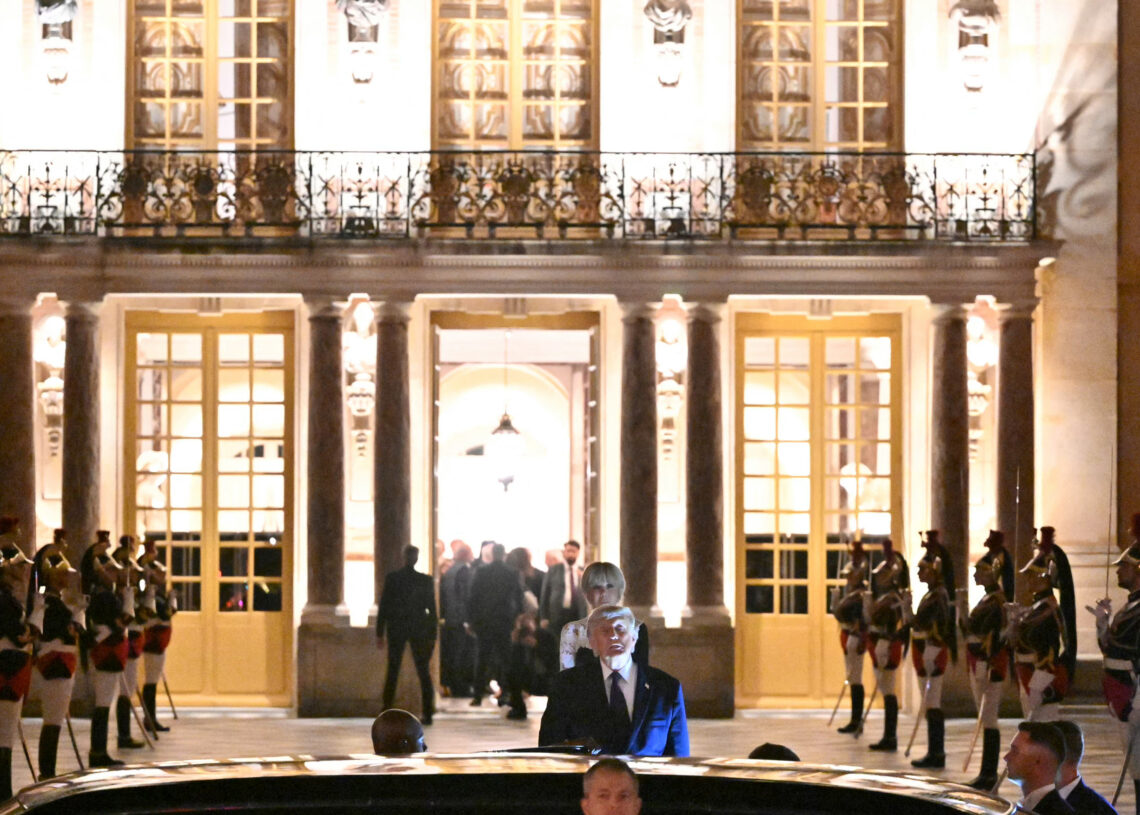
Oil prices fell and gas prices dropped below $4 a gallon for the first time since March after Trump signed the memorandum of understanding during a dinner at the Palace of Versailles on Wednesday night, capping off the Group of Seven summit in France, seated between French President Emmanuel Macron and his wife, Brigitte, with Secretary of State Marco Rubio standing behind him.
“It’s signed,” Trump told reporters outside the venue early Thursday local time. “Just signed it.”
Shortly after arriving back in the U.S. early Thursday, he celebrated “tumbling” oil prices in a post on Truth Social, deriding critics “who think I haven’t been tough enough on Iran” as “jealous, bad people, or stupid.”
Pezeshkian also signed the agreement, known as the Islamabad Memorandum of Understanding, in the early hours of Thursday, Iran’s state media reported. Later Thursday, he posted an image of the signed document on social media, saying that “peace will be achieved under the umbrella of mutual respect.”
U.S. and Iranian saber-rattling has continued despite the memorandum. Speaking Thursday after a visit to NATO headquarters in Brussels, Defense Secretary Pete Hegseth said the U.S. was “more than able to reimpose an ironclad blockade” if Iran does not comply with the terms of the deal.
“We’re going to be the big stick behind the negotiations that never existed under President Obama,” he said, referring to the Joint Comprehensive Plan of Action negotiated under the Obama administration that Trump pulled the U.S. out of in 2018.
Iran’s Foreign Ministry spokesman Esmaeil Baqaei said the war has made Iran “MORE #powerful both militarily and diplomatically,” in comments reported by Iranian state media.
The signing of the 14-point memorandum comes after nearly four months of war that has depleted U.S. munitions stockpiles, crippled shipping through the Strait of Hormuz, sent energy prices soaring and proved deeply unpopular in the U.S.
A ceasefire reached in April came under intense strain this month as back-and-forth strikes flared across the region, while Trump veered between threats of further attacks and efforts to end the war.
On Thursday global leaders welcomed the deal as a way of ending regional instability and reducing inflationary pressure, despite critical issues remaining unresolved. The bare-bones agreement has also been widely criticized as an acceptance of the status quo from before the U.S. and Israel launched strikes on Iran on Feb. 28. Key sticking points, including Iran’s nuclear capacity, remain subject to negotiations.
Pakistani Prime Minister Shehbaz Sharif, who helped mediate, said the deal would come into “immediate effect,” with Iran beginning to reopen the Strait of Hormuz and the U.S. lifting its naval blockade.
The signing “demonstrates the commitment of both sides to a diplomatic resolution of the conflict,” Sharif said, thanking authorities in the U.S. and Iran as well as in Qatar, Saudi Arabia, Turkey and Egypt who also worked to broker the deal.
Qatar’s Foreign Ministry said it considered the signing “a new confirmation” of a commitment to negotiations, describing it as a “solid foundation” for the next phase of talks.
International Atomic Energy Agency chief Rafael Mariano Grossi praised the U.S. and Iran for signing the memorandum and said the technical work is set to begin.
“All of this depends on the political will of both sides,” he said at a news conference Thursday in Geneva, where he fielded questions about the IAEA’s role under the agreement. “We are at the gates of the decisive phase of the technical conversations. Let’s have them, and then we’ll see,” he said.
The agreement was initially set to be signed in person Friday by Vance and Iran’s parliamentary speaker, Mohammad Bagher Ghalibaf, in Switzerland.
That meeting has now turned into a negotiation session, the timing of which Vance said was uncertain. It could come this weekend, he said.
Trump defended the agreement during a 70-minute news conference Wednesday, touting the economic benefits while acknowledging disagreement among advisers over Iran’s ballistic missile program, which isn’t specifically addressed in the initial deal. He also criticized Israel for its actions in Lebanon, where it is fighting Iranian-backed Hezbollah militants, saying that the country has a right to defend itself but that it had been too heavy-handed at times. “They could behave better, and frankly, they could do a better job,” Trump said.
Israel, which was not party to the agreement, did not publicly comment on the terms Thursday.
The initial deal declares the “immediate and permanent” end to military operations on all fronts, including Lebanon, and paves the way for a “final deal” in the next 60 days, “extendable with mutual consent,” according to the text of the memorandum shared by a senior U.S. official who read it out on the condition of anonymity.
Its terms include opening the Strait of Hormuz, lifting the U.S. blockade, and U.S. and regional partners developing a $300 billion plan for the “reconstruction and economic development” of Iran. The U.S. Treasury would also waive sanctions on Iranian oil exports and the two countries would “refrain from interfering in each other’s internal affairs” — a far cry from the regime change Trump initially embraced.
Shipping industry officials and maritime experts have said that even if the critical strait that carried around 20 percent of the world’s oil and gas supplies before the war began is opened, high energy prices and shortages could persist for months.
The strait remains studded with mines Iran has laid since the start of the war, and it could take weeks to clear hundreds of stranded vessels. Shipping firms are also concerned about putting vessels and crew at risk of attack, should the peace deal fracture.
Japanese shipping company Mitsui O.S.K. Lines said that its policy on shipping in the Strait of Hormuz had not changed since the signing of the agreement and that “operations will not resume until safety has been sufficiently confirmed.”
“The resumption of transit will require close coordination with the governments of the relevant countries, insurers, and other stakeholders,” it said in an emailed statement, adding that the company would continue to carefully assess whether safety could be assured.
The price of Brent crude oil, the international benchmark, dropped to $77 per barrel Thursday, a long way from the four-year-high of $126 reached in late April but higher than the $69 a barrel from before the war began.
Natalie Allison contributed to this report.
The post Vance tells Israel to ‘wake up’ after Iran deal criticism appeared first on Washington Post.