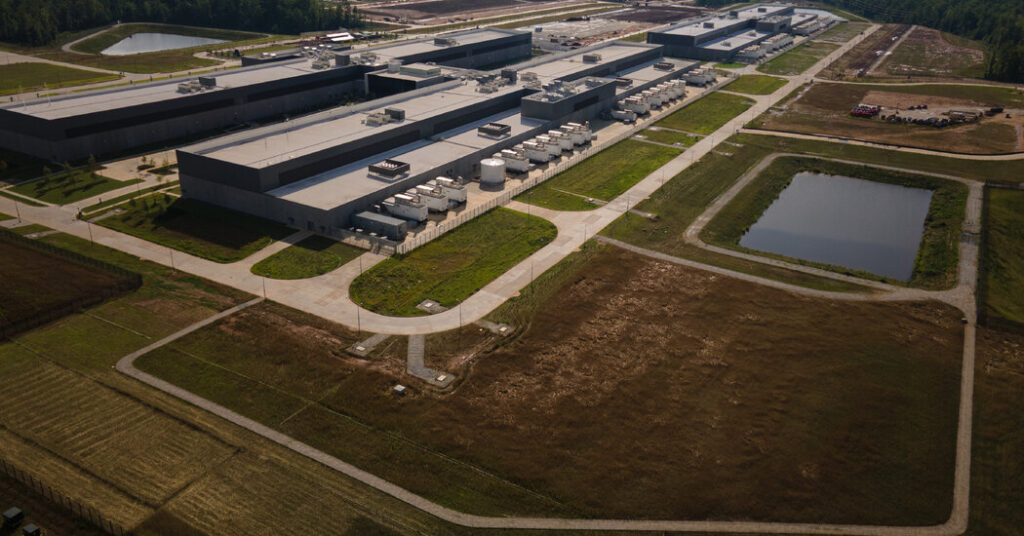
A federal energy regulator on Thursday adopted guidelines that it said would help protect individuals from shouldering some of the cost of connecting data centers to electric grids. Its new approach would also make it possible for data centers to connect to grids faster, if they agreed to certain conditions.
In a unanimous decision, the Federal Energy Regulatory Commission directed the organizations that manage electricity grids to make changes to address the growing frustration among many Americans that data centers were expanding too fast and driving up their energy bills.
The commission called on grid managers, utilities and other players to provide detailed information about how spending on new transmission lines and other equipment to serve data centers affects the rates paid by individuals to ensure that homeowners and renters were not effectively subsidizing technology companies.
In addition, the commission said grid managers should allow data centers to connect to their networks sooner if those centers were near electricity-generation sources; offered to build their own power supply; or were willing to reduce how much energy they used during periods of high demand like on very hot or very cold days.
U.S. technology companies in recent years have been building dozens of power-hungry data centers to develop artificial intelligence as they try to one-up each other and tech firms in China. That has contributed to an increase in electricity demand, driving up the cost of power for everybody connected to the grid.
“We are setting the stage for a resilient, reliable and forward-thinking grid that empowers communities and safeguards consumers by transforming the way large energy users access the grid,” said Laura V. Swett, the chairman of the five-member federal commission. “We can facilitate both, which is exactly what we did today.”
States and the electricity industry had been hoping that the commission would develop rules to ensure individuals and small businesses were not paying more for energy because of data centers. At the same time, technology companies wanted to shorten the time required to connect data centers to the grid, a process that in some places can take several years.
Thursday’s decision, utility industry experts said, appears to have found a way to meet both goals.
“This seems to be a surprisingly well-constructed federal energy initiative,” said Tyson Slocum, director of the energy program at Public Citizen, a nonprofit research and consumer group. “On its face the new principles seem to be productive in terms of attempting to shield consumers from cost shifts and ensuring transparency.”
Electric grids across the United States are increasingly under strain. Many of the lines, transformers and other equipment utilities use are aging. In some places, demand for electricity is also rising as more people use electric cars and heat pumps. And then there are data centers, some of which can use as much power as a midsize city.
Residential customers across the country are increasingly opposing new data centers because of concerns about the rising cost of electricity, the centers’ water use and other environmental and economic affects of such facilities. Data centers are expected to be a major issue in some elections this November.
The federal commission’s decision on Thursday will not quickly result in changes on the ground. The organizations that manage regional grids, like PJM in 13 Eastern states and the Midcontinent Independent Systems Operator in the Midwest, will now spend months making changes in consultation with the commission, experts said.
“This is a bold move by this commission,” said Rob Gramlich, president of Grid Strategies, a consulting firm based in Washington. “It’s a necessary step but it’s not sufficient. People are looking for the issue to get resolved.”
The post Federal Energy Regulator Seeks to Limit Conflicts Over Data Centers appeared first on New York Times.