Ramòn Saturnino knows the box the art world wants to put him in, whether he fits there or not.
“I’m a 26-year-old Mexican artist, a kid who grew up on the border,” he said. “I’m brown, middle class. I can’t escape becoming that character in their story.”
He also makes art about the border wall that separates the United States from his native country, which runs along his hometown, San Luis Rio Colorado in the northern state of Sonora. So he understands that curators and collectors may try to package him with other young artists whose work addresses issues of identity, migration and global economics, and who use references to the wall to make their point.
But people who view his solo presentation on display this week at Art Basel may be surprised. His work, he said, is not about what is happening between governments or people on either side of the wall; it is about the wall itself, and walls, fences and barricades, overall — how they are structured, the psychology behind them and how they impose themselves on the landscape.
Saturnino is not without opinions on world matters, he said. But he is an artist whose practice focuses on abstract minimalism, and that is a more appropriate way to categorize the work. Think of him as a contemporary version of Richard Serra, Sol LeWitt or Donald Judd.
Like those artists, his goal is to reduce objects to their core: to their basic shape, form and materials, and to create new objects that help people see the world in a simpler, deconstructed way.
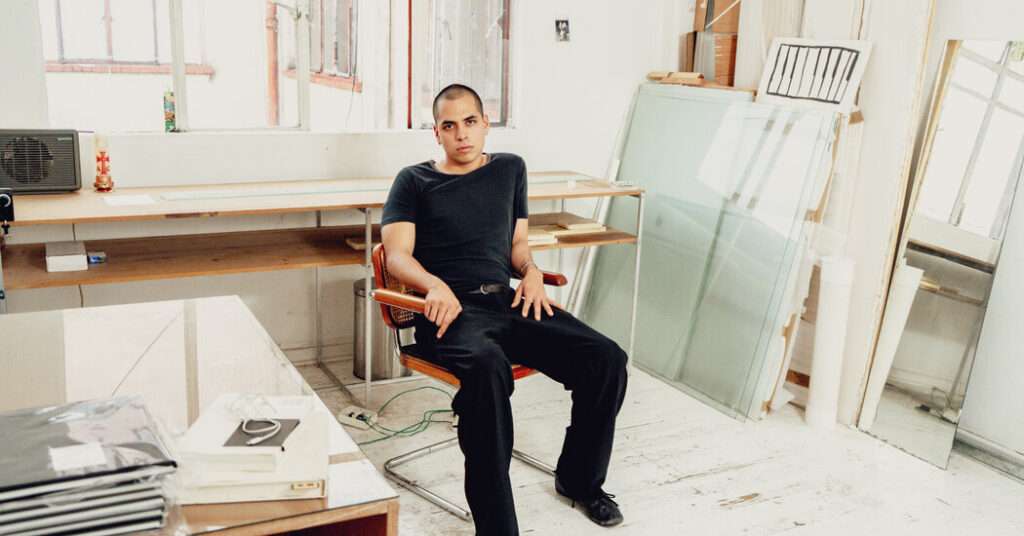
“What I’m trying to do is give them more space to think about these things, beyond my personal political point of view,” he said during an interview in his studio.
Saturnino will have an abstract version of the border wall in an installation set up by Lodos Gallery, which will present him at Art Basel, at a part of the fair meant to introduce emerging talents. The exhibit is built around a work made from a row of thin metal wires about six feet in length strung along a wall. Each is held at the top by a nail, driven into the wall exactly 30 centimeters from the ceiling and 15 centimeters from the one next to it, according to the very precise directions he wrote to accompany the piece. The wires run to the floor where they are individually weighted down by a small, rocklike chunk of white plaster.
The title of the work, “You, neighbor God, if sometimes in the night I rouse you with loud knocking, I do so only because I seldom hear you breathe,” is taken from a poem by Rainer Maria Rilke.
The work is delicate, fragile even, and not at all imposing.
But it is made from steel, just like the border wall, and the separation between the wires is the same distance as the posts on the actual wall around which, Saturnino said, he played as a child, peering through its openings and running his hand along the rails to make a clacking sound. His grandmother lived across the street from it.
“The piece is very obvious in what it’s referencing,” said Saturnino. “But it exists in this way that only art can allow it to exist, which is by reducing it to its bare bones.”
The installation also features recent photographs that Saturnino took in and around San Luis Rio Colorado of local buildings and tire tracks in the desert terrain. Francisco Cordero-Oceguera, who owns Lodos Gallery, described them as “landscape” photos.
Cordero-Oceguera has been operating galleries since 2012, starting with a basement project space he founded in Chicago when he was studying at the Art Institute of Chicago. When he returned to his native Mexico City in 2013, he brought Lodos with him, moving it around several locations before opening in the gallery-rich San Miguel Chapultepec neighborhood this year.
Betting on a young artist like Saturnino fits with the gallery’s business model of discovering new talents and guiding their development into the commercial art business, he said. Several artists on Lodos’s roster — more established names like Berenice Olmedo, Samuel Guerrero and Noah Barker — had their first commercial exhibitions with the gallery and have stuck around. Cordero-Oceguera has learned to trust his “hunches” when signing artists with promise, he said.
Still, bringing Saturnino to Basel, covering the cost of booth space, shipping and transportation, may be an especially risky venture, he acknowledged. Saturnino is self-taught. He is an architect by training and studied at Mexico’s national university. He has only shown art publicly a handful of times, never outside his home country.
Cordero-Oceguera became interested in Saturnino after seeing just one of his pieces in a group show. “No artist of his age in Mexico City works the same way he does,” he said.
He liked that Saturnino was a dedicated minimalist making challenging conceptual objects that had a place in contemporary art history, he said. It set him apart from artists who used their art as a platform for in-your-face proclamations about the state of the world, or social conditions in Mexico.
“It struck me that he wasn’t working with notions of identity politics or he wasn’t trying to exoticize his practice or himself,” Cordero-Oceguera said.
Their gallerist-artist relationship is close. When the gallery owners needed an architect to design their current space, they hired Saturnino’s firm. Working with Fredy Galarza, a design collaborator, Saturnino transformed a vacant storefront into a pristine white cube space, with exposed utility shop lights on the ceiling and galvanized-steel trim around walls and doorways. Saturnino had his first solo show there in March 2025.
Saturnino understands that his professional career is happening quickly, he said, and he wants to keep his options open. Other architectural commissions are possible. He also makes videos and sculptures. The border wall is only one of his subjects.
Before he left San Luis Rio Colorado for college, he played saxophone and bass, and produced experimental music concerts and events with other art-minded friends.
His upbringing was not so different than any other child in Mexico, or the United States for that matter, he said. People on both sides crossed the border frequently to shop or eat dinner. His city was full of opportunity and children were encouraged to go to college — though most used their degrees to get better jobs at the factories, he said.
While San Luis Rio Colorado is within a desert, he did not feel isolated. The internet gave him access to the world. He remembers seeing his first picture of a Richard Serra sculpture on Tumblr.
That will not keep other people from stereotyping him as an artist, and scanning his work for politics that may or may not be there, though he sees their interest as an advantage. He is two years out of school, has major representation and collectors are buying his art. That is a position other artists work a lot longer to achieve.
“In some ways I’m going to be taken a bit more seriously because people want to make me that character,” he said.
Once he has their attention, he can show whatever art he wants. “It gives me a certain amount of freedom,” he said.
The post This Mexican Artist Is Breaking Down Walls appeared first on New York Times.